
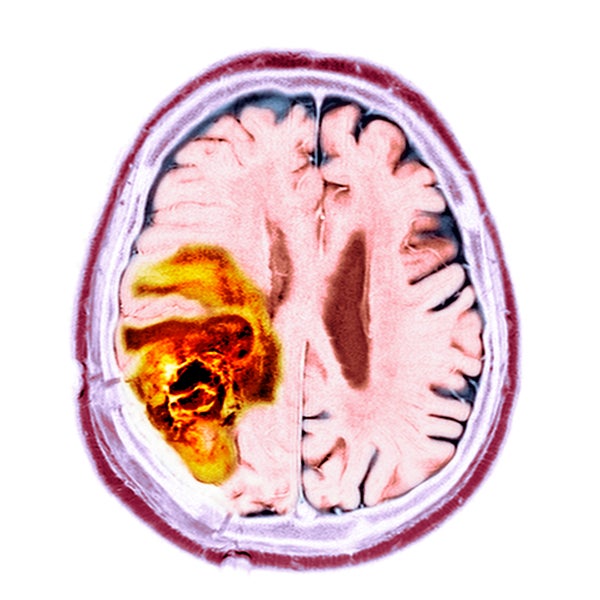
Tumour cells can plug into—and feed off—the brain’s complex network of neurons, according to a trio of studies. This nefarious ability could explain the mysterious behaviour of certain tumours, and point to new ways of treating cancer.
The studies, published on 18 September in Nature, describe this startling capability in brain cancers called gliomas, as well as in some breast cancers that spread to the brain. The findings bolster a growing realization among doctors and scientists that the nervous system plays an important role in the growth of cancers, says Michelle Monje, a paediatric neuro-oncologist at Stanford University in California and lead author of one of the studies.
Even so, finding cancer cells that behave like neurons was a surprise. “It’s unsettling,” Monje says. “We don’t think of cancer as forming an electrically active tissue like the brain.”
On supporting science journalism
If you're enjoying this article, consider supporting our award-winning journalism by subscribing. By purchasing a subscription you are helping to ensure the future of impactful stories about the discoveries and ideas shaping our world today.
Feeding off the brain
Frank Winkler, a neurologist at Heidelberg University in Germany and a lead author on another of the Nature studies, stumbled on the phenomenon in 2014 while studying communication networks established by cells in some brain tumours. He and his team discovered synapses, structures that neurons use to communicate with one another, in the tumours. It was “crazy stuff”, Winkler says. “Our first reaction was, ‘This is just difficult to believe.’”
The researchers assumed that the tumour synapses would be a random occurrence. But as Winkler and his colleagues report in their latest study, they found synapses in glioma samples taken from cancer cells grown in culture, human glioma tumours transplanted into mice and glioma samples taken from ten people.
At the same time that Winkler’s team was studying adult glioma synapses, Monje and her colleagues independently discovered synapses between neurons and cells in paediatric gliomas. The separate but parallel research by Monje and Winkler’s teams also showed that the tumour synapses help cancer cells flourish. The teams reported their results independently in two of the recent studies.
Monje’s findings explain some of the puzzling features of gliomas that she sees in her patients. The tumours are notoriously difficult to treat: instead of forming a hard, compact mass, they tend to weave through the brain, making them hard to remove. If a glioma infiltrates a large swathe of the brain, patients typically show few symptoms because the tumour doesn’t seem to disrupt many brain circuits, says Monje. “And now that makes sense, because it’s reliant upon their function.”
“If this is broadly applicable across more cancers, then it’s not necessarily surprising why it has been so challenging to treat cancers in the brain,” says Johanna Joyce, a cancer biologist at the Ludwig Institute for Cancer Research at the University of Lausanne in Switzerland. The tumour cells are essentially integrated into the brain’s neural network, she says. “It’s sobering.”
Deadly integration
The phenomenon isn’t limited to brain tumours. In a third paper published on 18 September, Douglas Hanahan, a cancer scientist at the Swiss Institute for Experimental Cancer Research in Lausanne, and his team describe breast-cancer cells in the brain that act like neurons. The researchers spotted this ability while searching through data on gene expression in tumours. Deadly breast cancers called triple-negative tumours turned on genes involved in signalling between neurons. These breast cancers are known for spreading to the brain and, once there, are very difficult to treat.
Hanahan and his colleagues showed that when breast-cancer cells infiltrate the brain, they form a specialized type of synapse that allows them to soak up a chemical called glutamate. It’s the most abundant neurotransmitter in the brain and can also boost tumour growth.
All three studies underscore the resilience of cancer cells, says Lisa Sevenich, who studies brain cancer at the University of Frankfurt in Germany. The brain is an extremely hostile environment for cancer cells she says. “But somehow the tumour cells manage to really adopt and co-opt the machinery there.”
Researchers hope that these findings will lead to new ways of treating cancer. In two of the latest studies, Winkler and Monje’s teams describe experiments demonstrating that an epilepsy drug slowed the spread of gliomas in mice. The scientists haven’t determined whether the treatment works in people, but they hope that interrupting the connection between tumour cells and neurons could stymie cancer’s growth.
The trick to developing such a treatment will be to target any neuron-cancer cell hybrids without damaging normal connections between brain cells, says Sevenich. “Honestly, I think it will be really tough,” she says. “If those cells take over certain circuits that are already there in the brain, it will be difficult to be selective. But my fingers are crossed.”
This article is reproduced with permission and was first published on September 18, 2019.