
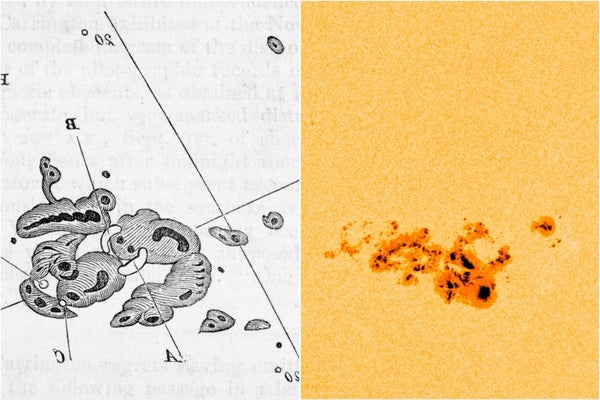
A sunspot cluster as wide as 16 Earths has shot out at least five eruptions of magnetic fields and solar plasma, several of which may merge to create a “cannibal” solar storm in Earth’s atmosphere this weekend.
The event prompted the National Oceanic and Atmospheric Administration to release its first G4-level Geomagnetic Storm Watch since 2005. NOAA classifies solar storms on a five-point scale, with G4 representing those that are “severe.” Severe solar storms can cause voltage surges in the power grid and affect satellite and high-frequency-radio communications. Operators in these industries have adaptations to protect their equipment during these storms, says NOAA space weather scientist Rob Steenburgh. These protections can include backup systems and radiation shielding, as well as temporary changes in operations. The potential new storm could make itself known to the public, however, via colorful auroras that would be visible from the northern part of the continental U.S.—and possibly in southern states, depending on the storm’s strength. The G4 watch is in effect starting at midafternoon today.
“We are expecting to see this activity persist through Sunday,” Steenburgh says.
On supporting science journalism
If you're enjoying this article, consider supporting our award-winning journalism by subscribing. By purchasing a subscription you are helping to ensure the future of impactful stories about the discoveries and ideas shaping our world today.
The cause of all this unrest is a region of very strong magnetic fields that underlies the sunspot cluster, says Erika Palmerio, a heliophysicist at Predictive Science, a solar modeling company in California. “There is this stronger, more concentrated magnetic field that obviously has the potential for stronger eruptions from the sun,” she says. “And this is what has been happening with this pretty big region over the past two days.”
The sunspot group is similar in size to the one that threw off such an eruption of plasma and magnetic fields, called a coronal mass ejection (CME), in 1859 and caused the Carrington Event, the most intense geomagnetic storm ever recorded. That event disrupted the only mass communication at the time, the telegraph network, and caused worldwide auroras.
The current sunspot won’t necessarily cause a similar-level storm, however. There have been 141 sunspot clusters as large as or larger than the current one, known as active region 3664 (AR3664), since 1996, Steenburgh says.
“The CMEs that are heading for Earth are probably much less massive and less potent than the big CMEs that caused the Carrington Event,” says Tony Phillips, an astronomer who runs Spaceweather.com, a site that tracks space weather events.
At least a few of the CMEs that the sunspot group has burped out over the past several days will likely merge, creating what is known as a “cannibal CME.” The impacts will depend on the speed of the CME and the direction of its merged magnetic fields, Palmerio says. These charged bubbles can speed away from the sun at anywhere from under 55,000 miles per hour to more than 6.7 million mph.
The sunspot cluster rotated into view of Earth a few days ago. At that time, the area looked fairly normal. But then “it just blew up into this behemoth,” Phillips says. That lucky timing allowed researchers to watch the giant sunspot cluster develop, Palmerio says. Over the next few days, the sun’s rotation will mean the sunspot group will turn away from Earth, Steenburgh says, so any further CMEs it sends out will head harmlessly into space. The spot could reappear, though. Clusters of sunspots of this size often persist for months, and a new rotation of the sun could bring the behemoth into Earth’s view in another two weeks.
The sun’s activity varies on an 11-year cycle. This cycle’s activity is expected to peak sometime in 2025. “This could be the first big event of a number that we will probably experience over the next two to three years,” Phillips says.