
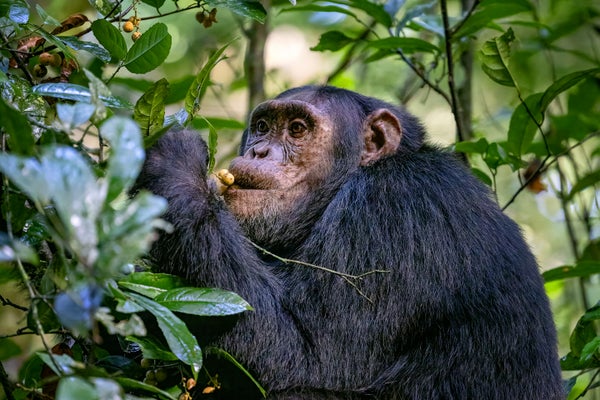
When chimpanzees eat ripe figs and other fruits in the wild, it’s a surprisingly boozy feast—the fruit they consume in a day contains the equivalent of a couple of adult beverages. That’s the upshot of a new study on the alcohol content of the preferred foods of one of our closest living relatives. The findings, published today in the journal Science Advances, may have implications for understanding human attraction to alcohol.
Chimpanzees are well known to be fruit lovers. In chimp communities in Uganda and Côte d’Ivoire, fruit makes up around 75 percent of their diet; scientists have documented the animals eating an estimated 10 pounds of fruit a day on average.
Some 25 years ago Robert Dudley of the University of California, Berkeley, who was studying monkeys at the time, proposed the “drunken monkey hypothesis,” which holds that we humans inherited our love of alcohol from our primate ancestors. The idea was that our primeval predecessors would have encountered ethanol—the form of alcohol found in wine, beer and spirits—in the fruit they ate, and evolved ways to exploit this resource. Being able to find and eat fruit containing ethanol might have helped them get more calories because fruits with higher concentrations of ethanol tend to be riper, with a higher sugar content.
On supporting science journalism
If you're enjoying this article, consider supporting our award-winning journalism by subscribing. By purchasing a subscription you are helping to ensure the future of impactful stories about the discoveries and ideas shaping our world today.
But back when Dudley formulated this hypothesis, scientists didn’t have enough data on the ethanol content of the fruits eaten by nonhuman primates to know whether early human ancestors could plausibly have encountered enough of the substance for it to be a significant factor in their evolution.
In the new study, U.C. Berkeley graduate student Aleksey Maro, Dudley and their colleagues set out to measure the ethanol content of 20 kinds of fruit favored by chimps at the sites of Ngogo in Uganda’s Kibale National Park and Taï in Côte d'Ivoire. They found that the fruit pulp contained around 0.3 percent ethanol by weight. That might not sound like much, but considering that the chimps eat 5 to 10 percent of their body weight in fruit each day, it adds up: the apes end up consuming some 14 grams of pure ethanol a day, the equivalent of a typical alcoholic beverage in the U.S. (or 1.4 drinks by international standards, as the researchers note).
When the researchers adjusted for the lower body mass of chimpanzees compared to humans, they determined that the chimps at Ngogo and Taï are ingesting the equivalent of more than two drinks a day on average. The total would be higher if the chimps chose riper fruits with higher sugar content.
“These findings are consistent with the hypothesis that ethanol is widespread within tropical fruits and that modern predisposition to alcohol consumption derives from ancestral exposure to this psychoactive substance among frugivorous primates,” Maro and his collaborators conclude in their paper.
Chimpanzees are not the only animals that consume alcohol. Other mammals, including elephants and tree shrews, and some birds, such as Cedar Waxwings and hummingbirds, eat fermented fruit and nectar, which contain ethanol. The effects of alcohol on the behavior of these animals are not well understood. But the authors of the new paper note that ripe fruit crops can attract large groups of chimps to a location, resulting in increased social interactions and social activities such as territorial patrols.