
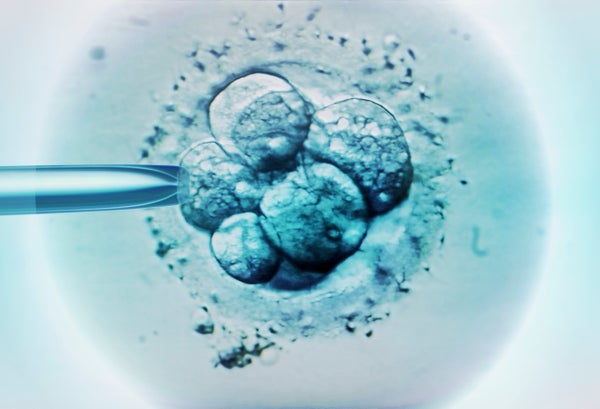
A clutch of artificial human embryos on China’s Tiangong space station could help researchers better understand whether human pregnancies in space are possible and safe.
The Chinese Academy of Sciences says the experiment marks the first study on human artificial embryos in space. The artificial embryos are actually structures derived from stem cells, and they mimic how embryos form during the early days of pregnancy. These structures wouldn’t be able to develop into humans even if they were implanted into a uterus. Researchers originally conceived these artificial embryolike structures as a model to study the earliest moments of development because of widespread international rules aimed at restricting research on real human embryos that are older than two weeks after fertilization.
“The human artificial embryo is made of human stem cells as raw materials,” said project leader Yu Leqian in a statement. “This is not a real human embryo and does not have the ability to develop into an individual. However, it can serve as a model for studying early human development.”
On supporting science journalism
If you're enjoying this article, consider supporting our award-winning journalism by subscribing. By purchasing a subscription you are helping to ensure the future of impactful stories about the discoveries and ideas shaping our world today.
The artificial embryos were launched to the Tiangong space station earlier this month, and a control group is being examined in an Earth-based lab. The experiment was designed to last for five days, after which the samples onboard the space station were frozen. They will eventually be returned to Earth for analysis.
“We hope that by comparing the development of space and ground samples, we can identify the factors affecting early human embryonic growth in the space environment, and address the risks and challenges humans may face during long-term space habitation,” Yu said.
Fertility in space has long been an object of study, and the results so far have been mixed. In 1994 NASA astronauts successfully mated Japanese rice fish onboard a space shuttle. Yet several other experiments conducted on fruit flies in low-Earth orbit suggested the insects’ larvae had a higher death rate in that environment than on Earth. A past effort to raise mice embryos in space didn’t succeed either, and attempts at mating rats also failed to result in pregnancies. And in 2014 another mating experiment involving geckos almost ended in disaster after the Russian satellite they were on lost contact with ground control. While contact with the spacecraft was reestablished, the geckos perished before they could possibly make more geckos.
The science of human reproduction in microgravity is sparser, for perhaps obvious reasons. But as NASA and private space companies such as Elon Musk’s SpaceX have begun exploring long-term bases on the moon and Mars, the field has drawn more interest. Earlier this year Australian scientists put human sperm into a microgravity simulation chamber to see if they could navigate an artificial female reproductive system. The sperm, seemingly confused by the low gravity, tended to get lost on their way to their final destination.