
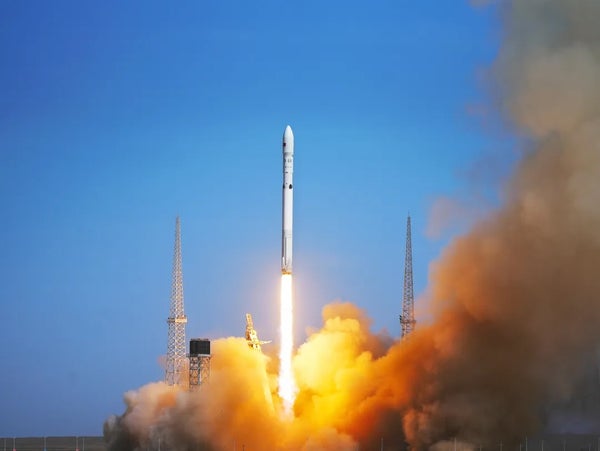
On Monday China launched its latest rocket, Long March 12B, for the first time with reportedly no advance warning. Typically, government space agencies and private space companies provide airspace and maritime warnings before launch—but state-owned rocket maker China Aerospace Science and Technology Corporation (CASC) apparently did neither.
Airspace and maritime warnings are standard global safety procedures prior to rocket launches. The International Civil Aviation Organization and the International Maritime Organization normally issue such advance alerts to ensure air traffic and shipping can avoid potential hazards, such as falling debris, from a space launch. International law mandates that nation states are responsible for any damage that might be caused from rocket launches from their territory. Space analysts have previously warned that China doesn’t always fully abide by these international norms, however, especially when it comes to safely disposing of debris from its rocket launches.
The spacecraft, which is similar in capability to SpaceX’s Falcon 9, lifted off at 4:40 A.M. EDT from the Dongfeng Commercial Aerospace Innovation Test Zone in the Gobi Desert, with news of the launch spreading first on Chinese social media, according to SpaceNews.
On supporting science journalism
If you're enjoying this article, consider supporting our award-winning journalism by subscribing. By purchasing a subscription you are helping to ensure the future of impactful stories about the discoveries and ideas shaping our world today.
CASC declared the flight a success. The rocket deployed operational satellites for China’s Qianfan megaconstellation, which is designed to rival SpaceX’s Starlink satellite Internet service. Long March 12B is meant to be reusable, but this flight did not attempt to recover the rocket’s first stage, according to CASC.
The success comes after China launched a prototype of the country’s moon rocket, the Long March 10, on a test flight in February that saw it enter orbit and perform a controlled splashdown in the South China Sea—a feat NASA’s own moon rocket, the Space Launch System, cannot currently match. Most space analysts and NASA expect China to attempt a crewed moon landing by 2030; that date is a major driver of NASA’s own Artemis program timeline to land humans back on the moon by 2028.