
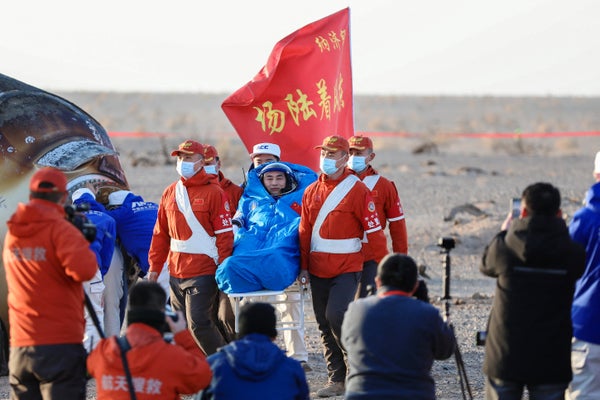
China is set to launch the Shenzhou-22 spacecraft to its orbital space station on November 25, providing a vital lifeboat for its three stranded astronauts after they spent days with no guaranteed trip back to Earth in an emergency.
The spacecraft will launch from the Jiuquan Satellite Launch Center in northwest China, the China Manned Space Agency said in a statement. After the crew of the damaged spacecraft Shenzhou-20 used Shenzhou-21 to return home, the three Shenzhou-21 astronauts were left with only a damaged spacecraft should they have had to return to Earth. And while they are apparently going about their work on the space station as usual, experts say scenarios like this one are dangerous and need to be better addressed.
Technically the damaged spacecraft that remains docked at China’s space station could have been used in an emergency, but that poses risks, especially because it remains unclear how much damage the craft suffered, says Jonathan McDowell, an astronomer at the Center for Astrophysics | Harvard & Smithsonian.
On supporting science journalism
If you're enjoying this article, consider supporting our award-winning journalism by subscribing. By purchasing a subscription you are helping to ensure the future of impactful stories about the discoveries and ideas shaping our world today.
“I'm not sure NASA would have done that,” McDowell says, but “everything in space flight is a balancing of risks.”
“There’s no not risky option,” he adds. And as the amount of space debris in orbit around Earth grows, space agencies must prepare for more scenarios like this. International cooperation will be critical to protecting astronauts of different nationalities in orbit, McDowell says. And as crewed launches into space increase, having better contingency plans for human rescue will become increasingly necessary, says RAND think-tank analyst Jan Osburg. Government space agencies could delegate these operations to private companies or NGOs who have the capacity and infrastructure to respond quickly, he says.
Already the U.S. and Russia use the same docking system at the ISS, allowing them to mitigate risks to both groups of astronauts. A partnership like that between the U.S. and China “would demonstrate a capability that each country could rescue the other astronauts in an emergency,” McDowell says.
If Shenzhou-22’s launch is successful tomorrow, China will have demonstrated its ability to respond to such scenarios on short notice, Osburg says. “That’s a pretty good achievement,” he says. China’s astronaut woes are reminiscent of last year’s saga at the ISS, when two NASA astronauts became stuck there for months longer than intended after their capsule—Boeing’s Starliner—encountered problems during the docking process. China’s human exploration program is a top priority for the country, with plans to send two astronauts to the moon by 2030.