
This summer Chinese scientists begin analyzing the first new samples brought back from the moon in 45 years—specimens that could reset the clock on not just lunar chronology but also planetary bodies' evolution across the solar system. And researchers around the world are eager to get a look.
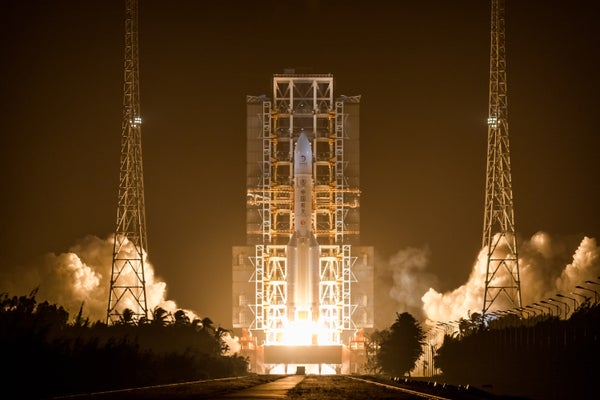
China's Chang'e 5 mission, whose return capsule reached Earth last December, collected about 1.7 kilograms of rock and soil from Oceanus Procellarum (the Ocean of Storms) in the northwestern corner of the moon's near side. Orbital imagery suggests the crust there formed about 1.5 billion years ago. But that relative youth is at odds with computer models, which show that a small body like the moon should by then have lost the internal heat remaining from its formation—heat needed to drive volcanic resurfacing and crust development.
Lacking samples from this region, scientists had estimated its surface age by counting impact craters: older surfaces, they reasoned, would bear more such scars than younger ones would. This technique extends to any solid planetary body. Samples that U.S. and Soviet missions collected from the moon's equatorial, northeastern and northern regions between 1969 and 1976 indicate those surfaces are three billion to four billion years old. “The Apollo samples were like ground truth for the crater-counting models,” says Julie Stopar, a geomorphologist at the Lunar and Planetary Institute in Houston. But the earlier samples cover only those older regions: “Anything that happened between roughly three to one billion years ago, we didn't have samples of.”
On supporting science journalism
If you're enjoying this article, consider supporting our award-winning journalism by subscribing. By purchasing a subscription you are helping to ensure the future of impactful stories about the discoveries and ideas shaping our world today.
If the new specimens prove younger than the crater-counting models suggest, “that means our whole chronology of the moon needs correcting. That's pretty fundamental,” says Brown University planetary scientist Jim Head. Other measurements, such as radioactivity, could help explain lunar volcanoes' extended activity. Learning this history is not only key to lunar evolution; it also helps age-date Mercury, Mars, Earth and other bodies.
A six-month time frame for Chinese investigators to submit requests for samples will end in July or August—and China's policy is to open future allocations to international research teams, Head says. The decade-old Wolf Amendment effectively bans NASA-backed entities from working with China. But exceptions are possible, and other agencies (including the National Science Foundation) are not subject to the congressional rule.
Head, for one, would like to see the U.S. and China conduct an Apollo-Chang'e 5 sample swap. “I'm hopeful in the not too distant future,” he says, “we will be able to have some of these kinds of exchanges.”