
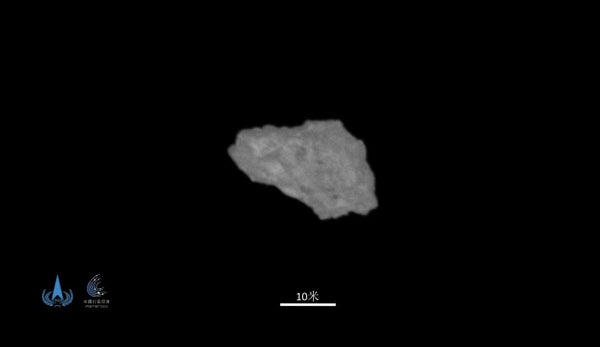
A Chinese spacecraft on a mission to collect and return samples of a near-Earth asteroid beamed back its first image of its target.
Called Kamo‘oalewa, the space rock loops by Earth, coming as close as 9 million miles and as far as 25 million miles from our planet. It’s a quasi-satellite, meaning it orbits the sun, but it sticks close to Earth—astronomers have discovered eight of these space rocks that seem to follow our planet's path.
Some space scientists affectionately refer to these objects as Earth’s “mini moons,” or “quasi moons,” although research suggests Kamo‘oalewa may in fact be a stray piece of our moon that was thrown into space by an ancient impact. Other evidence, including James Webb Space Telescope observations, dispute that theory, however.
On supporting science journalism
If you're enjoying this article, consider supporting our award-winning journalism by subscribing. By purchasing a subscription you are helping to ensure the future of impactful stories about the discoveries and ideas shaping our world today.
China’s Tianwen-2 has spent the last 400 days traveling to Kamo’oalewa, a journey that spanned around 621 million miles. The rock is about 66 feet in diameter—a little larger than a school bus—and it rotates on its axis every 28 minutes. It was discovered in 2016, and Tianwen-2 launched to retrieve samples from it on May 28, 2025. The spacecraft is scheduled to return the samples to Earth in 2027, dropping them into Earth’s atmosphere during a flyby of our planet.
Tianwen-2’s equipment will allow it to recover samples in three ways, depending on the situation. One way uses a touch-and-go method similar to that used by NASA’s OSIRIS-REx asteroid sampling mission and Japan’s Hayabusa2 asteroid mission. Tianwen-2 may also attempt an anchor-and-attach method, which involves the spacecraft physically attaching itself to the space rock and then collecting samples of the surface and subsurface. It could also use a hovering method, whereby a robotic arm will deploy from the spacecraft as it hovers above the asteroid and scoop up some of the surface material.
The China National Space Administration said in a statement that Tianwen-2 had reached a distance of 12 miles from the asteroid in late June.
"The probe will progressively conduct more detailed scientific exploration to acquire data on the asteroid’s morphology, material composition and internal structure, laying the groundwork for subsequent sample collection operations," CNSA said.
After Tianwen-2 drops off the samples in Earth’s atmosphere, it is set to continue its journey to comet 311P/PanSTARRS, where it will conduct further observations and scientific studies.