
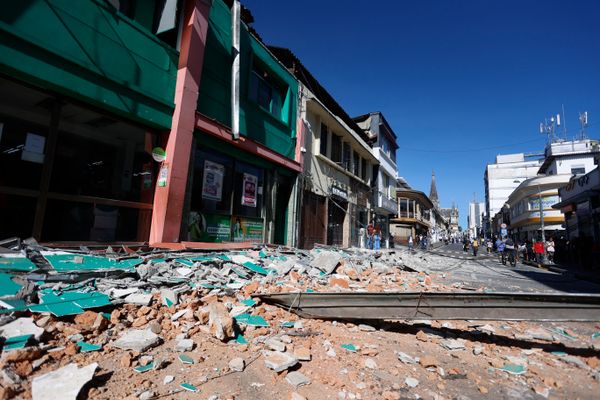
An earthquake of magnitude 7.4 hit Colombia on Monday, killing dozens of people and destroying buildings across the western part of the country.
The earthquake struck in the region of Chocó, about 150 miles west of the city of Bogotá, at 7:34 A.M. local time, according to the U.S. Geological Survey. This area is where the Nazca, South American and Caribbean tectonic plates interact, causing frequent seismic activity.
It’s not clear what exact fault caused this earthquake, says independent earthquake scientist Amilcar Carrera-Cevallos. What is clear, however, is that it occurred along a strike-slip fault, where these tectonic plates slide next to one another, he says, and its depth indicates that the event was not caused by an interaction between plates but rather as a result of stress building up inside the Nazca plate.
On supporting science journalism
If you're enjoying this article, consider supporting our award-winning journalism by subscribing. By purchasing a subscription you are helping to ensure the future of impactful stories about the discoveries and ideas shaping our world today.
The earthquake occurred some 66 miles (around 106 kilometers) below Earth’s surface, according to USGS. Earthquakes this deep are felt across a wide geographic area, but “that distance means the energy spreads out and weakens before it reaches ground level,” Carrera-Cevallos explains.
“The worst damage we’re seeing is concentrated where local soil conditions amplify the shaking, like sedimentary basins,” Carrera-Cevallos says. “Depth explains why the shaking traveled so far but hit more moderately, and magnitude explains the total energy released.”
The disaster comes weeks after a pair of earthquakes with a similar magnitude struck Venezuela in June. Those earthquakes had magnitudes of 7.2 and 7.5, respectfully, and struck within a minute of each other. Unlike today’s earthquake in Colombia, Venezuela’s June quakes occurred on two different fault systems at depths of less than 15 miles (around 24 km). That shallowness caused massive destruction within a small area, as well as more than 6,000 deaths.

Amanda Montañez
In Colombia, local officials are still assessing the damage caused by Monday’s seismic activity. The Colombian Geological Survey told the Associated Press that it was “the highest magnitude earthquake registered in Colombia in the last decade.” The country’s interior minister said in a statement that more than 20 municipalities across the country had been affected.
An event of this kind is not unprecedented for this specific spot in Colombia, Carrera-Cevallos says. A similar earthquake happened in the same region in 1979.
“That tells us this is a recurring process within the subducting Nazca plate at this exact location, not a one-off anomaly," Carrera-Cevallos adds.
Editor’s Note (8/10/26): This is a breaking news story and may be updated.