
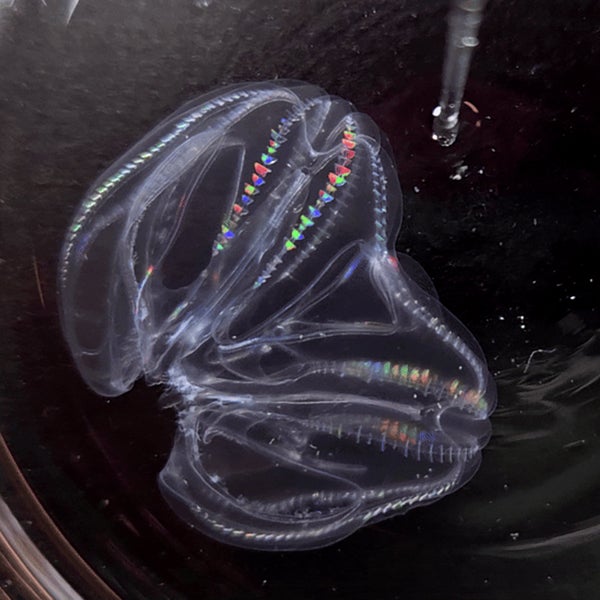
Researchers knew something strange was afoot at the Marine Biological Laboratory in Woods Hole, Mass., when they spied a ctenophore, or comb jelly—a gelatinous sea creature that resembles a jellyfish—with two butts.
Closer examination revealed that the jelly with the double derriere had recently been two separate “sea walnut” comb jellies (Mnemiopsis leidyi). After sustaining injuries while being collected the previous day, the comb jellies had fused overnight in the researchers’ tank to become one creature joined at the midbody.
The union was extensive, write Kei Jokura, a biologist at the University of Exeter in England and at Japan’s National Institutes of Natural Sciences, and his colleagues in a paper published in Current Biology. When the scientists poked one side, both bodies flinched, suggesting that the two nervous systems had joined.
On supporting science journalism
If you're enjoying this article, consider supporting our award-winning journalism by subscribing. By purchasing a subscription you are helping to ensure the future of impactful stories about the discoveries and ideas shaping our world today.
This team wasn’t the first to discover comb jellies’ spooky fusion trick. In the 1930s, at the very same research station, marine biologist B. R. Coonfield performed experiments on comb jellies that would make Frankenstein author Mary Shelley shudder. Perhaps the most impressive of Coonfield’s cteno-monsters comprised the bodies of four individuals with the mouth, sensory organs and anus of a fifth.
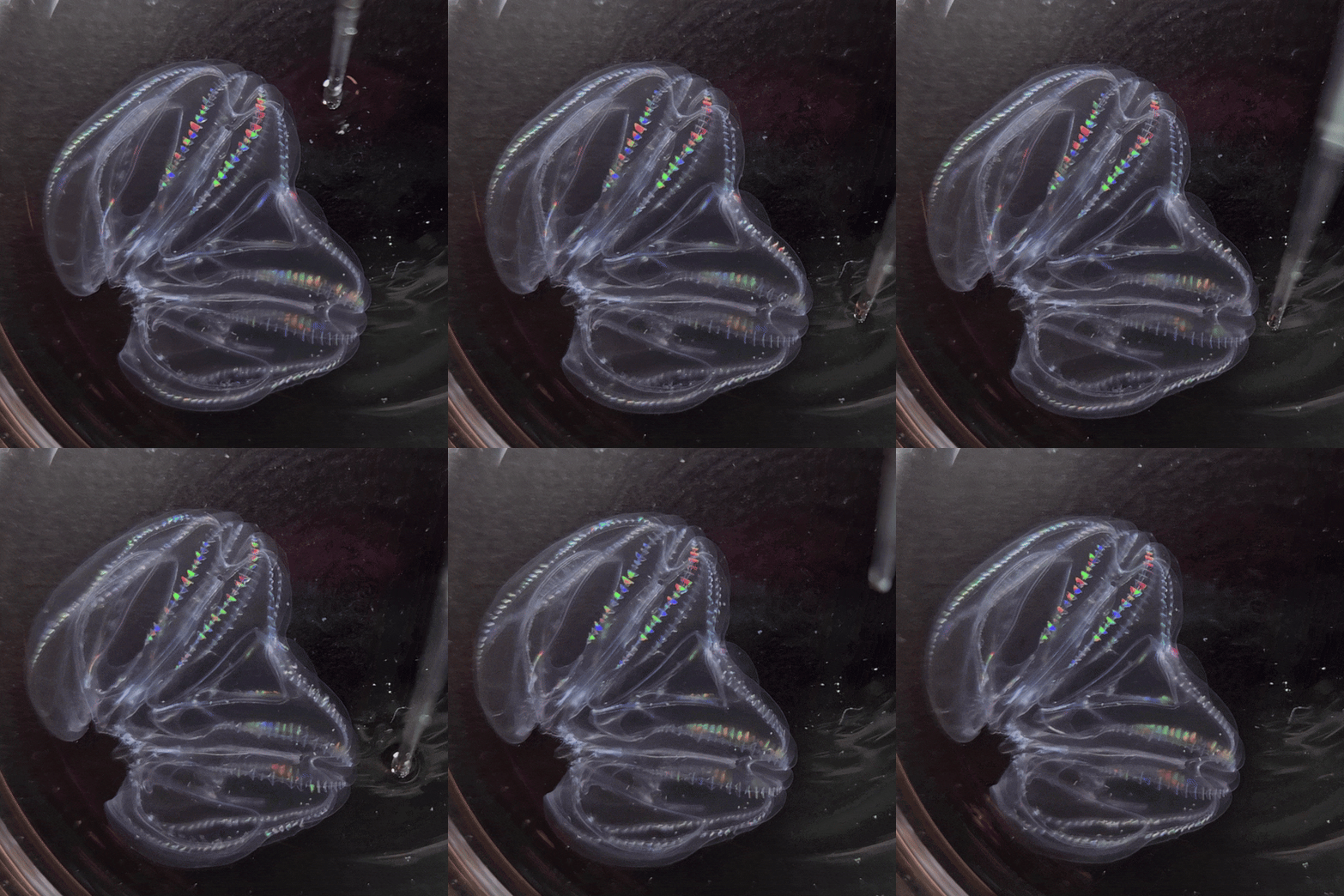
Two comb jellies merge to form one creature whose formerly separate nervous systems react in sync to stimuli.
Mariana Rodriguez-Santiago (CC BY-SA)
With 21st-century tools, Jokura and his team were able to rigorously test the process. By taking high-resolution images every second after grafting additional jellies together, the researchers found that the fusing comb jellies synchronized their respective nervous systems in just two hours. “The extent and the rapidity of that integration is pretty shocking,” says Steven Haddock, a marine biologist who studies ctenophores at the Monterey Bay Aquarium Research Institute and wasn’t involved in the study.
The researchers also determined that in the grafted jellies, food eaten by one mouth was shared between both digestive tracts. There was only one holdout of each animal’s individuality: Sea walnuts have a “transient anus,” meaning the opening appears only during defecation. Each body formed an anus and pooped, but they did not do so simultaneously.
The scientists say it’s unlikely that these animals’ fusion happens frequently in the wild because adults of the species aren’t often together. Still, the chance finding suggests that comb jellies lack allorecognition—the ability to distinguish between self and nonself within the same species.
“They’re completely okay with incorporating another animal’s tissue into their bodies,” says study co-author Tommi Anttonen, a sensory physiologist at the University of Southern Denmark.
The researchers hope comb jellies’ fusion could one day inform transplant techniques in humans. Allorecognition triggers the immune response that can lead to transplant rejections, and learning how the ctenophores’ immune system fares without it might help scientists make it easier for human bodies to accept a stranger’s organs. “Simple organisms [hold] clues to understanding our own complexity,” Jokura says, “as well as treasures that can benefit our lives.”