
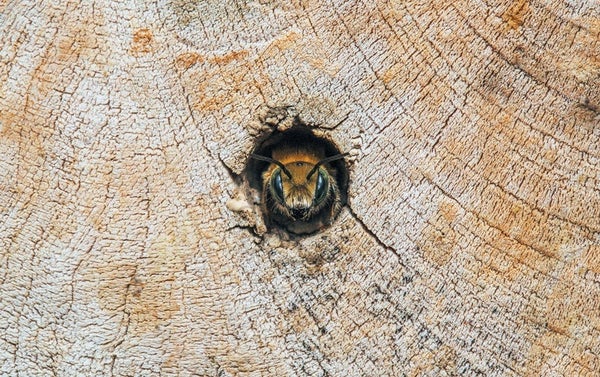
Like the opposite of a good perfume, a chemical humans use to protect crops may have the unexpected side effect of making certain bees less attractive to mates, potentially threatening populations of these crucial pollinators.
The common pesticide fenbuconazole is classified as relatively safe for bees because it specifically targets fungi (which are taxonomically very different from bees) and because exposure to it does not typically kill bees directly. Previous research had found that insecticides deemed “low risk” for bees can still impact their development, feeding behavior and learning; fungicides such as fenbuconazole had not been studied as extensively but were thought less likely to be harmful.
Samuel Boff, lead author of the new study in the Journal of Applied Ecology, and his colleagues wanted to know whether fenbuconazole—typically applied to wheat, apples and grapes—might subtly affect bees. “We did [the study] because this fungicide is used often,” says Boff, an ecologist at the University of Würzburg in Germany. “We did not expect to find an effect.”
On supporting science journalism
If you're enjoying this article, consider supporting our award-winning journalism by subscribing. By purchasing a subscription you are helping to ensure the future of impactful stories about the discoveries and ideas shaping our world today.
But there was, in fact, a surprising effect: fenbuconazole exposure altered two distinct components of male horned mason bees' courtship ritual. A male typically vibrates his thorax alluringly and also relies on his scent to attract females. Exposure to the fungicide lowered the vibrational frequency (possibly by influencing muscle contractions) and additionally altered the males' chemical profiles, changing their scent. Females seemed put off by these changes; they preferred unexposed males. The study authors speculate that such female mating avoidance could reduce populations of horned mason bees and other species with similar mating systems.
The study “is important because it's giving us a mechanism for decline,” says Susan Willis Chan, a bee researcher at the University of Guelph in Ontario, who was not involved with the study. “It's a great paper.” Boff hopes his team's findings will prompt more scrutiny of fungicide use and possibly lead to alternative pest-control methods.