
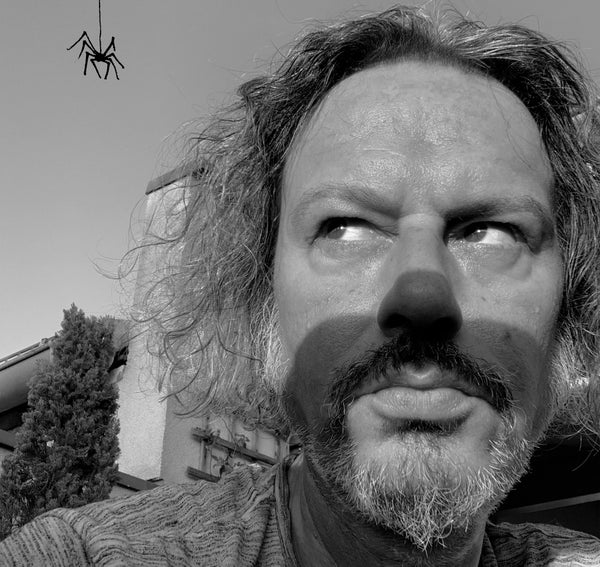
Thomas Fuchs
Advances
Illustrator Thomas Fuchs (above) says the weirder the assignment, the better. For more than a decade his illustrations for Scientific American have depicted strange scientific discoveries that can’t be captured in photographs. This month he was challenged to come up with visuals for quantum entanglement, fungal robots and seeing with sounds. Advances, the magazine’s news section, “is so un-illustratable, and I love it for that reason,” he says. “If there’s no image in your head, it frees you up a lot, and you can go completely wild.” Also see the drawing Fuchs did for our Science Agenda about book bans.
Fuchs has long been artistically inclined. “I was always the guy in school who would paint the AC/DC logo on jean jackets—I was like, I can draw a straight line,” he jokes. He started art school for graphic design but soon realized he could focus on illustration instead. “Straight lines look good and all, but every once in a while [you can] put a curve in it.” For Fuchs, illustration is about looking deeper into the science behind the story and choosing imagery that “opens up another question” beyond what is in the article itself.
On supporting science journalism
If you're enjoying this article, consider supporting our award-winning journalism by subscribing. By purchasing a subscription you are helping to ensure the future of impactful stories about the discoveries and ideas shaping our world today.
“The way we think about our ancient relationships to horses is very much the on-the-ground reality for folks today.” —William T. Taylor, archaeozoologist, author
William T. Taylor
When Horse Became Steed
Growing up in Montana, William T. Taylor lived in a house that was “adorned with every trapping of cowboy culture you could imagine,” he says. “On a fancy occasion, you’d put on your cowboy boots, your bolo and your hat.” His grandfather was a rancher, but his own father was a lawyer, so they didn’t have any animals. Then, after graduating from college, Taylor spent a summer doing archaeology research in Mongolia, another place with “very vibrant horse culture.” While helping to excavate a 2,500-year-old horse burial, “I had so many questions about the interactions between people and horses that I couldn’t really get an answer to.”
Taylor ultimately became an archaeozoologist and recently published a book called Hoof Beats (University of California Press, 2024). In this issue, he tells the story of horses’ domestication and spread across the ancient world. These findings inform our understanding of both the past and the present, shaping conservation strategies for the planet’s last wild horse species, native to Central Asia, and supporting Indigenous peoples’ long histories with horses on America’s Great Plains. “The way we think about our ancient relationships to horses,” Taylor says, “is very much the on-the-ground reality for folks today.”
Violet Frances
Tessellation Revelation
As an assistant art director at Scientific American in the 1990s, Violet Frances became enchanted by older issues from the 1950s and 1960s. “The design was so clear, so laser-focused,” she says. In what was an era of busy, 3D illustrations, she became fixated on simplicity. Her favorite illustration she produced was a two-page spread for a 1998 story about fundamental particles called gluons: a single, eye-catching Feynman diagram. These pared-down graphics “look kind of like scientific hieroglyphics,” she says. “I was struck by how beautiful they are.”
Today Frances still aims to find the simplest way to represent abstract scientific truths. For this issue’s feature on a class of new shapes by science writer Elise Cutts, “I tried approaching the illustrations to just let the geometry sing,” she says. Frances is also a fine artist, and her multimedia work often focuses on the human form. Since she came out as a trans woman five years ago, her art has completely transformed. “Along with the disorienting joy of that time, I realized that so much of my fine art was me trying to make a golem of myself,” she says. After that, “I became way more interested in just the mess of existence.” In 2023 she had her first solo art exhibition since coming out as trans. “For me, life is an experiment,” Frances says. “That’s how I want to live it.”