
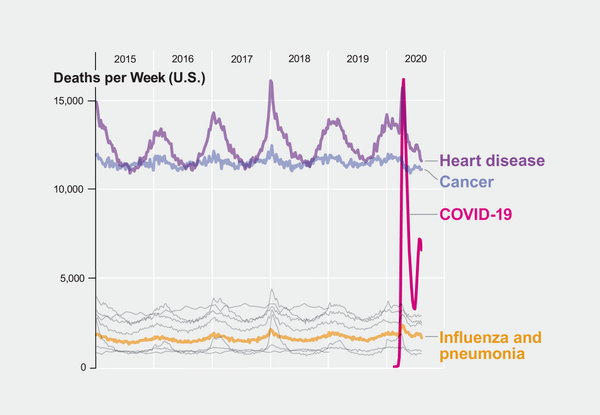
“It affects virtually nobody,” President Donald Trump said of the novel coronavirus on September 21—a few hours before U.S. deaths from COVID-19 exceeded 200,000 and less than two weeks before he tested positive. Unlike the president, the numbers don’t lie. The human toll underlying that milestone figure is a number about as big as the population of Salt Lake City or Birmingham, Ala.—and greater than the deaths in any U.S. conflict except for the Civil War and World War II.
The figures speak for themselves, and Scientific American takes a deeper look here. COVID-19 became the third biggest cause of deaths in the week of March 30 to April 4, trailing heart disease and cancer. It killed more people than stroke, chronic lower respiratory disease, Alzheimer’s, diabetes, kidney disease or influenza. In that week, close to 10,000 people died of the illness caused by the coronavirus. The flu, which Trump and others have invoked when discussing COVID-19, led to 1,870 deaths (a figure that includes pneumonia) over the same time frame. A spike in the week-by-week accounting came in mid-April, when COVID-19 cases became the leading cause of death. The disease returned to the third deadliest spot in the week of May 4 to 9 and has stayed there since.
This profile of loss can be broadened further to measure excess deaths above typical mortality rates. Provisional death counts from the Centers for Disease Control and Prevention show that more people died every month from March to August this year than during the same period in the past 20 years. (The statistics include deaths from both the virus and upticks for other causes such as a lack of medical care as hospitals became overwhelmed.)
On supporting science journalism
If you're enjoying this article, consider supporting our award-winning journalism by subscribing. By purchasing a subscription you are helping to ensure the future of impactful stories about the discoveries and ideas shaping our world today.
COVID-19 marks at least a temporary setback for epidemiology. The share of Americans who died in the first eight months of this year was greater than that of any year going back to 1970—a year that paradoxically turned out to be a good one for public health. In 1970 President Richard Nixon signed the Occupational Safety and Health Act, put his signature on a bill to ban television and radio cigarette ads, and sent to Congress a plan for setting up the Environmental Protection Agency. Maybe such actions can serve as precedents in years ahead when policy makers convene to plan for the inevitability of future pandemics.

Credit: Youyou Zhou; Sources: U.S. Census, Centers for Disease Control and Prevention, and National Center for Health Statistics

Credit: Youyou Zhou; Sources: U.S. Census, Centers for Disease Control and Prevention, and National Center for Health Statistics

Credit: Youyou Zhou; Sources: Centers for Disease Control and Prevention, National Center for Health Statistics