
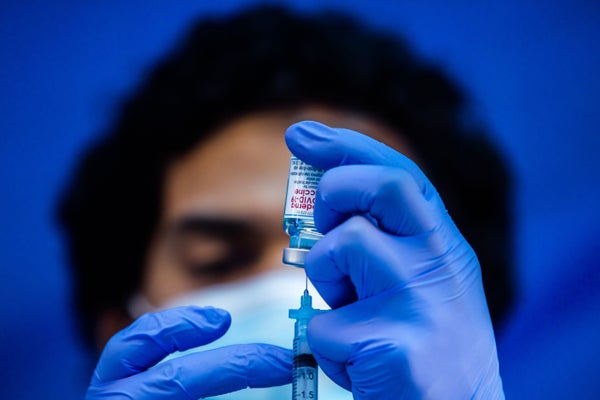
Even people who have had COVID-19 receive long-lasting benefits from a full course of vaccination, according to three recent studies. What's more, one of the studies found that the ‘hybrid’ immunity caused by vaccination and infection is long-lasting, conferring highly effective protection against symptomatic disease for at least six to eight months after vaccination.
The data were collected before the Omicron variant emerged, casting some doubt on the studies’ relevance today. But if the findings hold up, they could inform vaccination schemes and vaccine passports, which some countries require for entry to places such as restaurants. The work also counters high-profile claims that people who have had COVID-19 don’t benefit from vaccination.
Just such a claim helped to launch some of the research. Brazilian President Jair Bolsonaro “said that he already had COVID-19, and for this reason, it is not necessary to take a vaccination”, says Julio Croda, an infectious-disease doctor and epidemiologist at the Oswaldo Cruz Foundation in Rio de Janeiro, Brazil. Croda and his colleagues drew on Brazilian vaccination and infection databases to test such assertions.
On supporting science journalism
If you're enjoying this article, consider supporting our award-winning journalism by subscribing. By purchasing a subscription you are helping to ensure the future of impactful stories about the discoveries and ideas shaping our world today.
The researchers found that between February 2020 and November 2021, people who had previously been infected with SARS-CoV-2 and then received one vaccine dose — made by either Pfizer–BioNTech, Oxford–AstraZeneca, SinoVac or Johnson & Johnson — avoided as many as 45% of the COVID-19 cases that the group would have been expected to contract without vaccination. Full courses of two-dose vaccines prevented as many as 65% of expected infections and more than 80% of expected cases of severe COVID-19. “The big message is this: you need to have a full vaccination scheme for COVID-19,” Croda said.
‘Immunity’ passports?
Some authorities consider previous infections when deciding who should have entry to public places such as concerts and restaurants, but others consider only vaccination status. Peter Nordström, an epidemiologist at Umeå University in Sweden, says this dichotomy prompted him and his colleagues to perform another of the studies. Using records collected by the Public Health Agency of Sweden between March 2020 and October 2021, the researchers showed that Swedish residents who had been infected with SARS-CoV-2 had a 95% reduction in their risk of contracting COVID-19 compared with people who had no immunity — and protection grew over the three months following infection and lasted until at least 20 months after infection. One dose of vaccine reduced the risk of infection by about an additional 50%, and a second dose stabilized the additional protection over the six months following vaccination.
Although vaccination increases protection, Nordström thinks the immunity offered by infection alone is worthy of consideration. “Perhaps we should have immunity passports instead of vaccination passports. So you are considered immune — and less likely to transmit the disease — if you have been fully vaccinated, or you have had a documented previous infection,” he says.
Epidemiologist Victoria Hall at the UK Health Security Agency in London and her colleagues performed the third study by tracking infections in thousands of health-care workers from March 2020 to September 2021. The researchers found that previous infections prevented more than 80% of the COVID-19 cases that otherwise would have been expected in the year after infection, but protection waned to around 70% after a year. Study participants who received two doses of the Pfizer–BioNTech or Oxford–AstraZeneca vaccine after an infection had near 100% protection for at least six to eight months following the second dose. “Protection declined over time after vaccination, and also after infection, but remained persistently high in those with hybrid immunity,” Hall wrote in an e-mail to Nature.
Miguel Hernan, an epidemiologist at the Harvard T.H. Chan School of Public Health in Boston, Massachusetts, says the studies show the near-universal benefit of full vaccination. Some nations have issued guidelines that encourage people who have had COVID-19 to receive only a single vaccine dose: a move that “may be justified in a setting of vaccine scarcity, but not otherwise”, Hernan wrote in an e-mail to Nature.
Variant might change the game
Dan Barouch, a virologist at the Beth Israel Deaconess Medical Center in Boston, Massachusetts, says the findings are in line with previous research. “Vaccination following infection, or infection following vaccination, results in particularly robust antibody responses” he wrote in an e-mail to Nature. But Barouch notes that all three studies draw on data collected before the Omicron variant emerged. He and others caution that past infections will provide imperfect protection against emerging strains.
Dan Kelly, an infectious-disease epidemiologist at the University of California, San Francisco, underscores that concern. Omicron is so different from the strains analysed in the studies that the findings might not apply to people who were infected with Omicron after being vaccinated. His advice to people who fall into this category: “Just be really careful.”
This article is reproduced with permission and was first published on April 6 2022.