
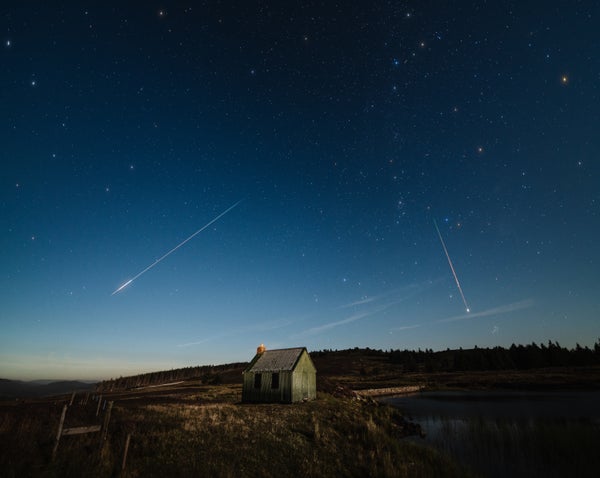
We need to keep better track of invaders from space. And by invaders, I mean meteors. And by we, I mean you—or, more accurately, any astronomy nerd who can.
Meteors, sometimes poetically, if not terribly accurately, called shooting stars, are the luminous displays that occur when cosmic debris—usually small bits of rock or metal—hits Earth’s air. These tiny chunks, generically called meteoroids, ram through the upper atmosphere at hypersonic speeds, heating up the gas ahead of them so much that it glows, creating bright meteors. The meteoroid heats up tremendously as well, ablating—blowing off—material from its surface, often leaving a lingering bright streak called a train. Usually, the meteoroid itself vaporizes high above the ground.
And then those of us down here ooh and aah because, honestly, meteors are a lot of fun to watch.
On supporting science journalism
If you're enjoying this article, consider supporting our award-winning journalism by subscribing. By purchasing a subscription you are helping to ensure the future of impactful stories about the discoveries and ideas shaping our world today.
Meteoroids come in two broad varieties. Those created by asteroids colliding with each other are essentially shrapnel orbiting the sun and can come from anywhere in the sky at any time, so they’re called sporadic meteors. Others are composed of rocks and dust shed more gently by sunlight-warmed comets and follow much the same orbit as the parent body; the result is meteor showers that repeat at the same time every year when Earth plows through their path.
In either case, the meteors literally bring their far-distant, otherwise-inaccessible parent bodies down to Earth, where watchful scientists can better study them.
Shooting stars aren’t stingy either: estimates vary, but approximately 50 to 100 metric tons of meteoroids hit Earth every day. Chicken Little may have been onto something! But while the sky may indeed be falling, it’s very unlikely to fall on you specifically. It’s a big sky, and meteoroids usually burn up 80 to 100 kilometers above our planet’s surface.
That is part of what makes meteor science difficult. Excluding the special cases of meteor showers, a viewer on the ground will see only about five or so sporadic meteors per hour on average, which isn’t terribly many. And because there’s so much randomness in their arrival and trajectory through our atmosphere, observing them in a consistent manner is tricky.
This is where cameras come in. Ones with wide fields of view and sensitive detectors can easily spot these incoming bits of interplanetary jetsam and gather data on their brightness, size, speed and direction. Just as importantly, multiple cameras catching the same meteor can allow researchers to reconstruct its three-dimensional trajectory—and even to trace that back through space to determine the orbit of the meteoroid, linking it to known asteroids.
Doing this at scale—combining all this data, getting as many cameras on the sky looking for meteoric flashes as possible—is what really makes this a critical scientific tool. To that end, several groups of scientists have created various meteor camera networks, each distributed geographically across large areas and with a central clearing house for collecting and analyzing the data.
One such network is the 106-camera Spectroscopy of Meteoroids in the Atmosphere with Robotic Technologies (SMART) project, which has been monitoring the skies of Spain since 2006. One of SMART’s main purposes is to determine the physical properties of meteoroids, including their compositions. For example, in 2020 it obtained a lovely series of spectra showing strong sodium emission in one meteor. Sodium is not necessarily an abundant element in meteoroids, but it ionizes and glows at relatively low temperatures, making it an early and obvious feature of many observations.
Such networks can benefit the study of meteor showers from comets as well. The number of meteors in a shower can vary depending on the parent comet’s structure, orbit and location in space relative to Earth (in general, showers are stronger when the comet has recently passed Earth, leaving more fresh debris behind).
There are many famous showers, like the Perseids and Geminids. But there are also very weak ones, some averaging just a few meteors per night, and these are extremely difficult to measure. Camera networks can be used to root through all the various meteors seen and determine which ones belong to what shower. It doesn’t happen often, but new showers can appear as well—and such new meteoroid streams can betray the presence of a previously unknown cometary source.
There are also meteorites: fragments of meteoroids that survive their fiery passage through Earth’s air to reach the surface. Collectors have gathered them by the thousands across history, but scientists have only managed to correlate a precious few with known meteors. Three-dimensional tracking of meteors is a game changer, allowing scientists to pinpoint landing sites and retrieve meteorites rapidly after impact, minimizing contamination from our terrestrial environment. And these meteorites can sometimes also be linked with known asteroids, allowing planetary scientists to examine these distant objects without all the fuss of having to travel to them. Asteroids are mostly leftover rubble from the solar system’s formation, so studying their associated meteorites is like opening a history book on the birth of the planets.
Interestingly, in March 2026 there was a significant uptick in sporadic meteors, with reports of large, bright fireballs doubling in number compared with previous years. Many of these fireballs were only observed by eye, with no cameras, adding uncertainty to some reports. Was this increase the result of a distant asteroid collision, with Earth passing through the debris field? Or was it merely small-number statistics, random chance? More cameras on the sky could help solve such cosmic conundrums.
As I wrote in a Universe column last summer, there is also the mystery of interstellar meteors. Astronomers have discovered three comets from other stars passing by the sun in recent years, and there should be an observable number of meteoroids burning up in our atmosphere from other stars systems as well. Showing conclusively that any given meteoroid comes from interstellar space is a notoriously difficult task, but having more cameras on the sky to boost the odds for good trajectory and velocity measurements would be extremely helpful.
And you can be a part of it! Several crowdsourced camera networks are active and looking for more participants. Some of the bigger ones are the Global Meteor Network, the SETI Institute’s Cameras for Allsky Meteor Surveillance and the AllSkyCams Network. The hardware required to contribute observations isn’t terribly expensive, and the process comes with detailed instructions, as well as enthusiastic support for rookies just getting started. If you have a good view of the sky, you can be a part of a large and growing group of meteor-watching enthusiasts. We really do need more of them; there’s a lot of real estate up there, and the more cameras we have taking a look, the more we’ll understand these brilliant and ephemeral visitors.