
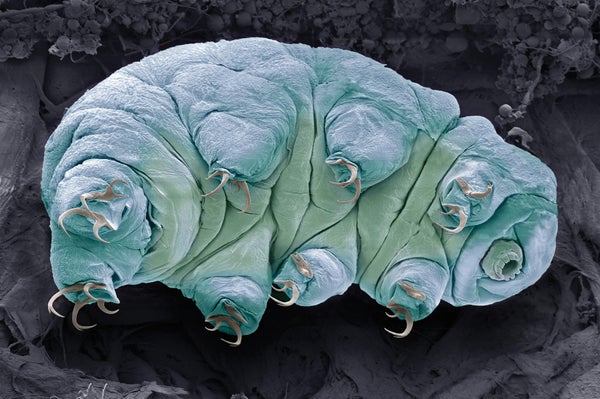
Tiny tardigrades have three claims to fame: their charmingly pudgy appearance, their delightful common names (water bear and moss piglet), and their stunning resilience in the face of threats such as the vacuum of space and temperatures near absolute zero. “They’re masters of protecting themselves,” says Derrick Kolling, a chemist at Marshall University.
Now Kolling and his colleagues have identified a key mechanism contributing to tardigrades’ toughness: a kind of molecular switch that triggers a hardy dormant state. It’s just one piece of the complex system the minuscule creatures use to survive harsh circumstances, but the researchers hope the new work, published in the journal PLOS ONE,will encourage further investigations. “It’s opened up a whole huge repertoire of experiments we can now pursue,” says study co-author Leslie Hicks, a chemist at the University of North Carolina at Chapel Hill.
The research began when, on a whim, Kolling put a tardigrade into a machine that detects “free radicals,” or atoms and molecules that contain unpaired electrons. An animal’s normal metabolic processes, as well as environmental stressors such as smoke and other pollutants, can create free radicals inside cells, so he thought it was likely that tardigrades would also produce such molecules.
On supporting science journalism
If you're enjoying this article, consider supporting our award-winning journalism by subscribing. By purchasing a subscription you are helping to ensure the future of impactful stories about the discoveries and ideas shaping our world today.
When they accumulate, free radicals—most notably, reactive forms of oxygen—snatch electrons from their surroundings to achieve stability in a process known as oxidation. This reaction can damage cells and compounds within the body. But in small quantities, free radicals can also act as signaling molecules, Hicks says, and her laboratory studies show that they affect a cell’s behavior when they glom on to and pop off of a variety of proteins.
When Kolling told Hicks about seeing free radicals in a tardigrade, she wondered whether these molecules could have anything to do with the animal’s hardiness. The team devised several experiments to temporarily expose water bears to stress-inducing, free-radical-producing conditions, such as high levels of salt, sugar and hydrogen peroxide. Under these forms of stress, tardigrades curl up into a temporary, protective state of dormancy called a tun. The researchers monitored the conditions in which the tardigrades hunkered down and found that free radicals did seem to induce the tun state, although the mechanism was not yet clear.
Hicks studies signaling interactions between free radicals and the amino acid cysteine, and she decided to test whether that molecule could play a part in tun formation. So she and her colleagues introduced the tardigrades to different kinds of molecules known to block cysteine oxidation. Under stressful conditions, with cysteine unavailable to the free radicals being produced, the tardigrades couldn’t form tuns—pointing to cysteine oxidation as a required mechanism.
Kazuharu Arakawa, a biologist who studies tardigrades at Keio University in Japan, says the new work aligns with previous research; an earlier study showed the role of oxidation in a midge known for withstanding total desiccation (the process of drying out). The similarities suggest the mechanism may be a common trigger for tuns and other forms of hardy dormancy, a phenomenon that scientists call cryptobiosis.
But water bears still hold many mysteries. When they enter the tun state, they temporarily shut down their metabolism—a feat that even cysteine oxidation can’t explain, says Hans Ramløv, a comparative animal physiologist at Roskilde University in Denmark. “There is no single study to date that explains it,” he says. “In my opinion, we are far, far from understanding that.”
Kolling and Hicks agree that there’s much more research to be done to understand how free radicals work in tardigrades. The resilient tun state isn’t the only tactic water bears use to survive environmental stress, and the team plans to scrutinize other strategies. The researchers also aim to study various species of tardigrades (they examined only Hypsibius exemplaris), and they expect to find that cysteine oxidation is widely used among the animals.
Hicks hopes that in the long run the work can inform investigations of aging and space travel, which both involve free-radical damage to vital cellular machinery such as DNA and proteins.