
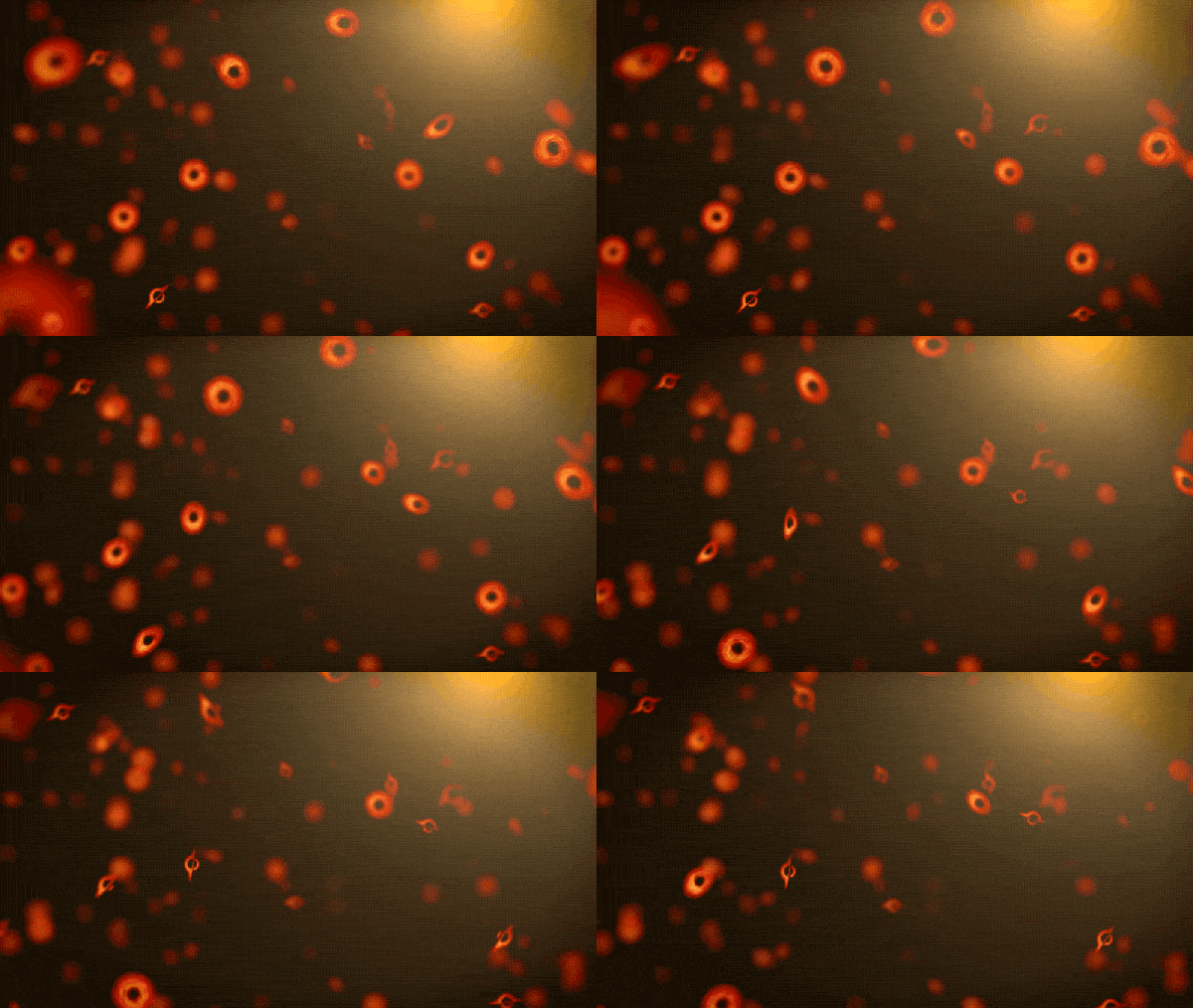
What if dark matter isn’t some exotic particle that stubbornly eludes discovery but is instead swarms of tiny “primordial” black holes born in the first second of the universe?
Once derided as fringe science, this bizarre idea is having a very real comeback as searches for dark matter continue coming up empty. Yet actual evidence for the existence of primordial black holes remains scarce, potentially making them just another cosmic case of wishful thinking—unless, that is, scientists have finally spotted one.
In two papers posted to the preprint server arXiv.org on May 19, researchers led by Renee Key of Swinburne University of Technology in Australia say they’ve done exactly that. Their potential primordial black hole (PBH) would be an object three times as massive as Earth’s moon, briefly glimpsed as it drifted through the Milky Way’s halo—our galaxy’s star-sparse outskirts thought to host most of its dark matter.
On supporting science journalism
If you're enjoying this article, consider supporting our award-winning journalism by subscribing. By purchasing a subscription you are helping to ensure the future of impactful stories about the discoveries and ideas shaping our world today.
The result is controversial, and Key acknowledges there are “weaknesses with our data.” But the possibility of an epochal discovery that radically changes our understanding of the universe’s history and solves one of the greatest mysteries in modern astrophysics is too alluring to ignore. And even if the claim evaporates with further scrutiny, it still highlights how scientists are needing to think outside the box as the hunt for dark matter continues to flounder.
First proposed in the 1960s, PBHs were explored in detail by physicist Bernard Carr and the late physicist Stephen Hawking in the 1970s. Carr and Hawking suggested that, in the first quadrillionths of a second after the big bang, especially matter-dense regions of the expanding universe could have collapsed under their own gravity, leading to the formation of countless black holes with a wide range of masses, from lighter than subatomic particles to much heavier than stars.
Such black holes would be extremely hard to spot and thus might account for some or all of the universe’s dark matter—an invisible, lightless something that seems to act like gravitational glue, binding together galaxies and galaxy clusters. But in the decades since PBHs were first proposed, astronomers found clever ways to narrow down their plausible range of masses, ruling out many scenarios in which these black holes could account for dark matter. “There’s a really big wealth of constraints on PBHs,” says Djuna Croon, a theoretical particle physicist at Durham University in England, who was not involved with the studies from Key and colleagues. Finding one, she adds, would be an “extraordinary” discovery.
Today experts assert that dark matter particles could fall within an overwhelmingly large mass range—anywhere between trillionths of an electron’s mass to about 1,000 times the mass of a proton. Searching for them is like seeking a needle in a cosmic haystack—if the “haystack” is made of variously sized needles and you don’t know how big your target needle needs to be. The far tighter constraints for PBHs suggest a typical one should have roughly the mass of an asteroid if they constitute most or all dark matter—a very small “needle,” to be sure, but still a more tractable task.
Key’s putative heavier-than-the-moon black hole, named “Phoebe,” would be an outlier. The team found it in five nights of observations from 2019 with the Dark Energy Camera at the Cerro Tololo Inter-American Observatory in Chile. Every minute during their time on the telescope, Key and her colleagues took images of some 10 million stars in the Large Magellanic Cloud, a dwarf galaxy about 163,000 light-years away, looking for any that momentarily brightened from a rogue black hole briefly passing in front of them and amplifying their light with its space-warping gravitational field.
This rare and fleeting occurrence, known as a microlensing event, is one of the main search strategies for PBHs in and around the Milky Way. And it’s what Key and her team think they saw when, for an hour, a star estimated to be twice the size of our sun suddenly became much brighter before fading back to baseline just as quickly.
The effect could conceivably have come from stellar variability—a burp from the star rather than a light-magnifying PBH. Or perhaps the brightening was caused by a free-floating planet (FFP) somewhere in our galaxy, a world ejected from an alien planetary system that could create a PBH-mimicking microlensing event of its own. (Phoebe was named for the acronyms FFP and PBH.)
After exhaustive modeling of these scenarios, however, the team’s best fit for what it saw was a black hole three times the mass of our moon some 60,000 light-years from Earth, moving through the Milky Way’s halo at about 300 kilometers a second. If correct, the black hole itself would be tiny despite its mass, spanning “less than the diameter of a human hair,” Key says.
Because microlensing depends on one-off geometric alignments, the faraway object that caused the event by passing so perfectly through our line of sight can never be seen again. Of the meager methods available to test Key’s claim, the most promising involves monitoring the distant star for any signs of stellar variability. If the star brightens in a similar way again, “then you would be very suspicious indeed that this has nothing to do with microlensing,” says Ken Freeman, an astronomer at the Australian National University and a co-author on the papers.
If PBHs do exist, they could explain more than dark matter. Born at the dawn of time, they could also account for the murky origins of supermassive black holes, the million- to billion-solar-mass behemoths seen at the centers of most large galaxies. Observations with the James Webb Space Telescope have found such large black holes within galaxies earlier and earlier in the universe, including the recent discovery of a 50-million-solar-mass black hole seen just 700 million years after the big bang. So far scientists have struggled to explain how these titans grew so quickly, but PBHs could be an answer. By growing from bulky PBHs, “maybe these supermassive black holes had a head start,” says David Kaiser, a physicist at the Massachusetts Institute of Technology.
Unsurprisingly, not everyone is convinced that Phoebe is a genuine PBH. Przemek Mróz, an astronomer at the University of Warsaw, says if it really is a lunar-mass black hole, we should have seen similar objects in other searches, such as a microlensing survey of the Large Magellanic Cloud and the Small Magellanic Cloud called the Optical Gravitational Lensing Experiment (OGLE), which he is a team member on. “We should see hundreds of such microlensing events in our data,” he says, making other explanations more likely. “This is consistent with just a mundane variable star.”
It’s possible, Key says, that her team was just “entirely lucky” in seeing this event; it could be that most PBHs are smaller, the mass of an asteroid, and some are bigger like Phoebe and they just happened to spot one. Recent observations from the Subaru Telescope in Hawaii provide some support for this idea. In a preprint paper posted in February, a team led by Sunao Sugiyama of the Kavli Institute for the Physics and Mathematics of the Universe in Japan observed the Andromeda galaxy and reported 12 microlensing events comparable to Phoebe, some of which might have been caused by PBHs in the Milky Way’s halo. “Our candidates are also in the lunar-mass scale,” Sugiyama says. Mroz counters, however, that none of those cases are actual microlensing events and instead the mere fluctuations of ordinary variable stars.
Clearly, performing these searches is difficult. Images must be taken at a high cadence, at least every few minutes or so, to spot the telltale tweak to a star’s brightness as it’s microlensed by a relatively small PBH. Sifting through all those images poses additional challenges: Key’s five nights of observations, for instance, produced a terabyte of data. New projects designed to cope with such deluges of data and boasting panoramic optics—such as the Vera C. Rubin Observatory in Chile and NASA’s Nancy Grace Roman Space Telescope launching later this year—might be well suited to the search.
PBHs can disclose their presence in other ways besides microlensing, too. Last year Kaiser and his Ph.D. student Alexandra Klipfel suggested that a powerful neutrino spotted in a partially complete detector called KM3NeT off the coast of Sicily might have been caused by an exploding PBH. A process called Hawking radiation causes black holes to shed particles and effectively evaporate over time. And the lower the mass of a black hole, the faster it evaporates, culminating in an exponentially accelerating release of high-energy radiation. This means black holes go out with a bang, with lower-mass PBHs exploding at different epochs of the universe. The smallest possible PBHs should have long ago expired in this way, and today it would be the lower-asteroid-mass PBHs that are exploding; Kaiser and Klipfel suggested one of these might have caused KM3NeT’s neutrino. That idea remains hotly contested. “I am doubtful that makes sense,” says Ignacio Taboada, a neutrino astrophysicist at the Georgia Institute of Technology. “If this neutrino had really been from a primordial black hole, we should have seen it in gamma rays somehow.”
Kaiser is also working with a team of astronomers in France to look for any changes in the position of Mars that might be caused by the occasional passage of a PBH through our solar system. It’s a long shot, Kaiser admits, but an intriguing one to explore all the same. “I’m still enamored to the idea,” he says.
Meanwhile, a merger of two objects spotted via gravitational waves by the LIGO-Virgo-KAGRA collaboration last year has intrigued scientists—because both objects might be less than a solar mass. If those objects were black holes, the only known way they could arise would be through primordial production. “There’s nothing much else a black hole of that mass can be other than primordial,” Freeman says.
For astronomers like Key, scouring the skies for brief boosts in starlight is still the best hope for finding PBHs. Already she is sifting through more data from the Dark Energy Camera, this time targeting 100 million stars, to look for more microlensing events. Maybe, just maybe, we’ll soon witness the passage of more candidate primordial black holes like Phoebe as they trundle around the Milky Way’s perimeter.