
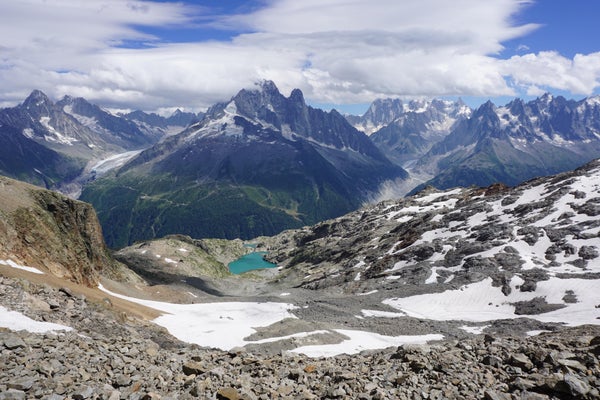
Rising temperatures could reduce the area covered by alpine glaciers around the world by more than one-fifth this century, exposing vast areas of land to the atmosphere for the first time in thousands of years. The emerging habitats that will form as the ice retreats present challenges — as well as opportunities — for conservation efforts, new research shows.
Alpine glaciers outside of Antarctica and Greenland currently cover some 650,000 square kilometres. They supply summer water to nearly 2 billion people as well as to ecosystems across the globe, and their retreat has provided striking evidence of the perils of global warming.
Researchers modelled the future of those glaciers, as well as the terrain that they would leave behind, under both low and high greenhouse-gas emissions scenarios. The results, published today in Nature, suggest that even in the most optimistic scenario an area twice the size of Ireland could be exposed by the end of the century. That exposure more than doubles in a scenario with high emissions, with the greatest area impacts seen in Alaska and the high mountains of Asia.
On supporting science journalism
If you're enjoying this article, consider supporting our award-winning journalism by subscribing. By purchasing a subscription you are helping to ensure the future of impactful stories about the discoveries and ideas shaping our world today.
“This could be one of the largest ecosystem changes on our planet,” says lead author Jean-Baptiste Bosson, a glaciologist with the Conservatory of Natural Areas of Haute-Savoie (ASTERS), a conservation group based in Annecy, France.
Birth of habitats
Bosson and his colleagues project that around 78% of newly exposed terrain would be on land, whereas 14% and 8% percent of the ice-free areas would occur in marine and freshwater regions, respectively. In a curious twist, Bosson says, many of these areas could provide crucial new habitat that must be protected: colonization by plants could lead to increased carbon storage at a time when forests elsewhere are being destroyed, while also providing fresh habitats for animals threatened by climate change at lower elevations.
The study provides useful guidance for scientists who are working to understand how microorganisms, plants and animals move into pristine spaces, says Francesco Ficetola, a zoologist at the University of Milan in Italy who studies glacial ecosystems. It could also help governments to prepare for inevitable questions about land management: less than half of the glacial areas analysed in the study are currently located in parks and other protected areas.
What’s needed going forward is an integration of such global analyses with detailed ecological studies that create a baseline for tracking the evolution of these new habitats, Ficetola says. “This will allow us to develop a more accurate prediction of what happens in each deglaciated area of the planet.”
For Bosson, the study is yet another reminder of what is at stake as the world works to reduce greenhouse emissions. “We are at a turning point for glaciers,” he says. “We can save something like 75% of the current ice up to the end of this century, but we have to act.”
This article is reproduced with permission and was first published on August 16, 2023.