
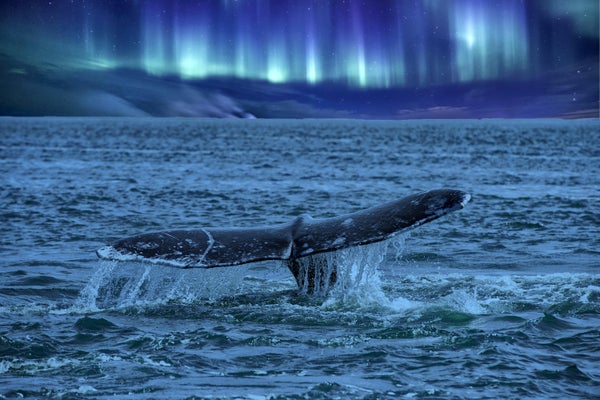
This month the most powerful solar storm in at least 20 years sent dazzling auroras dancing across the skies over the U.S., Europe and Asia. These spectacular displays, also called the northern lights when they occur in the Northern Hemisphere, delighted human observers. But they may have had a less pleasant effect on organisms that use Earth’s magnetic field as a road map.
The spinning of Earth’s molten outer core creates a magnetic field that surrounds our planet and interacts with the constant flow of energy from the sun. Although humans need specific devices to detect this field, various animals—including birds, bees, and some whales and dolphins—can detect the field lines and use their orientation to navigate. This built-in GPS is particularly useful for animals that can’t rely on visual cues, such as those traveling at night or living in the pitch-black deep sea.
The strength of Earth’s magnetic field changes throughout the day: “As Earth rotates, different parts of its surface experience a slightly different magnetic field depending on how they’re facing the sun,” says Eric Gulson-Castillo, a Ph.D. student in ecology and evolutionary biology at the University of Michigan. Beyond those typical variations, intense solar storms can cause dramatic fluctuations. It seems reasonable, Gulson-Castillo says, that this inconsistency would affect animals’ ability to reliably interpret and use clues from the magnetic field—and a few studies have suggested this might happen.
On supporting science journalism
If you're enjoying this article, consider supporting our award-winning journalism by subscribing. By purchasing a subscription you are helping to ensure the future of impactful stories about the discoveries and ideas shaping our world today.
Physicist Klaus Heinrich Vanselow of Kiel University in Germany says that when he started researching whether solar storms were disrupting whales around two decades ago, “many people thought, ‘That’s nonsense.’” But his studies have found that solar activity could influence about 20 percent of strandings of sperm whales (Physeter macrocephalus) in the North Sea.
Other researchers have recorded correlations between gray whale (Eschrichtius robustus) strandings and sunspots, which are associated with solar storms. “The gray whales that we were looking at had a fourfold increased likelihood of stranding on a day where there were very high radio-frequency levels coming from the sun,” says Jesse Granger, a postdoctoral associate at Duke University, who led the study behind that finding.
Previous research has also shown that magnetic field disturbances cause some migratory bird species to depart from their normal routes. When such fluctuations occur, European Robins (Erithacus rubecula) also tendto be less active at night, and homing pigeons sometimes get lost. Gulson-Castillo’s most recent study on the subject found fewer birds migrated during strong space weather events—and those that did so had more difficulty navigating.
Determining more specifically how these disruptions impact migration, though, is “very, very difficult to research,” Vanselow says. Wild birds are hard to catch and often too small to affix tracking tags to. And whales living in the open ocean are notoriously difficult to monitor.
There are also limited opportunities to study really big geomagnetic storms, like the one that occurred in May. They only happen a few times during every 11-year solar cycle; if they take place outside of migration season, the research opportunity is lost.
Many other variables must be taken into account, Gulson-Castillo says, and it can be hard to determine whether behavioral changes are caused by the geomagnetic environment or something else, such as—especially in the case of birds—wind, rain, cloud cover, turbulence or changes to the landscape. Likewise, whale strandings can be caused by illness, injury, disorientation from military sonar or other factors, Vanselow says.
And it’s possible that the effects of magnetic disturbance on some animals could be temporary or that the animals might realize something is off and be able to correct for it—meaning scientists might never know if or how such species are affected.
When animals do get confused and lose their way, however, it can be catastrophic. Researchers believe this is what happened to 29 sperm whales that stranded in the North Sea after solar storms in 2016. “The North Sea is like a mousetrap,” Vanselow says. Sperm whales usually live in deep water, but the North Sea gets very shallow very quickly, and “they don’t realize they’re going the wrong way.”
Once the whales are caught in such a trap, they can panic and strand or can become unable to find food and starve. It can take weeks before their bodies wash onshore on British or other European coastlines.
In birds, experienced adults are more likely to correct their mistakes—but juveniles often use a very simple travel strategy called vector navigation. “They pick a direction and fly in that direction,” Gulson-Castillo says. If a bird were to get lost, he says, “most likely, it would either continue moving, try to find a better place, or it might die.”
It’s too soon for scientists to know whether the most recent solar storms affected wildlife. Gulson-Castillo thinks some birds may have been displaced, yet this would be more likely if the disturbance had happened in the fall, when there are more juveniles.
Some birds may have held off migrating, he says. “Maybe, under these wacky conditions, birds are potentially deciding to wait it out a little bit longer and delay the start of their evening’s migration—or maybe not migrate at all that night,” Gulson-Castillo adds.
With solar maximum, when solar storm activity peaks, nearing, Granger suggests there may be an uptick in whale strandings for at least the next couple of years.
Gulson-Castillo says that such an outcome is an “unfortunate reality of the risk of living in the wild” but that it doesn’t threaten entire populations. In that regard, it pales in comparison with human-caused threats such as habitat loss and climate change. Yet “when you already have an at-risk population,” Granger says, “having a couple of whales strand here and there [from solar storms] is a lot more of a problem than it would have been otherwise.”