
Humans typically consider peeing a private act. But for many animals, it’s a crucial way to share information—one that goes way beyond simply marking territory. Scientists are increasingly aware of urine communication in all its startling forms.
“Animals in general want to learn as much as they can about other animals, such as their sex, dominance, species, and so on,” says Thomas Breithaupt, a sensory ecologist at the University of Hull in England, “and a lot of information is in the urine.”
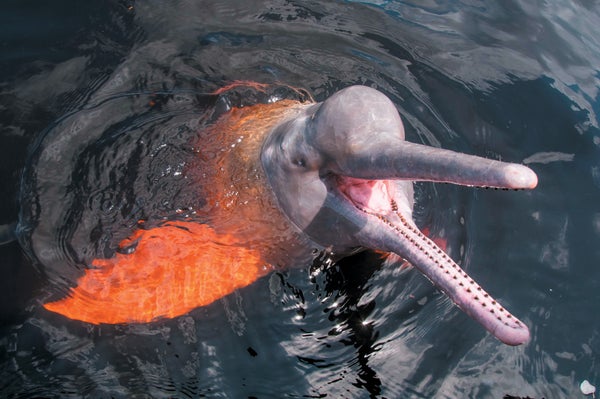
Recently researchers documented Amazon River dolphins (Inia geoffrensis) performing a curious behavior: aerial urination. A male turns on its back at the water’s surface and ejects a stream of pee into the air—and almost 70 percent of the time, the team reported in Behavioural Processes, a nearby male “receiver” approaches this spontaneous fountain.
On supporting science journalism
If you're enjoying this article, consider supporting our award-winning journalism by subscribing. By purchasing a subscription you are helping to ensure the future of impactful stories about the discoveries and ideas shaping our world today.
The researchers speculate that male dolphins might use aerial peeing to deliberately communicate their “social position or physical condition,” says study co-author Claryana Araújo-Wang, a biologist at Botos do Cerrado Research Project in Brazil. Further experiments are needed to pin down precisely what’s happening, says Joachim Frommen, a behavioral ecologist at Manchester Metropolitan University in England, who was not involved in the study.
But this is just the latest in a long and varied list of the stories that urine can tell. In primates, it can provide clues about an individual’s species, gender and group membership “and could support both individual recognition and the finding of mating partners,” says Marlen Kücklich, a behavioral ecologist at Leipzig University in Germany. Some primates even wash themselves with their own pee. This behavior is not fully understood, but the authors of a study on capuchin monkeys proposed that males might attract females via urine’s testosterone content.
In aquatic environments, some fish use urine to communicate their size and aggressiveness before fights. For a few crustaceans, such as lobsters—which pee from their heads—urine can also convey information about social status and readiness to mate. Female stickleback fish get information on a male’s immune system by sniffing its urine, and they tend to choose males with “immune systems that are very comparable to or compatible with their own,” Frommen says.
“When it comes to communication, humans always focus on visual cues and acoustic cues because we are visual animals and acoustic animals,” Frommen adds. But smell is a crucial sense, too, though understudied in some species, and urine is a major provider of olfactory information. In recent years, he says, “people became more aware that we are focusing on a very limited area of communication, and more and more studies started thinking about smell.”