
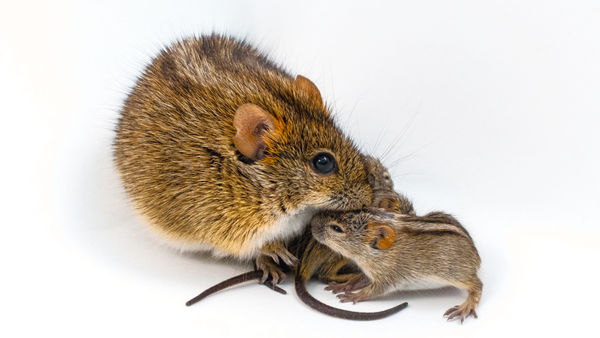
In the animal kingdom, doting dads are scarce: Research shows as few as 3 to 5 percent of mammalian fathers take an active role in parenting their offspring. But the reason why some seem more geared toward parenting than others, at least in part, may come down to their neurobiology.
According to a new study on African striped mice, a single gene may play an outsize role in parental caregiving in male mice. By studying the brains of males of the species, researchers found that more aggressive males tended to have higher expression of a gene called Agouti than those that were more caring toward young mice. Activating the gene in the caring mice also made them more aggressive toward pups, the researchers found.
Interestingly, mice that lived in groups were more likely to have higher Agouti expression than male mice that lived alone, suggesting that aspects of a mouse’s environment—such as resource scarcity or population level—may be playing a role in its caregiving instincts, explains Forrest Rogers, a postdoctoral researcher at Princeton University and lead author of the study.
On supporting science journalism
If you're enjoying this article, consider supporting our award-winning journalism by subscribing. By purchasing a subscription you are helping to ensure the future of impactful stories about the discoveries and ideas shaping our world today.
An important takeaway from the study is that the male mice “have what they need to be good dads,” says Catherine Peña, an assistant professor of neuroscience at Princeton University and senior author of the study.
“We didn’t find that they needed new circuitry,” she says. “We didn’t find that they had some unique evolution of cells in the brain that they needed to be dads.”
Rather their findings suggest that “there may be optimal conditions to help promote one’s own best parenting,” she says.
The research was published on Wednesday in the journal Nature.
African striped mice, like humans, are among the few mammals for which the males typically act as caregivers to young—at least to some extent. In the wild, male mice can be observed caring for pups by grooming them or providing them with food. But some seem to lack this instinct altogether and ignore or even kill their pups.
The study is an “important step forward for the field of parental behavior and its brain origins,” says Christian Broberger, a professor of neurochemistry at Stockholm University in Sweden. The neurobiology of maternal parenting is relatively well studied, Broberger says, but “far less” is known about paternal parenting. The finding that Agouti—a gene known for roles in pigmentation and metabolism—may play a part in paternal instinct was a “surprise,” he says.
The results offer clues to the potential neurobiology underlying what makes male mammals tend to their children, although the study was obviously limited to mice. The findings don’t extrapolate to human fathers or indicate that there may be a “magic pill for parenting,” Peña says.
But future research could illuminate whether other species also share similar neurobiology.