
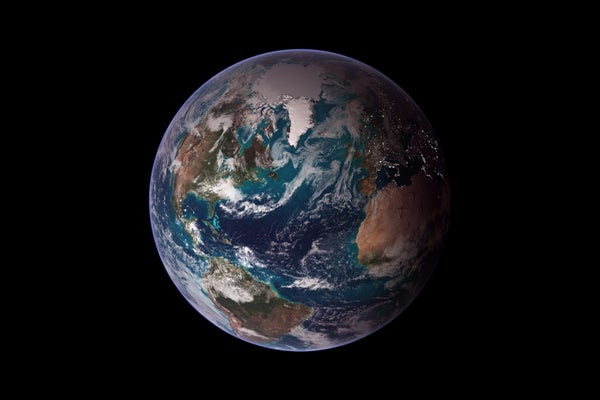
The view of Earth from space is famously familiar—bright blue ocean, swirling gyres of white clouds, touches of terrestrial green. The luminosity of this image is the result of the sun’s rays shining on the planet, where they’re either reflected or absorbed by materials on Earth’s surface and in our atmosphere. But a new study that examined Earth’s overall brightness reveals that something eerie is happening to that familiar picture.
Scientists measure the planet’s brightness by factoring in how much light reaches earth and how much is reflected back out to space (as measured by orbiting satellites). This reflectivity is known as albedo, and Earth’s overall albedo has been decreasing for decades. But according to a new study published recently in Proceedings of the National Academy of Sciences USA, that change isn’t uniform: the Northern Hemisphere is getting even darker than its southern counterpart. This loss of brightness could result in increased warming in the Northern Hemisphere, throwing Earth’s weather systems out of balance.
Norman Loeb, senior technologist for radiation sciences at NASA and lead author of the study, and his colleagues investigated the changes in Earth’s brightness using data from three different satellites measuring incoming sunlight against what is called outgoing longwave radiation, or the amount of radiation reflected back into space, over a 24-year period. They combined this with data from high-resolution spectral imagers, snow and cloud maps, and computer climate models. What they found was surprising.
On supporting science journalism
If you're enjoying this article, consider supporting our award-winning journalism by subscribing. By purchasing a subscription you are helping to ensure the future of impactful stories about the discoveries and ideas shaping our world today.
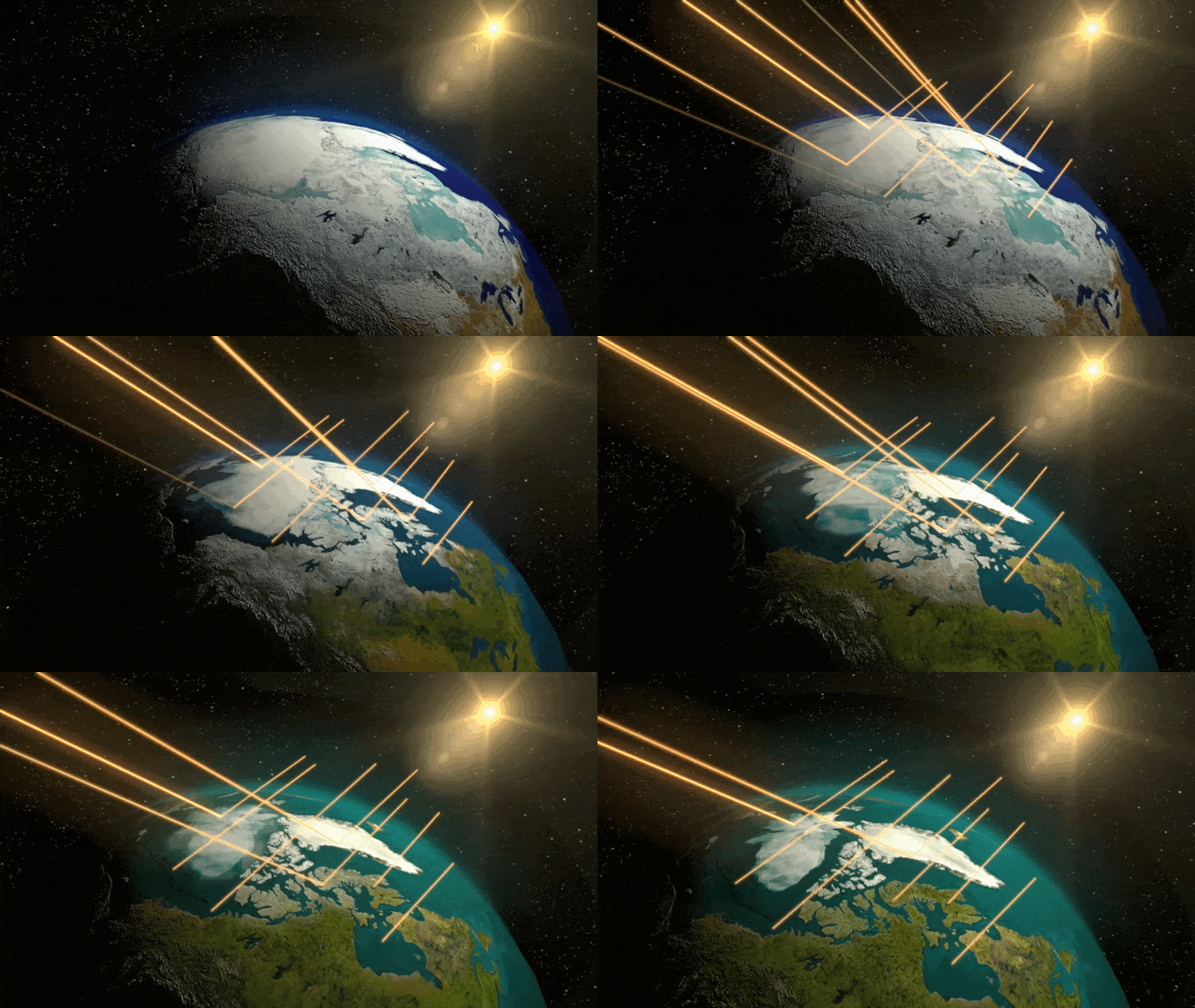
This is a conceptual animation showing how polar ice reflects light from the sun. As this ice begins to melt, less sunlight gets reflected into space. It is instead absorbed into the oceans and land, raising the overall temperature, and fueling further melting.
NASA/Goddard Space Flight Center Conceptual Image Lab
Historically scientists believed a fundamental property of Earth was that the brightness of the Northern and Southern Hemispheres were symmetrical. The two hemispheres have different albedos—the Northern Hemisphere has more land and snow and ice cover, and thus it is more reflective. “One has a lot of continents; the other has more ocean. One has Antarctica; the other has the Arctic Ocean,” says Brian Soden, a University of Miami professor of atmospheric science. But despite these differences, they appear to reflect the same amount of sunlight from space.
That equilibrium was thought to be because of cloud cover. Formed from both water vapor and aerosols, clouds can, at varying altitudes, reflect or absorb solar rays. But Loeb’s team found a break in the hemispheric symmetry, which suggests that there’s a limit to the role clouds play in maintaining it. The researchers have hypotheses about why they observed differences between the hemispheres: when the Earth warms, the air holds more water vapor, which absorbs solar radiation. The Northern Hemisphere is experiencing more warming, so this could account for some level of darkening.
Some of the difference could also come from changes in aerosols, small particles in the atmosphere ranging from pollutants to dust or sea salt, that reflect solar radiation. Because of stricter controls on aerosols in the Northern Hemisphere since the early 2000s in countries such as the U.S. and China, coupled with melting ice and snow, this part of the globe is reflecting less sunlight. In the Southern Hemisphere, on the other hand, a major volcanic eruption and Australian bush fires have both contributed aerosols to the atmosphere in the past few years, increasing reflectivity.
When the balance in reflectivity shifts, “the whole circulation of the climate will shift in order to transport energy from the hemisphere that has a surplus to the one that has a deficit,” Soden says. This could influence ocean currents and the location of rainfall bands, which can have ramifications for water availability.
And of course, if more solar radiation is coming in, the Northern Hemisphere will continue to get hotter. This could mean that more ice and snow will melt, further fueling the global heating and darkening. Though he can’t confirm the correlation, Loeb says that tropical precipitation in the Northern Hemisphere has increased relative to the south. “This is still early,” he said. “I will be very interested to see what further implications may arise.”