
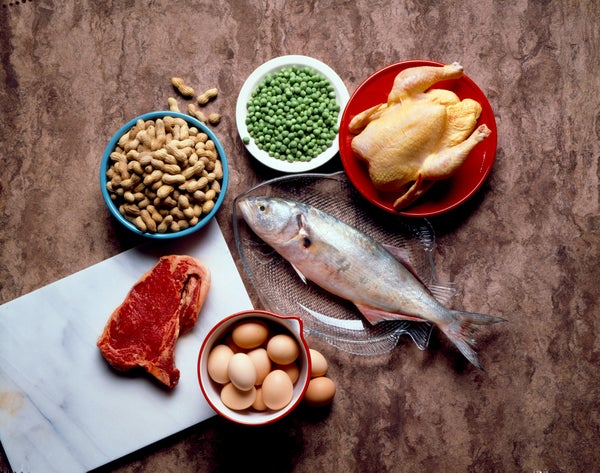
Some people think that the newest trend of “protein maxxing” will help them live longer and healthier lives, but new research suggests the opposite: reducing protein intake could add years to your lifespan, not to mention dollars to your pocket.
The popularity of the protein maxxing craze on social media has coincided with a glut of protein-infused products on the market that have ranged from water to Starbucks drinks to Doritos. People may be buying those foods and drinks in the hope bulking up, but studies have shown the majority of Americans are already getting plenty of protein in their diets.
In a new review published on Friday in Cell Press Blue, researchers summarized findings from more than 350 previous studies and found widespread evidence that when it comes to protein, there can be too much of a good thing.
On supporting science journalism
If you're enjoying this article, consider supporting our award-winning journalism by subscribing. By purchasing a subscription you are helping to ensure the future of impactful stories about the discoveries and ideas shaping our world today.
“Humans typically, on an average, roughly speaking, eat about 17 percent of their calories from protein,” says Dudley Lamming, a professor at the University of Wisconsin–Madison and the paper’s co-author.
In summarizing previous research, Lamming says control groups of mice had diets that were about 20 percent protein, and mice that were given far lower amounts of protein, especially in the range of 5 to 8 percent, were found to have longer lifespans.
Part of the link between higher protein intake and lower lifespan arises from the role of essential amino acids in our diets. Dietary protein is our main source of essential amino acids because our bodies can’t make these molecules on their own. While we need these amino acids to live and grow, Lamming’s research has shown that they can also be harmful in excess. In a paper published on July 24 in Nature Aging, he and his colleagues demonstrated that by cutting down on the amino acid valine, the median lifespan of male mice increased by 23 percent, or half a year. These rodents showed fewer signs of frailty as they aged and less adipose tissue, and fewer of them developed cancer.
“You need the essential amino acids in protein,” acknowledges Steven Heymsfield, a professor at Louisiana State University, who wasn’t involved in the new review or Lamming’s July 24 study. But after metabolizing a sufficient amount to maintain your muscles, organs and other essential bits, “all the rest is just energy. If you’re eating a ton of protein beyond that essential amino acid need, it’s going to get either converted to something else like fat or ... oxidized for calories. So I don’t see the massive protein intake [trend] being anything more than just BS.”
There have been countless studies showing a link between overall calorie restriction and longer life, but practically speaking, this is hard for people to do. Lamming and other researchers think that perhaps some of the same lifespan extension benefits could come from simply restricting protein. Most studies on the ties between longevity and a protein-restricted diet have been done with animal models such as mice rather than humans because of the challenges of following a person’s diet over the course of their entire life. Still, there are enough similarities between what a mouse and a human eat that the data collected by such studies can still apply. Both humans and mice need roughly the same proportion of protein and rely on the same nine essential amino acids to survive and thrive.
“Mice are really good for modeling food due to the fact that they basically eat human food, and they use it for the same processes to grow, to reproduce and to maintain themselves,” Lamming says.
The rodent studies that the researchers analyzed in the new review had varied results and used different species and sexes of mice and rats, but the increase in lifespan on a low-protein diet was as high as 53 percent. For perspective, that would be like a human with an expected lifespan of 80 years living to be older than age 120.
The lengthened lifespan effect is likely related to a hormone called FGF21, the researchers believe. When humans, or mice, restrict protein, that leads to a boost in the production of FGF21. When that hormone reaches the brain, it triggers a process called sympathetic signaling, in which the nervous system cues white adipose tissue cells to generate more mitochondria. That, in turn, leads to the fat getting burned as fuel.
“What we actually see in protein-restricted animals—and was actually shown last year in protein-restricted humans as well—is that [those] on protein-restricted diet have higher energy expenditure,” Lamming says.
Having that excess fat disappear can help reduce the risk of illnesses such as diabetes, heart disease and some cancers.
Restricting protein intake has other benefits, Heymsfield says. When protein is digested, the end metabolic product, called urea, is produced in the liver, and excess urea can lead to kidney issues. Foods that have a lot of protein can also have a lot of saturated fats, and eating too much of these fats is linked to a higher risk of heart disease, which has led some researchers to criticize the meat-heavy keto diet.
As for what the optimal level of protein intake is for a human, that’s difficult to say. Until recently, the U.S. Department of Agriculture’s dietary guidelines for Americans recommended a daily intake of 0.8 gram of protein per kilogram of body weight. But in the latest edition, that was upped to 1.2 to 1.6 g/kg daily. (The updated version, which was presented by Secretary of Health Robert F. Kennedy, Jr., in January, has drawn fire from doctors, who have alleged that some people who were responsible for assembling the new guidelines had conflicts of interest.) That recommendation to increase protein intake is at odds with the suggestion there's benefits to reducing protein intake. And protein needs can vary from person to person: A pregnant person needs more protein than someone who isn’t pregnant. And increased protein intake is also recommended for others who are in particular circumstances, such as someone who is recovering from an injury. Being very physically active could also mean a bump in protein won’t do any harm.
“Our working model overall is that for people who are exercising, dietary protein is probably beneficial and certainly not harmful,” Lamming says. “But for sedentary people, it’s likely that if you’re eating too much protein, that’s probably going to be bad for you.”