New Issue: Orbital Catastrophe Ahead? Read Now

Eerie brainlike nebula captured in stunning new JWST images

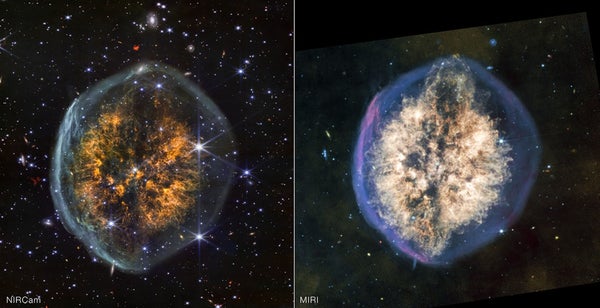
Nebula PMR 1 looks uncannily similar to an electrified brain inside a semitransparent skull

Two images side by side show the Exposed Cranium Nebula in near- and mid-infrared

NASA/ESA/CSA/STScI (image); Joseph DePasquale/STScI (image processing)

Join Our Community of Science Lovers!

The death of a star never looked so beautiful. New images captured by the James Webb Space Telescope reveal what looks eerily like a brain floating in space and housed inside a semitransparent skull.

This is the “Exposed Cranium” Nebula, also known as Nebula PMR 1. Located some 5,000 light-years away in the constellation Vela, it’s the result of a massive, moribund star coming to the end of its fuel-burning life. As the star dies, it is shedding layers of its material, generating billowing clouds of gas and dust.

The new images show the nebula in both near- and mid-infrared light, revealing a dark channel that runs through the middle of the clouds of gas and dust—just like the longitudinal fissure that separates our brain’s right and left hemispheres. In the nebula, this feature may be caused by jets coming from the dying star, pushing the inner gas out. The outer layer of gas is mostly made up of simple hydrogen, but the inner gas clouds are more complex.


On supporting science journalism

If you're enjoying this article, consider supporting our award-winning journalism by subscribing. By purchasing a subscription you are helping to ensure the future of impactful stories about the discoveries and ideas shaping our world today.


It’s unclear what will happen to the dying star. If it is massive enough, it will explode into a supernova. But if not, it will deteriorate until only its core remains, at which point it will become a white dwarf, a dense object that astronomers believe cools over time to become a black dwarf—a cold, dark object that exists only in theory, perhaps because the universe is too young for any to have formed.

Subscribe to Support Independent Journalism

Great science journalism requires human expertise, time, effort and creativity. And it costs money. That’s why I and the journalists here at Scientific American hope you’ll join our community.

When you subscribe, you are supporting staff and freelance journalists who are passionate about telling science stories that are true, important and compelling. Our editors and reporters are often experts in their fields, which means they understand the nuances of big discoveries and can untangle the breakthroughs from the hype. With a subscription, you are also supporting rigorous fact-checking to ensure the words we publish are precise and accurate. And you’re supporting original illustrations, graphics and photos that bring you closer to an advanced laboratory, an ice sheet in Antarctica or a space mission in orbit. You’re helping us craft other types of high-quality journalism as well: Our newsletters are carefully written, edited and curated by staffers you have or will come to know and love. Our Science Quickly podcast is based on original reporting, collaboration with editors and scientists and exacting production.

Subscriptions keep this engine running so we can continue to deliver thoughtful, rigorous and independent science journalism to you. In an era of viral misinformation, this work is crucial. If you value what we do, I hope you’ll consider joining us as a subscriber

Thank you,

Jeanna Bryner, Editor in Chief, Scientific American

Subscribe