
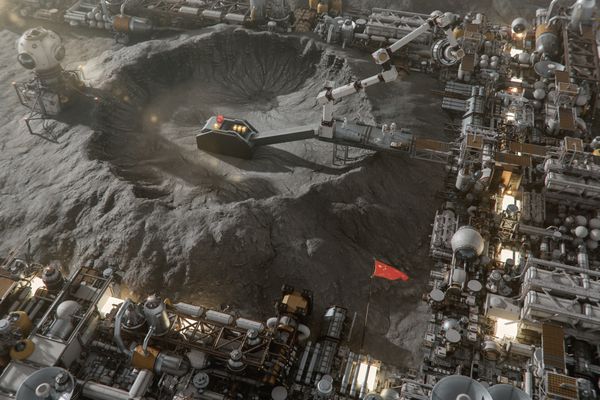
Elon Musk laid out a sweeping plan for SpaceX to reach profitability during an investor call on Tuesday—including robotic satellite factories on the moon.
Musk, who is known for making ambitious timeline predictions that don’t always hold up to reality, told investors this will come to fruition “faster than you think.”
Building factories largely staffed by robotic workers “sounds like super sci-fi right now,” he acknowledged, “but it’s going to happen.”
On supporting science journalism
If you're enjoying this article, consider supporting our award-winning journalism by subscribing. By purchasing a subscription you are helping to ensure the future of impactful stories about the discoveries and ideas shaping our world today.
Those facilities, when combined with solar and radiation-based energy production on the lunar surface, would allow humanity to “scale to 1,000 times the economy of Earth in terms of intelligence launched to space but probably, maybe even a million times,” he said.
The idea of manufacturing on the moon isn’t ludicrous, says Patrick Suermann, a professor of construction science at Texas A&M University, who recently visited SpaceX’s Starbase headquarters in Texas. He pointed to NASA’s timeline for establishing a permanent lunar base, currently slated to be completed by 2032, replete with a nuclear power reactor.
Constructing a lunar satellite factory would likely make economic sense because the moon’s reduced gravity would mean that less fuel would be necessary to launch satellites from there compared with launching them from Earth, he says.
“I think that it’s wise because the most expensive part of a launch is the fuel to get it out of our atmosphere,” Suermann says. “If you could have the level of productivity that they have at their ‘gigafactory’ or at the Starbase factory but be able to then cut out that huge portion of cost to be able to launch things into a cislunar orbit or back to a low-Earth orbit or even onto Mars, I think that’s really the main driving force.”
Getting the infrastructure in place for a factory would be extremely expensive. Also on Tuesday SpaceX posted a loss of $542 million from its space segment, as well as a $1.257-billion loss from its artificial intelligence operations, for the quarter. During that day’s call, Musk told investors that he anticipated that SpaceX’s investment in AI infrastructure will eventually pay off as the company leverages its rocketry expertise into improving its data center engineering.
“If you apply a small amount of the engineering skill that goes into making gigantic rockets reach orbit on a regular basis reliably to terrestrial data centers, this is like, frankly, the New York Yankees going in and playing a Little League team,” he said.
In the immediate term, those financial losses were offset by the profitability of the connectivity portion of the business, which is primarily composed of the Starlink communications satellite constellation. All in all, SpaceX had a $143-million loss from operations.
On the call, Musk also touted two recent successful test flights of the company’s Starship megarocket, which has been beset by delays. During the most recent flight, the vehicle deployed 20 Starlink satellites before returning to Earth, although a fire did briefly break out following splashdown. Starship’s upcoming 14th test flight is tentatively slated for some time in late August.
“It’s difficult to actually explain to most people just the incredible significance of Starship, and I think perhaps describing it in terms of tonnage to orbit is a good way to appreciate the magnitude of the impact Starship will have on the future of civilization,” Musk said. The rocket, he claimed, will one day launch “over one million tons to orbit and probably ultimately 10 million tons per year.”