
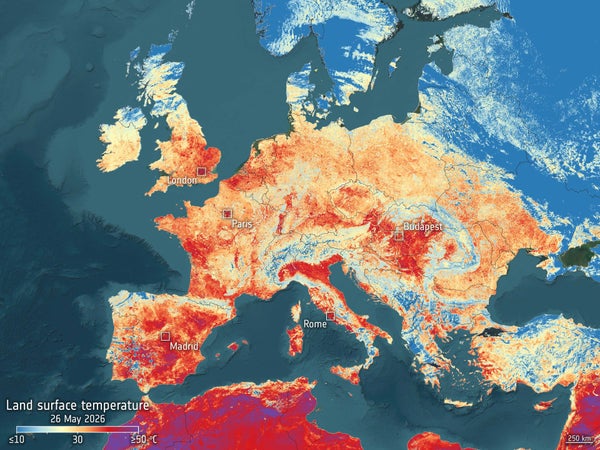
Stark new data show how much the spring heat wave that has been affecting much of Western Europe has shattered temperature records. The heat has been linked to 12 deaths in the U.K. alone. Three occurred on Wednesday and Thursday, when three teenage boys died in separate water incidents while they sought reprieve from temperatures that beat the previous records by several degrees in portions of the nation.
The gravity of the situation can be seen in an image captured by the European Space Agency’s Copernicus Sentinel-3 satellite, which is used to monitor surface temperatures, on May 26. The areas in red are indicative of temperatures well in excess of 30 degrees Celsius (86 degrees Fahrenheit) and include major European cities such as Madrid and Paris.
The heat wave has broken a “remarkable number” of records for temperature, the U.K.’s Met Office said in a statement. Some 23 weather stations across England, Wales, Scotland and Northern Ireland have reported temperatures exceeding the previous U.K.-wide record of 32.8 degrees C (91 degrees F), which was set in 1922 and 1944. On Tuesday a research station in London’s Kew Gardens recorded temperatures of 35.1 degrees C (95.2 degrees F), obliterating its previous record of 29.3 degrees C (84.7 degrees F) for the month.
On supporting science journalism
If you're enjoying this article, consider supporting our award-winning journalism by subscribing. By purchasing a subscription you are helping to ensure the future of impactful stories about the discoveries and ideas shaping our world today.

Amanda Montañez; Source: Met Office, U.K.
At least seven other deaths in France, five from drowning, have also been tied to the sweltering conditions. May 26 was the hottest May weather in the country’s history, according to Météo-France, the French national weather service, with an average temperature of 24.9 degrees Celsius (76.8 degrees F). Two days later, daytime highs peaked at almost 40 degrees C (104 degrees F) in several regions.
“Such high temperatures have never been recorded in May since records began,” Météo-France said in a French-language statement.
The heat was bad enough to affect tennis’s French Open: top-ranked player Jannik Sinner was eliminated on Thursday after he took a medical time-out for cramping that was likely caused by dehydration.
The weather is being driven by a heat dome—a block of high pressure that traps hot air—hovering over Western Europe. But even with the heat dome factored in, temperatures have hit levels that are unusual at the peak of summer in several countries.
The heat seen since May 22 across much of France, Switzerland, Italy, Austria, Liechtenstein, Spain, Portugal and the U.K. was likely made three to five times more likely because of the effects of climate change, according to Climate Central’s Climate Shift Index.
Recent experience suggest more deaths are likely: unlike in the U.S., where an estimated 90 percent of households are equipped with air-conditioning, Europeans lag behind at only 20 percent, according to the International Energy Agency. That can make high temperatures particularly dangerous on the continent—in 2025 a series of heat waves led to some 24,400 deaths, 16,500 of which were attributed to climate change, while more than 62,700 people died of heat-related causes the year before.