

When I arrived at the Fermi National Accelerator Laboratory (Fermilab) in the prairie suburbs west of Chicago to begin my Ph.D., the mood among many physicists there still carried a quiet sadness.
Just a few years earlier, in 1993, the U.S. Congress had canceled the Superconducting Super Collider (SSC), which would have been the most powerful particle accelerator ever built—an 83-kilometer subterranean edifice beneath the plains of Texas that was designed to collide particles at about three times the energy of what we achieve today at CERN’s Large Hadron Collider (LHC) near Geneva. Construction had begun, and the physics community was alive with anticipation. Then, abruptly, the SSC was gone—and with it, an opportunity to explore a frontier that remains beyond our reach more than three decades later.
On May 22, 2026, in Budapest, Hungary, the CERN Council unanimously adopted an updated strategy, calling for the Future Circular Collider (FCC) to succeed the LHC. This 91-kilometer ring would run beneath the Swiss-French border and would first host a precision electron-positron collider while preserving a path toward a proton collider that would operate at more than twice the energies targeted for the unrealized SSC.
On supporting science journalism
If you're enjoying this article, consider supporting our award-winning journalism by subscribing. By purchasing a subscription you are helping to ensure the future of impactful stories about the discoveries and ideas shaping our world today.
The FCC, as currently envisioned, will require resources beyond CERN’s current budget. The scientific case is strong, the technical feasibility has been demonstrated, and the community has spoken with unusual clarity.
What remains is the difficult task of turning that vision into reality.
The Era of the LHC
The sense of loss surrounding the SSC lingered for years, especially among senior physicists who understood its long-term consequences. But for young researchers like me, the community still seemed full of life. Experiments were running, discoveries being made, and conferences hummed with new ideas. Only later did I appreciate that the cancellation of the SSC had not just halted one project; it had fractured the long-term vision for high-energy physics in the U.S.
In Europe, however, CERN followed a different trajectory: pursuing the LHC. The LHC was not a response to the SSC’s cancellation—the project was already then technically mature. But the timing was telling: official approval of the LHC came just 14 months after SSC was canceled. Fifteen years later, in 2009, the LHC began operation—a monumental effort that would define the next era of discovery.

A view inside CERN’s Building 40 in Geneva, Switzerland, which is decorated with a scale photo of the Compact Muon Solenoid (CMS) experiment. The CMS is one of two large general-purpose particle physics detectors within CERN’s Large Hadron Collider, the world’s largest and most powerful particle accelerator.
Dean Mouhtaropoulos/Getty Images
Success was neither swift nor guaranteed; the LHC faced serious resistance at CERN, with some member states reluctant to commit to a particle physics project of unprecedented scale and cost. But whereas the SSC collapsed after meeting with the same resistance, CERN took it on and built the LHC. Making the machine a reality took years of negotiation and real institutional sacrifice—CERN had to shed roughly 800 permanent staff over the construction period to absorb the cost. Having lost its own machine, the U.S. chipped in as well, ultimately contributing around half a billion dollars to the project. The two colliders were the same kind of bet placed under the same kind of pressure; what separated them was not the physics but the willingness to see the project through.
The SSC’s demise reshaped the geopolitical landscape for generations and came at a significant scientific cost. Had the SSC been completed, the U.S. likely would have discovered the Higgs boson years earlier, and its higher-energy collisions might have opened the door to phenomena that remain beyond our reach to this day. Instead the discovery of the Higgs boson belonged to CERN. Colliding protons at record-setting energies of almost 14 trillion electron volts (TeV), the LHC became the world’s most powerful collider and redrew the map of experimental particle physics.
The Higgs boson is no mere academic footnote; for decades, it was the missing cornerstone of the Standard Model (SM), and its discovery at the LHC confirmed a startling idea: that an invisible field fills the universe, giving mass to fundamental particles. Without it, atoms, stars and life itself could not exist.
Yet the SM still remains an incomplete description of nature. Its success is all the more extraordinary because it describes an enormous range of phenomena with astonishing accuracy while still leaving some of the biggest questions about the universe unanswered. The theory cannot account for dark matter and offers no explanation for why the universe is made almost entirely of matter rather than equal parts matter and antimatter.
The unanswered questions do not stop there. The SM cannot explain why the fundamental particles have the masses and interaction strengths that they do; roughly 20 parameters must be inserted by hand rather than derived from the theory itself. A deeper theory would make such features consequences of the theory rather than arbitrary inputs. Viewed this way, the SM resembles the periodic table before the advent of quantum mechanics: a remarkably successful description of nature that nonetheless points to a deeper organizing principle still waiting to be uncovered. The SM is not merely incomplete at its edges—it also raises questions from within.
Throughout the history of particle physics, progress has often come through the discovery of new particles and phenomena. The basic logic is straightforward: to create heavier particles, one needs more collision energy. This is what we call the energy frontier. But a deeper theory need not reveal itself only through direct discovery. Even particles that are too heavy for us to produce directly can alter, ever so slightly, the behavior of those that we can observe. Measuring known particles with high precision provides a second path to discovery: the precision frontier.
The Higgs illustrates why both approaches are needed. Discovering it required pushing the energy frontier; understanding it now demands making increasingly precise measurements. And more than a decade into the LHC era, neither frontier has come close to exhausting its potential. The absence of new particles at the LHC has not narrowed the opportunity; it has told us where to look. And it has done so by pointing in both directions at once—toward higher energies, where heavier states would be produced, and toward higher precision, where their fingerprints would appear in the particles we already have.
Following the Frontier
As the great colliders in the U.S. shut down, much of the American collider community carried its expertise to CERN, joining the global effort at the LHC. Others stayed in the U.S., turning toward neutrino physics, driven by the discovery that these particles—once thought to be massless—actually have a tiny mass, a clue that something fundamental is still missing.
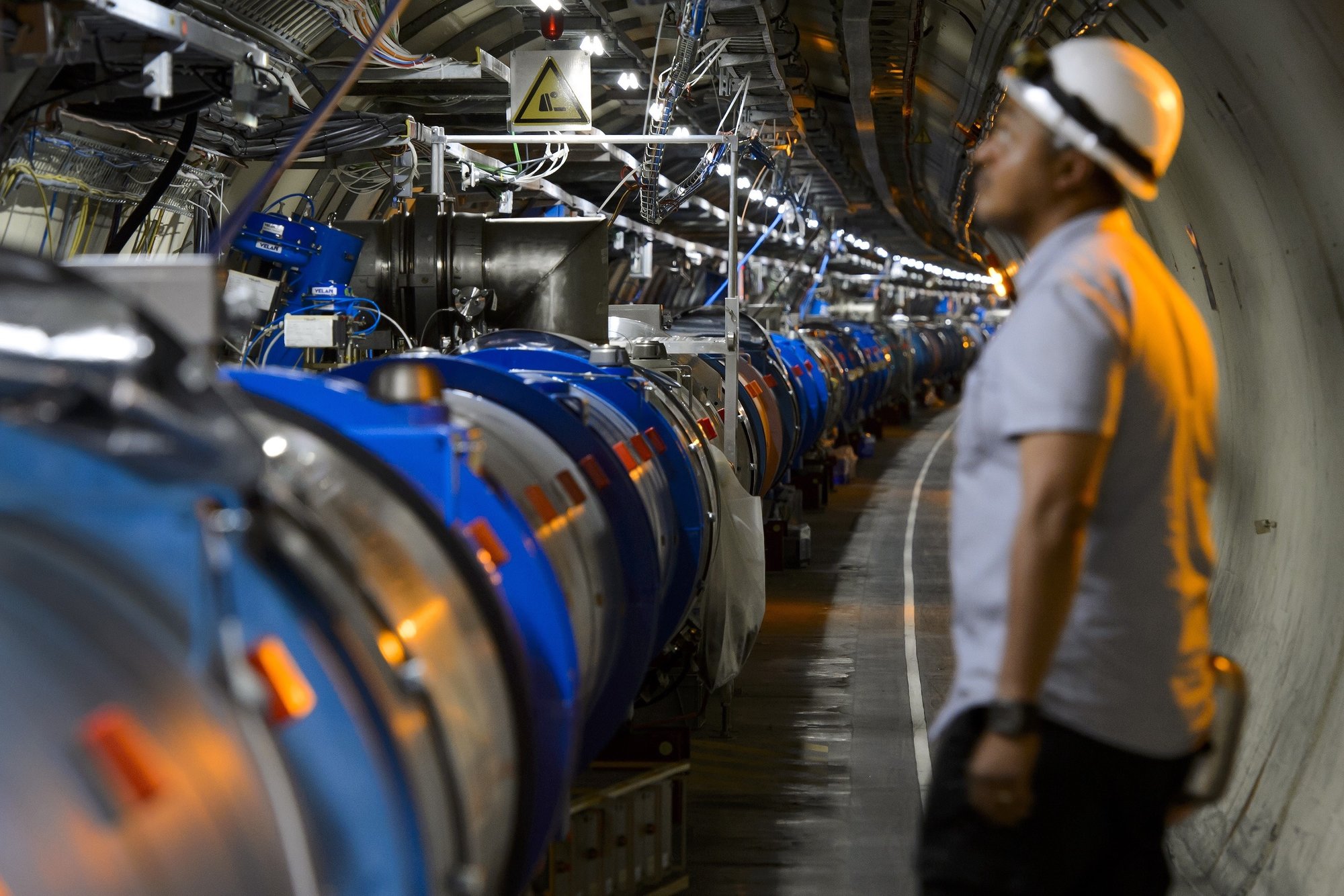
A scientist examines a section of the Large Hadron Collider’s beamline within a tunnel deep beneath the Swiss-French border during maintenance work on July 19, 2013.
Fabrice Coffrini/AFP/Getty Images
My own path has led me to the same crossroads. I left South America to study physics, earning my Ph.D. and completing postdoctoral training in the U.S., where I later became a professor. In 2011, as Fermilab’s Tevatron shut down and the nation began to pivot away from collider physics and toward neutrino research, I faced a choice: stay in the U.S. or move to Europe, the new center of the energy frontier. I chose Europe, drawn by the hope that collider-based particle physics would continue to prosper here. Many others made the same move, trusting that Europe still had the determination to push forward where others had stopped.
That hope rests on solid ground. CERN today is more than a physics laboratory—it is living proof that nations can build something together that none could build alone. Over the past decades, its global footprint has effectively doubled, expanding to encompass 80 countries and more than 12,000 scientists from institutions around the world, alongside educational programs that train researchers at every level. Yet what has grown alongside these numbers is something harder to quantify: a community united around shared questions, whose pursuit of fundamental knowledge has propelled technological innovation and international cooperation forward in ways no one anticipated.
The FCC would build on this legacy.
From the Higgs to the Next Frontier
The road to the FCC remains long, and Europe has been traversing it for years. Glimmers of that far-off goal emerged in 2013, when the CERN Council launched the first update of the European Strategy for Particle Physics (ESPP)—a process designed to set the direction of the field every five to seven years through broad consultation with particle physicists worldwide. The report was unambiguous: Europe needed to be in a position to propose an ambitious post-LHC accelerator project at CERN by the next update. At that time, however, the community was not yet ready to commit to a specific large-scale project. The consensus was to focus first on upgrading the LHC to increase its luminosity—the number of collisions per second—rather than immediately beginning to build a successor.
Thus, the High-Luminosity LHC (HL-LHC) came into being. Now under construction, it is designed to deliver several times more data than the LHC, whose run ended on June 14, 2026. The HL-LHC will take over around 2030 and run for roughly a decade.
A 2020 update to the ESPP marked a decisive shift, directly confronting the question of what comes after the LHC. It reaffirmed the HL-LHC as the top near-term priority but, for the longer term, pointed unambiguously toward a hadron collider capable of reaching 100 TeV. That energy lies far beyond what foreseeable magnet technology could achieve in the current LHC tunnel. The strategy, therefore, called for a new, larger tunnel, built to host the program in two stages: first, a precision electron-positron collider to probe the SM in extraordinary detail, then a hadron collider to extend the energy frontier. Each would pursue physics that the other could not.
Because these machines take decades to design and build, the decision must come soon if the next collider is to begin operations by the mid-2040s. Delaying much beyond that risks the continuity that has sustained collider physics for generations. Particle physics will not disappear—its scientific reach extends beyond colliders—but flagship projects anchor communities of scientists and engineers whose expertise is built over decades and passed from one project to the next. Without a clear path beyond the HL-LHC, that chain becomes harder to maintain.
In 2025, CERN completed a comprehensive feasibility study for the FCC, marking an important milestone in the implementation of the 2020 ESPP strategy. The study describes not just a new machine but a decades-long program of technological innovation—from the exquisite beam control needed to make precision measurements of the Higgs boson to the development of superconducting magnets powerful enough to reach 100 TeV. Some of it has yet to be invented—as is always the case at the frontier.
The FCC feasibility study was only one element of a much broader process of the 2026 update to the ESPP. The strategy process evaluated a wide range of proposals, including linear electron-positron colliders, muon colliders, electron-proton facilities, and reuse of the existing LHC tunnel. After nearly two years, the conclusion of this process was clear: the FCC would offer the strongest combination of scientific reach, technical readiness, and long-term strategic value. When the CERN Council met in Budapest in May, it endorsed the ESPP’s recommendations and set CERN on the path to preparing a proposal for governments to evaluate by 2028. The question is no longer what can be built. It is whether we are willing to build it.
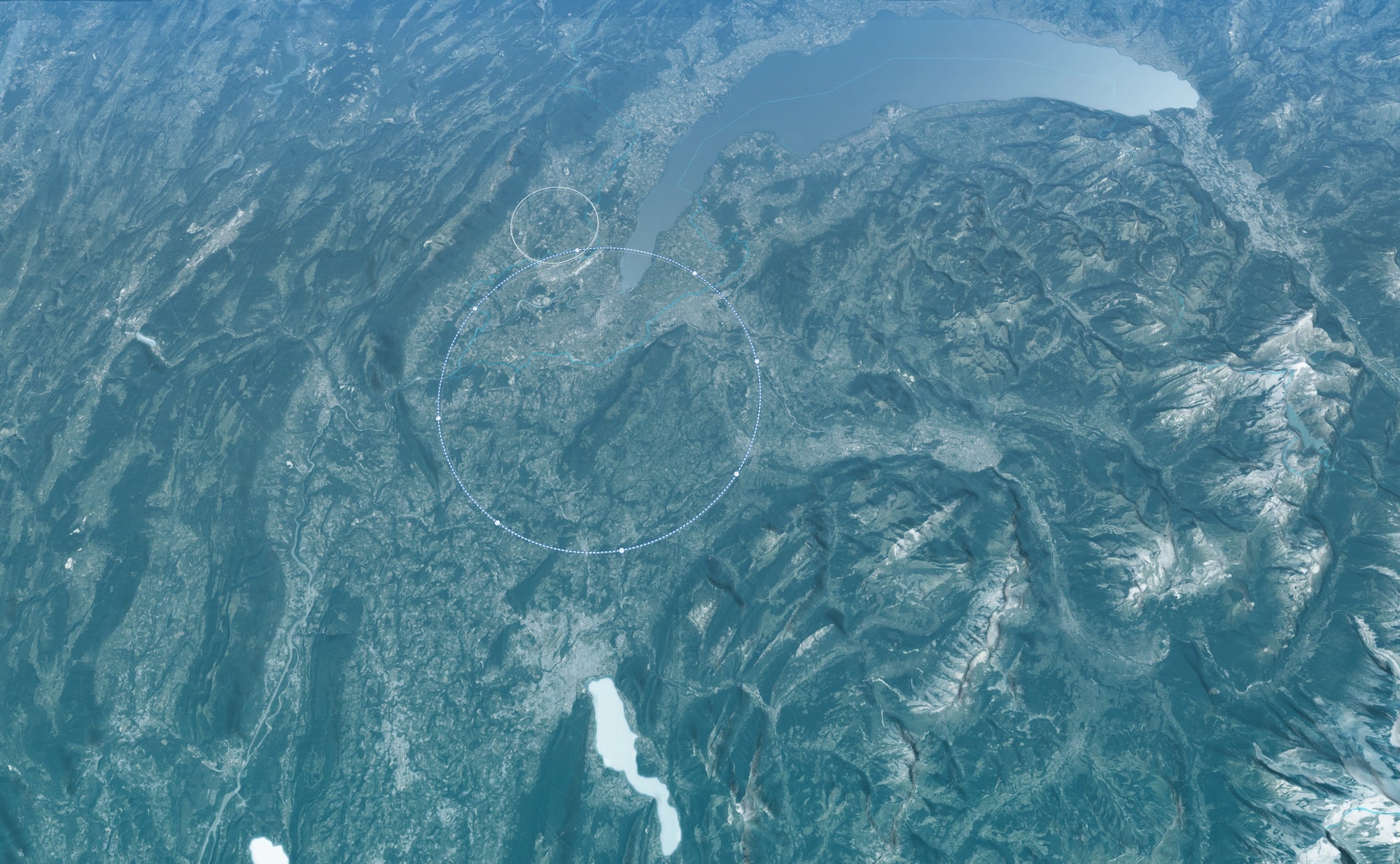
A map showing the preferred placement of CERN’s Future Circular Collider and its 91-kilometer-long subterranean ring along the Swiss-French border. The smaller ring of the Large Hadron Collider is shown for comparison.
CERN
Some encouraging signals suggest the will to close the funding gap may exist. In 2025, a consortium of private donors pledged $1 billion toward the FCC’s construction, marking the first time in CERN’s history that private philanthropy has committed to a flagship research project at this scale. And the European Commission has signaled the FCC’s strategic importance to the continent by including it among 11 proposed “moonshots” in its draft plans for major science projects between 2028 and 2034. And in 2024, CERN and the U.S. signed a joint statement of intent that expressed the U.S.’s intention to collaborate on the FCC, should CERN member states select it as the laboratory’s next major facility.
Europe’s Choice
Today, CERN stands proudly at the center of the global particle physics enterprise. The responsibility for taking the next step may rest with Europe, but the opportunity belongs to everyone who has ever wondered what the universe is made of and why it has the structure it does.
For decades, the incremental path was the right one: upgrading existing facilities, extending timelines, squeezing more reach from the tunnels we already had—each step returned real physics, and the HL-LHC will return more. But incrementalism is a strategy for when the field is still deciding what to build next, and that is no longer the situation. We know now what the next machine must do—push both frontiers in turn—and the field has identified a preferred path for doing so.
The questions that particle physics asks are thousands of years old. We have made them sharper and more sophisticated, but their nature is unchanged: What is the world made of, and why does it have the structure it has? To stop seeking answers is a choice to dim a light that has guided human inquiry for millennia.
My own career will likely end around the time the HL-LHC delivers its last collisions, a prospect I consider a privilege. I entered the field in the shadow of the SSC, already knowing I would never see that energy frontier. I will probably leave it the same way—without having seen the next one. But what matters is not whether I see it. What matters is that we keep pursuing all that is worth finding and that we build the tools to find it, even knowing that the finding may fall to those who come after. That belief—that the universe rewards curiosity—is what makes us not just physicists but conscious participants in one of humanity’s oldest endeavors: the long effort to understand the universe we find ourselves in.
This is an opinion and analysis article, and the views expressed by the author or authors are not necessarily those of Scientific American.