
Matter and antimatter are like mirror opposites: except for their electric charge, they are the same in every respect. Well, almost the same—very occasionally matter and antimatter behave differently from each other, and when they do, physicists get very excited. Now scientists at the world’s largest particle collider have observed a new class of antimatter particles breaking down at a different rate than their matter counterparts. The discovery is a significant step in physicists’ quest to solve one of the biggest mysteries in the universe: why there is something rather than nothing.
Everything around us is made of matter—the stars, planets, people and things that populate our cosmos are composed of atoms that contain only matter and no antimatter. But it didn’t have to be this way. Our best theories suggest that when the universe was born, it had equal amounts of matter and antimatter, and when the two made contact, they annihilated each other. For some reason, a small excess of matter survived and went on to create the physical world. Why? No one knows.
So physicists have been on the hunt for any sign of a difference between matter and antimatter known in the field as a violation of charge conjugation–parity symmetry, or CP violation, that could explain why some matter escaped destruction in the early universe.
On supporting science journalism
If you're enjoying this article, consider supporting our award-winning journalism by subscribing. By purchasing a subscription you are helping to ensure the future of impactful stories about the discoveries and ideas shaping our world today.
Physicists working on a machine called the LHCb experiment at the Large Hadron Collider (LHC) near Geneva announced in Nature that they have measured CP violation for the first time in baryons, the class of particles that includes the protons and neutrons inside atoms. Baryons are all built from triplets of even smaller particles called quarks. Previous experiments dating back to 1964 had revealed CP violation in meson particles, which, unlike baryons, are made of a quark-antiquark pair. In the new experiment, scientists observed that baryons made of three quark types—an “up” quark, a “down” quark and one of their more exotic cousins, called a “beauty” quark—decay more often than baryons made of the antimatter versions of those same three quarks.
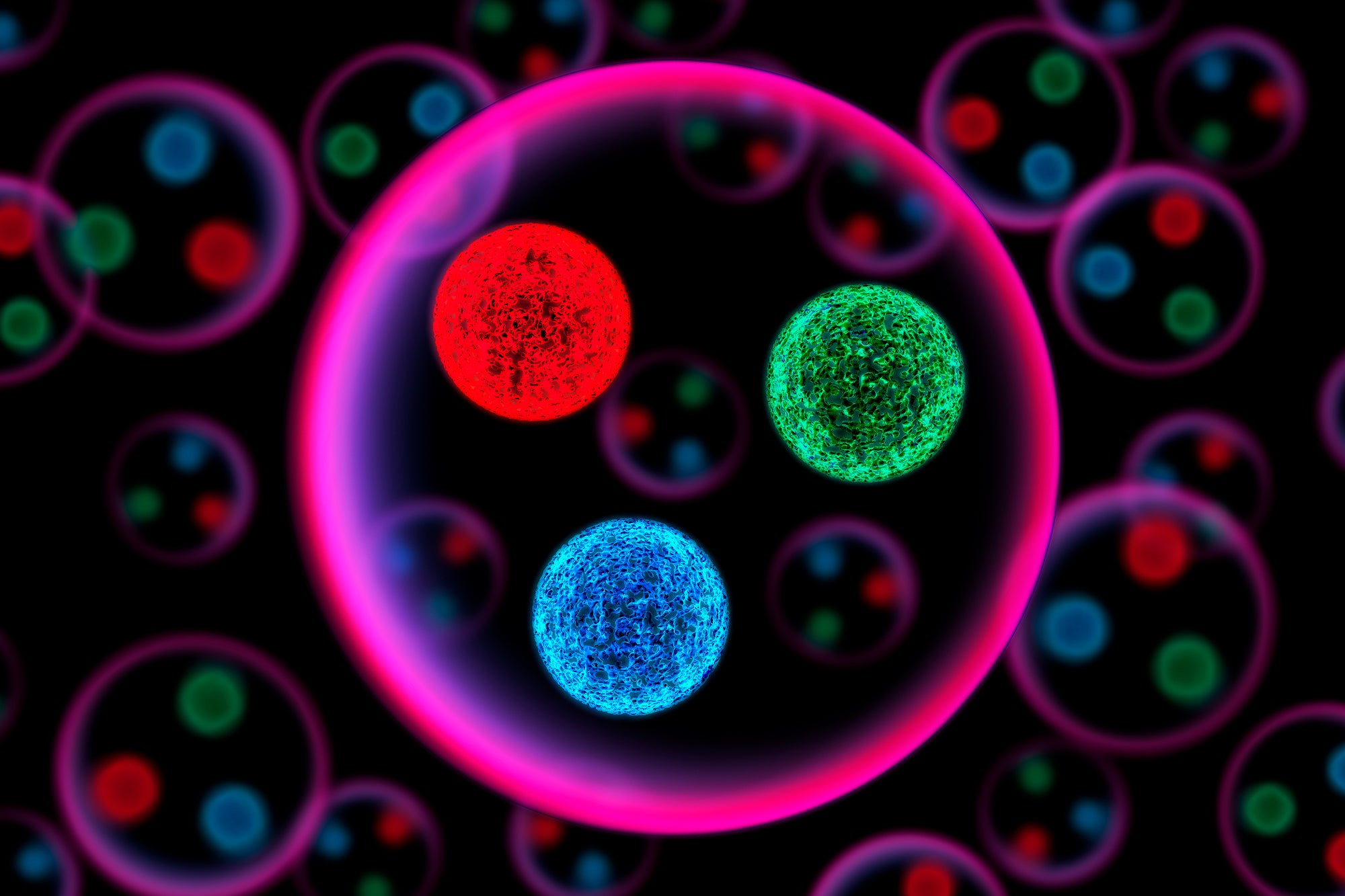
Baryon particle illustration.
Thomas Parsons/Science Source
“This is a milestone in the search for CP violation,” says Xueting Yang of Peking University, a member of the LHCb team that analyzed the data behind the measurement. “Because baryons are the building blocks of the everyday things around us, the first observation of CP violation in baryons opens a new window for us to search for hints of new physics.”
The LHC is the only machine in the world that can summon sufficient energies to make baryons containing beauty quarks. It does so by accelerating protons to nearly the speed of light, then smashing them together in about 200 million collisions every second. As the protons dissolve, the energy of the crash makes new particles spring into being.
“It is an amazing measurement,” says theoretical physicist Edward Witten of the Institute for Advanced Study in Princeton, N.J., who was not involved in the experiment. “Baryons containing b [beauty] quarks are relatively hard to produce, and CP violation is very delicate and hard to study.”
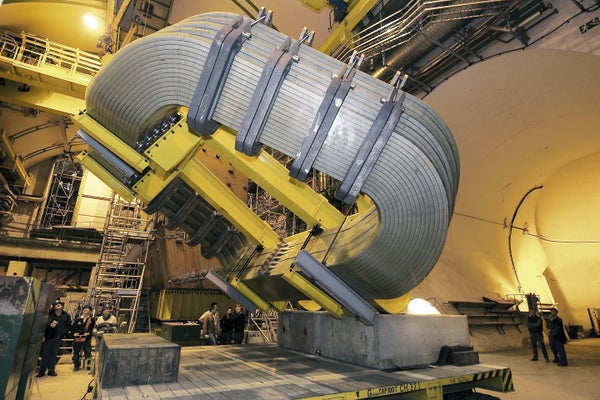
The 69-foot-long, 6,000-ton LHCb experiment can track all the particles created during the collisions and the many ways they can break down into smaller particles. “The detector is like a gigantic four-dimensional camera that is able to record the passage of all the particles through it,” says LHCb spokesperson and study co-author Vincenzo Vagnoni of the National Institute for Nuclear Physics in Florence. “With all this information, we can reconstruct precisely what happened in the initial collision and everything that came out and then decayed.”
The matter-antimatter difference scientists observed in this case is relatively small and fits within predictions of the Standard Model of particle physics, the reigning theory of the subatomic realm. This puny amount of CP violation alone cannot account for the profound asymmetry between matter and antimatter seen throughout space.
“The measurement itself is a great achievement, but the result, to me, is not surprising,” says Jessica Turner, a theoretical physicist at Durham University in England, who was not involved in the research. “The observed CP violation seems to be in line with what has been measured before in the quark sector, and we know that is not enough to produce the observed baryon asymmetry.”
To understand how matter got the upper hand in the early universe, physicists must find new ways that matter and antimatter diverge, most likely via particles that have yet to be seen. “There should be a new class of particles that were present in the early universe that exhibit a much larger amount of this behavior,” Vagnoni says. “We are trying to find little discrepancies between what we observe and what is predicted by the Standard Model. If we find a discrepancy, then we can pinpoint what is wrong.”
The researchers hope to discover more cracks in the Standard Model as the experiment keeps running. Eventually LHCb should collect about 30 times more data than used for this analysis; that will allow physicists to search for CP violation in particle decays that are even rarer than the one observed here. So stay tuned for an answer to why anything exists at all.