
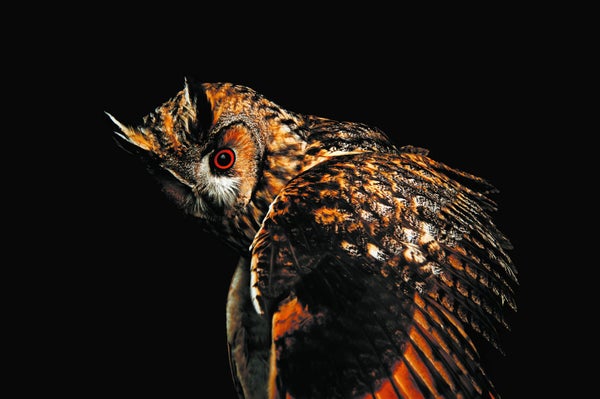
Close to Birds: An Intimate Look at Our Feathered Friends
by Roine Magnusson, Mats Ottosson and Åsa Ottosson.
Roost Books, 2019 ($39.95)
In 2019 a disturbing report ran in Science that global bird populations have plummeted by 29 percent—some three billion birds lost—since 1970. That birds provide vital services to hold most ecosystems together is undoubtable; their decline is either the canary of coming ecosystem disaster or evidence that it might be too late to save many of Earth's diverse biomes. Photographer Magnusson and nature writers Ottosson and Ottosson teamed up to create this striking collection of bird portraits paired with intimate, lesser-known details about the subjects. The arresting red ring around a common gull's eye and the tiny dinosaurlike talon of the thrush nightingale remind us of all that we stand to lose if more birds disappear.
Love Drugs: The Chemical Future of Relationships
by Brian D. Earp and Julian Savulescu.
Stanford University Press, 2020 ($25)
On supporting science journalism
If you're enjoying this article, consider supporting our award-winning journalism by subscribing. By purchasing a subscription you are helping to ensure the future of impactful stories about the discoveries and ideas shaping our world today.
What if you could take a pill to fix a broken relationship—or get over one? MDMA (aka Ecstasy) was used in psychotherapy in the early 1980s, but since the drug was made illegal in 1985, the practice has gone underground. And early studies of the “bonding” hormone oxytocin's effects on interpersonal relationships are promising, but the findings are too preliminary to recommend taking it for therapeutic use. Ethicists Earp and Savulescu make the case that existing pharmaceuticals already unintentionally influence relationships (some antidepressants can affect sexual desire and function, for example), so why not explore the use of “love drugs” on relationships explicitly? Such drugs should never be given to oppress or “convert” sexual minorities, the authors clarify—but when taken consensually to have a desired effect on a relationship, they could be just what the doctor ordered. —Tanya Lewis
The Contact Paradox: Challenging Our Assumptions in the Search for Extraterrestrial Intelligence
by Keith Cooper.
Bloomsbury, 2020 ($28)
For decades we have turned an eye upward to look for alien worlds, so far without success. Not to worry, says space journalist Cooper; we are just beginning the search for extraterrestrial intelligence (SETI). But where should we look for signs of aliens? And what happens if we actually find them? Cooper investigates different ways that a technological civilization might signal us, from radio waves to neutrino beams, and considers life-forms that could inhabit icy moons. He also ponders the gruesome history of conquistadors on Earth as an example of the kind of culture clash that could follow first contact. Although he criticizes many traditional notions of SETI scientists—such as assuming alien intelligence will look like our own—Cooper leaves us with an optimistic outlook: even if we don't find aliens, we will learn a lot about ourselves just by looking. —Kelso Harper
The Math of Life and Death: 7 Mathematical Principles That Shape Our Lives
by Kit Yates.
Scribner, 2020 ($26)
Many people assume that the closest math gets to their daily lives is when it's time to calculate the tip at a restaurant or the discount being offered at a store. But mathematician Yates shows that everyone—even the most math-phobic among us—interacts with math much more often and deeply than we realize. He untangles the interesting (and chilling) mathematics involved in the courtroom, for instance, explaining how an erroneous statistic presented during a trial wrongly put a woman behind bars for murder. He also dives into how exponential growth dooms pyramid schemes, how gynecologists mistakenly interpret the rate of false positives in breast cancer screenings, and how binary code errors cost soldiers' lives during the First Gulf War. Math “leads us,” Yates writes, “on the myriad paths of our lives.” —Clara Moskowitz
