
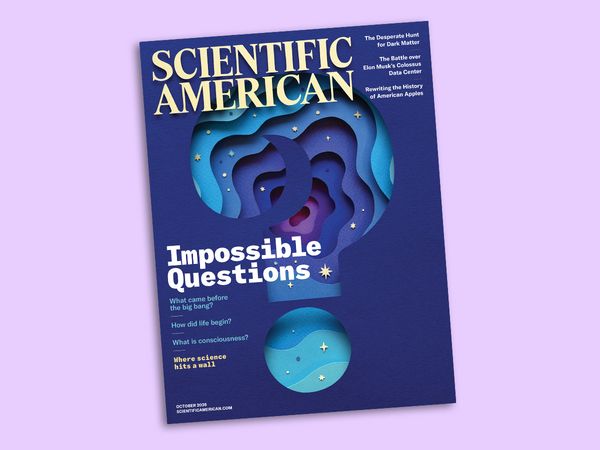
There are questions in science that have been studied for so long without anyone turning up answers that they seem to move into the realm of “unsolvable” or even “impossible.” This is the realm we explore in Scientific American’s October issue.
When the editors first discussed this idea, a real concern became immediately apparent: Will our readers be disappointed at the very premise of an unanswerable question? Why dive in if we can’t satisfy their, and our, curiosity with a solution?
But we soon realized that this open-endedness is part of the appeal. Often the most fascinating questions are the ones with no obvious or direct rewards. Unlike figuring out the odds that someone will have a green-eyed baby, the knotty, impossible questions sit in uncharted territory. Scientists must approach them from many different angles, some of which require new tools and experiments never before conducted. Such undirected searching is exactly what fuels serendipity.
On supporting science journalism
If you're enjoying this article, consider supporting our award-winning journalism by subscribing. By purchasing a subscription you are helping to ensure the future of impactful stories about the discoveries and ideas shaping our world today.
We probably wouldn’t have the blockbuster GLP-1 weight-loss drugs now reshaping medicine, for instance, if someone didn’t ask how Gila monsters cheat starvation—the lizards’ blood sugar never collapses even though they sometimes go months without eating. There was no obvious payoff to finding the answer and no pharmacology at the time that could explain the anomaly.
Alchemists searched for centuries for a way to turn common metals into precious ones such as gold—an impossible challenge when relying on a philosopher’s stone. Along the way, they established the field of chemistry and discovered the process of distillation that is ubiquitous today in water purification, pharmaceutical production and even fragrance making. (Physicists at the Large Hadron Collider at CERN near Geneva accidentally did turn lead into gold recently, at least for a fraction of a second.)
For more than 2,000 years mathematicians chased a problem called squaring the circle, in which they tried to craft a square with the same area as a circle, using only a compass and a straightedge. Proof that it was impossible came with the discovery of transcendental numbers, which led to theorems that opened entirely new branches of mathematics.
In the special report, philosopher Tim Bayne asks whether consciousness is real, a question that epitomizes the word “intractable”: the very act of studying it requires the faculty it’s trying to explain. But plenty of scientists have dedicated their lives to finding an answer. Along the way, that work has refined the tools we use to keep people safely unconscious under anesthesia. Other researchers turned to LSD and psilocybin to probe consciousness at its edges and found, serendipitously, that these substances carry real therapeutic effects for depression, post-traumatic stress disorder, and other resistant conditions.
The same pattern can be seen in the decades physicists have spent looking for the constituents of dark matter. The still unanswered question has led to ever more sensitive detector technology and a deeper understanding of what dark matter isn’t.
Although these “discoveries along the way” are meaningful, they might not even be the primary reason to pursue impossible questions. As physicist and Scientific American senior reporter Joseph Howlett writes of the search for dark matter, “Maybe the search for absolute truth—not just a reliably predictive picture of the world but a meaningful one—was always too ambitious.”
Perhaps the journey we take in our search for meaning is the goal. Humans are wired for curiosity and social connection. At the end of the day, impossible questions might satisfy both because they require us to ask why, how and what. All of science builds on the discoveries that came before and the people who made them. The intractable part could be the very thing that gives our lives meaning.