
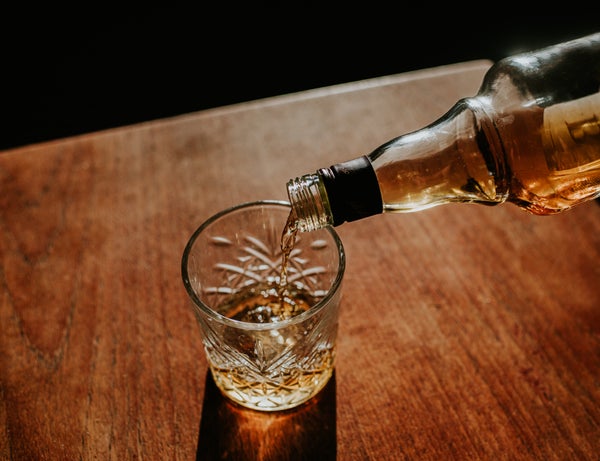
Just one alcoholic drink a day is enough to raise a person’s risk of premature death—that’s the major takeaway of a study published this week in the Journal of Studies on Alcohol and Drugs. The research was commissioned during the Biden administration to help inform the U.S. Dietary Guidelines; the Trump administration did not include the study’s findings in the latest update to the guidelines, released in January.
Instead the guidelines recommend that Americans drink less. That loose recommendation is not backed up by science, says Robert Vincent, a former federal public health analyst who helped get the new study off the ground. Instead, the study suggests that no amount of alcohol appears to be safe, he says.
Vincent was fired from the Substance Abuse and Mental Health Services Administration (SAMHSA) after nearly two decades in April 2025, in a wave of cuts to federal employees made by the Elon Musk–led Department of Government Efficiency. At SAMHSA, he served as associate administrator for prevention and treatment policy and staff chair for the Interagency Coordinating Committee on the Prevention of Underage Drinking (ICCPUD).
On supporting science journalism
If you're enjoying this article, consider supporting our award-winning journalism by subscribing. By purchasing a subscription you are helping to ensure the future of impactful stories about the discoveries and ideas shaping our world today.
In an editorial accompanying the new study, Vincent alleged that the Trump administration deliberately omitted the research from the new guidelines, favoring instead studies such as one from the National Academies of Sciences, Engineering, and Medicine (NASEM) in 2024 that found that moderate drinking was linked to reduced risk of all-cause mortality.
Department of Health and Human Services (HHS) press secretary Emily G. Hilliard said in a statement that “Any characterization that the study was sidelined is inaccurate. HHS and [the U.S. Department of Agriculture] reviewed the study alongside the broader body of available scientific evidence and followed the established process for developing the 2025–2030 Dietary Guidelines for Americans. Ultimately, the Dietary Guidelines were based on the best available scientific research. One thing is clear: the evidence on alcohol and health has been remarkably consistent over time.”
Scientific American spoke to Vincent about how the new study got started and why he thinks it came under pressure from outside forces.
[An edited transcript of the interview follows.]
How did the Alcohol Intake and Health Study get started?
Beginning in 2021, I was associate administrator for alcohol prevention and treatment policy. In that role, I also served as staff chair for ICCPUD. Over several years, we had repeated discussions about adult drinking habits and the rising harms associated with alcohol use, while colleagues across [the Centers for Disease Control and Prevention], the National Institute on Alcohol Abuse and Alcoholism, and other research agencies were producing and reviewing related evidence. Collectively, we felt it was important to take a closer look at the relationship between underage drinking and adult drinking patterns. At the same time, the [Biden] administration asked us to provide supporting research to inform the U.S. Dietary Guidelines. Out of those conversations, we commissioned the Alcohol Intake and Health Study.
Can you tell me some more about the study, approved in 2022, and what it was designed to do?
The ICCPUD staff representatives and I established two groups to guide the work: a federal technical review subcommittee and an independent scientific review panel made up of outside experts. The researchers who conducted the study came from that independent panel, and the work now being published is that independent scientific review.
In April 2022, the ICCPUD principals approved moving forward with the Alcohol Intake and Health Study. After that, the scientific review panel began developing the study, and we later published the methodology for public comment in the Federal Register. My role was to work closely with the technical review subcommittee, the federal review body. As the independent scientists developed their work, they presented it to us for discussion and scrutiny. We went back and forth on the approach, the strengths of the evidence and the scientific merits to ensure the final product reflected the strongest possible science.
As we approached the final report and began coordinating with the Dietary Guidelines group, pushback from the alcohol industry intensified. The draft report remains available on the [SAMHSA] website.
Did you face pressure to alter or end the study?
I had a few people I know in the industry—and some others kind of around it—say to me at one point, “You should just kill this thing.” And I remember thinking, “Why would we do that?”
And honestly, it wasn’t just the industry. That pressure was coming from inside the agency, too. There were people internally who thought we should shut it down. I had folks at HHS say to me pretty directly, “You need to kill this thing”—including some people on the prevention side.
When did the pushback really start ramping up? I know that in 2024 some members of Congress wrote an open letter criticizing the study. The criticisms included that the study wasn’t being conducted in accordance with federal law and that SAMSHA was “duplicating” or even “undermining” a separate congressionally mandated NASEM study on alcohol.
It wasn’t just one letter or a single congressional inquiry. There were several, followed by FOIA requests and, eventually, subpoenas. That was when the pressure became unmistakable. Around the same time, I began to feel myself being edged out—in terms of my role, my access and the extent to which I was allowed to stay involved.
ICCPUD is an interagency coordinating committee established under the STOP Act (Sober Truth on Preventing Underage Drinking Act) and chaired by the assistant secretary for mental health and substance abuse on behalf of the secretary of health and human Services—not a Federal Advisory Committee Act (FACA) body convened to issue outside advisory opinions. Its role is to help guide federal policy and program development on underage drinking, coordinate across agencies and provide science and information to support federal decision-making. In this case, we built a notably transparent process: a federal technical review subcommittee, an independent scientific review panel, a published methodology open to public comment and then a draft report opened for public comment as well. I think that level of visibility is part of what made the study such a target.
The scientific review panel submitted the report in early March 2025. After that, it was essentially ignored by the new administration.
What are the implications of sidelining the report and not including it in the latest dietary guidance?
It’s sad because we’re just not communicating good science or making sure people have the ability to make an informed choice. I’m not anti-alcohol. Science should be good science, and we should know what we’re talking about. If this was any other industry, we would just put the information out there.
Do you think the current administration was more skeptical of the study than previous administrations?
Honestly, when [Robert F. Kennedy, Jr.,] first came in, I was somewhat optimistic. I thought: “Okay, if the focus is really on making America healthy, maybe this work will be taken seriously.” That didn’t turn out to be the case.
So the new Dietary Guidelines released in January have scrapped the previous recommendations with quantitative limits on drinking in favor of just advising that people drink less. What do you think about the change?
The upside is that “less is better” is a simple, clear message—and as a sound bite, it works. But on its own, it’s not enough. It doesn’t tell people much about individual risk. If you have diabetes, a genetic predisposition [for diabetes], or an elevated cancer risk, that kind of blanket guidance doesn’t really help you make an informed decision. And it still stops short of saying plainly what the evidence increasingly shows: there isn’t really a safe level of drinking. Risk begins with the first drink.
For decades, the guidance rested on the familiar formula of two drinks a day for men and one for women. But that framework no longer reflects the best available science. I think MAHA, for all its rhetoric about health, has largely sidestepped alcohol—and I think industry pressure is a big reason why.
Do you think you and your colleagues were targeted by the Trump administration when you were let go in 2025?
I believe I was targeted, unequivocally, because I was making noise and pressing the question: What exactly was the problem with the study? It was scientifically solid. We had a top-tier team of scientists working on it.
How do you feel about the remaining expertise on alcohol in the administration?
I have very little confidence in anything coming out of this administration scientifically or their work on their alcohol policy.
What do you want people to take from this study now that it is published?
First, I hope ordinary people actually read it. For all the attention paid to dietary guidelines and public health recommendations, most Americans never see that material—and even fewer are likely to read a peer-reviewed journal. I hope physicians, scientific societies and professional groups take it seriously and help translate it for the public. But more than anything, I hope it prompts a harder look at the industry’s influence and renews the commitment to protecting scientific integrity.
Overall, I do think people are drinking less, and I think the multifaceted approach has helped. We’ve spent years communicating, consistently, that alcohol carries real harms. My worry is that without that steady drumbeat, we’ll start to lose ground.