
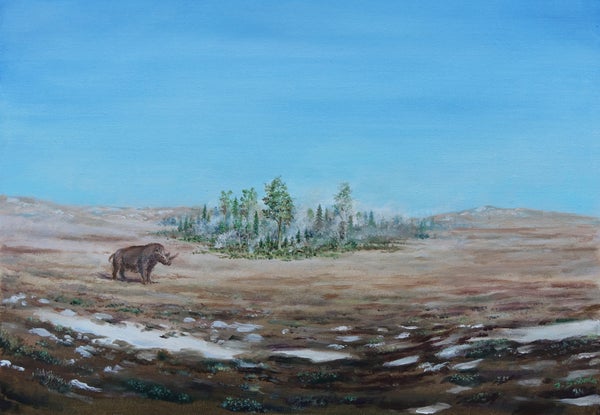
A “tree spa” created by hot springs in what is now the Czech Republic may have served as a refuge for plants—and possibly animals—during the last ice age, when much of Europe was covered by ice, new fossil evidence suggests.
Clues that this hot spring oasis existed include fossilized leaf fragments, wood and pollen from temperate, or “warmth-loving,” species, including oaks, lindens and ashes. Such trees were thought to have survived the final phase of the last ice age, called the last glacial maximum (LGM), only in the relatively warm Mediterranean Basin.
But radiocarbon dating shows that many of the newly discovered fossils from the Vienna Basin region of the Czech Republic date to between 26,000 and 19,000 years ago—the height of the LGM. The researchers also found signs of hydrothermal activity in the area at that time. This suggests that geothermal heat reached the tree roots in water from hot springs and likely kept those trees alive over thousands of years in an isolated pocket of warm forest that was hundreds of miles to the north of their Mediterranean cousins.
On supporting science journalism
If you're enjoying this article, consider supporting our award-winning journalism by subscribing. By purchasing a subscription you are helping to ensure the future of impactful stories about the discoveries and ideas shaping our world today.
Biologists have debated for decades about the existence of glacial refugia, or areas where the climate remained temperate, in northern Europe during the LGM. But “the precise locations of refugia and their impact on the present-day distribution and diversity of species is still under investigation,” wrote University of Oxford biologists Katherine Willis and Robert Whittaker in an article in Science in 2000.
The genetics of most warmth-loving trees in modern Europe don’t completely correspond to their Mediterranean strains, which suggests that such refugia must have existed where genetically different trees of those species survived. But this is the first time that one has been found.
“As far as we know, this is the first macrofossil-based evidence of temperate tree species dated to the LGM,” says Jan Hošek of the Czech Geological Survey, a geoarchaeologist and lead author of the paper that described the research, which was published on Friday in the journal Science Advances.
Today the Vienna Basin, where the fossils were found, boasts several freshwater springs with unheated water. But the researchers think that long ago the weight of thick glaciers on the nearby Alps may have triggered tectonic activity that released geothermally heated water from deep in our planet’s crust.
Supporting that idea, the fossilized tree remains were found within buried samples of the mineral geyserite, or “silica sinter”—a type of sediment that is typically found around hot springs and geysers—which results when silicon dioxide from rocks dissolves in warm water.
Within the mineral samples, the researcher also discovered distinctive varieties, or isotopes, of oxygen that depend on warm water to form. They indicate the hot springs were typically between 68 and 95 degrees Fahrenheit (between 20 and 35 degrees Celsius), Hošek says.
The resulting “hot spring oasis” may have covered an area of up to 20 square miles (50 square kilometers) where trees thrived during an ice age, he says. But it probably wasn’t large enough for any large animals or humans to have survived there. And there is no sign that they did, although such refugia must have been attractive places for animals throughout the last glacial maximum.
“Skeletal remains are unfortunately very rarely preserved in this type of sediment,” Hošek says. “Despite the fact that the area north of the Alps was very sparsely populated—or even not at all—during the LGM, we hope to find some evidence of such kind in future research.”
Botanist John Birks, a professor emeritus of paleoecology at the University of Bergen in Norway and University College London, who wasn’t involved in the new study, says it provides the first robust evidence for warmth-loving tree species surviving in central Europe during that time.
“This exciting publication is very important,” Birks says. “It should stimulate further searches for such refugia [and] encourage a revision of ideas about where European temperate trees grew in the LGM—a problem that has fascinated biogeographers for over 100 years.”