
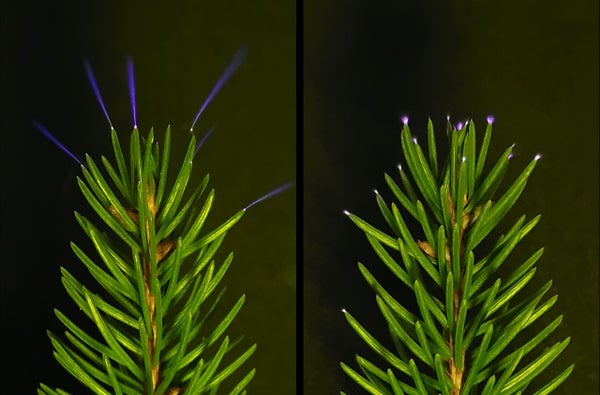
For almost a century, scientists have wondered how thunderstorms might affect forests below them, with many believing that a storm could ignite weak electrical discharges on plants that would catch at the tips of their leaves and along their branches. These phenomena, known as coronas, had never been seen in nature—until now.
A new study published earlier this month in Geophysical Research Letters reveals how the tips of tree leaves burn with ghostly ultraviolet sparks.
“These things actually happen; we’ve seen them; we know they exist now,” said Patrick McFarland, a meteorologist at Pennsylvania State University and lead author of the study, in a statement.
On supporting science journalism
If you're enjoying this article, consider supporting our award-winning journalism by subscribing. By purchasing a subscription you are helping to ensure the future of impactful stories about the discoveries and ideas shaping our world today.
Before this study, scientists had observed in the lab how such electrical discharges might form.
“In the laboratory, if you turn off all the lights, close the door and block the windows, you can just barely see the coronae. They look like a blue glow,” McFarland said.
Those observations suggested that the electrical charge of a thunderstorm overhead could induce an opposing charge on the ground below. Attracted to the thunderstorm’s charge, the opposing charge would travel to the highest points it could reach. In the case of forests, this would be the tree canopy. The tips of leaves would then discharge the electricity, producing blue sparks, or coronas.
To observe the coronas in the wild, McFarland and his team fitted a Toyota Sienna with a mobile weather station, complete with ultraviolet camera. Then they went storm hunting, taking videos as they went. Analyzing the video footage revealed the coronas glowing on the tips of tree leaves and even hopping from leaf to leaf.
If humans could see in ultraviolet, McFarland said, it would likely look to observers like the entire tree canopy was aglow. “It’d probably look like a pretty cool light show, as if thousands of UV-flashing fireflies descended on the treetops,” he said.