
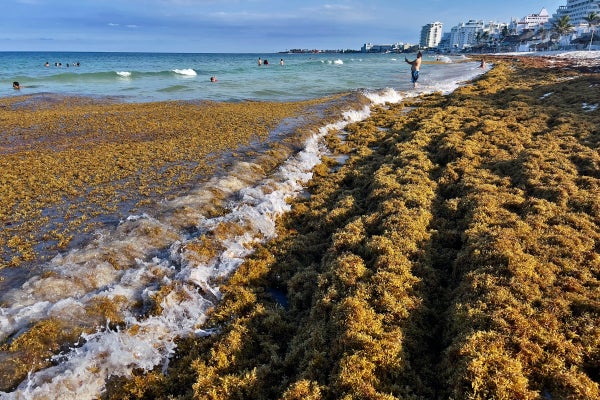
A “blob” of seaweed double the width of the U.S. that’s inching across the Caribbean and delivering loads of algae to Florida beaches is also carrying some unwelcome tourists: disease-causing bacteria. And the plastic debris we pour into the oceans may be making the situation worse.
The bacteria belong to a genus called Vibrio, which includes more than 100 species. About a dozen of these can harm humans, typically by infecting open wounds or causing food poisoning when consumed. In a new study published on May 3 in the journal Water Research, scientists analyzed the genomes of Vibrio found on samples of plastic debris and Sargassum, a brown seaweed, that were fished from the Caribbean and Sargasso seas in the North Atlantic Ocean. Their goal was to figure out if the rafting species could cause diseases in humans.
“It’s actually quite difficult to prove that something is a pathogen,” says Linda A. Amaral-Zettler, a marine microbiologist at the Royal Netherlands Institute for Sea Research and one of the lead authors of the paper. “But effectively, we’ve shown that the genome itself contains all of the ingredients, if you will, for a pathogen.”
On supporting science journalism
If you're enjoying this article, consider supporting our award-winning journalism by subscribing. By purchasing a subscription you are helping to ensure the future of impactful stories about the discoveries and ideas shaping our world today.
That’s an important new step, says marine biologist Valerie Michotey of Aix-Marseille University in France, who was not involved in the new research. “Previous studies have just demonstrated occurrence of the Vibrio, but they have not analyzed if they were pathogenic or not,” she says.
The most dangerous species of Vibrio are V. cholerae, which causes the diarrheal disease cholera, and V. vulnificus, often called “flesh-eating bacteria” because of the sometimes deadly damage it can do if it infects an open wound. Amaral-Zettler and her colleagues didn’t find either of these species in the samples they studied. Instead they found four other known species: V. alginolyticus, V. campbellii, V. fortis and V. parahaemolyticus.
Because bacteria can swap genes and have high genetic diversity, identifying a species isn’t as helpful in determining how dangerous a bacterium is to humans as studying what genes are present in its DNA. In all the samples they analyzed, the researchers found a gene for a protein that V. vulnificus uses to stick to human intestinal cells and genes that produce compounds that break open red blood cells. In many of the samples, they also found a gene that produces a toxin that weakens the connections between cells lining the intestines—all evidence that the bacteria could harm humans.
“I think it’s one of the first studies of its kind that’s been able to sort of put together genomes from that kind of environmental sample,” says Craig Baker-Austin, a microbiologist at the U.K.’s Center for Environment Fisheries and Aquaculture Science, who was not involved in the study.
The researchers also ran lab tests that showed that most of the Vibrio found in the samples stuck to plastic very well and could break open blood cells from sheep, a telltale sign of potential pathogenicity. “They combined genetic approaches and also biochemical approaches, so that strengthens the results,” Michotey says. She notes, however, that the researchers don’t know the rate at which pathogenic bacteria occur on the plastic debris or Sargassum, which will be an important step in understanding how big a health risk Vibrio bacteria represent.
Still, Amaral-Zettler says that the new research is conclusive enough to be “a bit of a wake-up call” about the complicated relationship among Vibrio, Sargassum and humans. Although Sargassum creates a natural ecosystem that helps sustain fish, sea turtles and other animals in the open ocean, within the past decade it has begun regularly forming massive blooms that wash up on beaches. Scientists say these blooms are partly fed by nutrient runoff, including from fertilizers, into the oceans. Humans are also responsible for the recent flood of plastic marine debris that gives Vibrio more footholds, as well as rising water temperatures that scientists have shown are creating an environment ripe for the bacteria to thrive.
Despite all this, because Vibrio are naturally marine bacteria, they may only accidentally be a threat to humans. “It isn’t that their whole evolutionary mission is to be pathogenic to humans; humans are sort of inadvertent intruders in the pathways of these organisms,” says microbiologist Rita R. Colwell of the University of Maryland, who wasn’t involved in the study. Still, Colwell says the new research adds to evidence that human exposure to Vibrio is increasing in ways that people need to respond to.
For beachgoers, the bacteria are a reason to stay away from the Sargassum that may pile up in the coming months. “In general, if you have open wounds, it’s not a good idea to be walking around on the beach,” Amaral-Zettler says.