
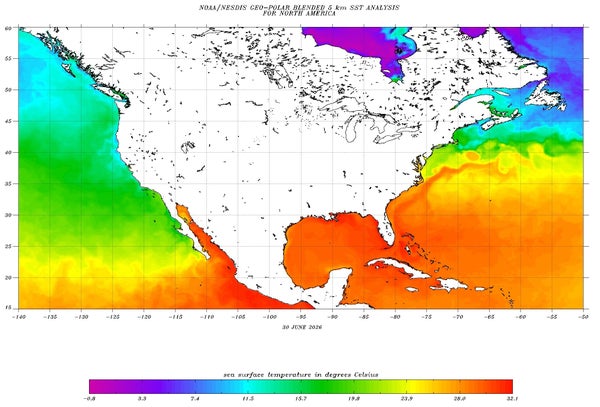
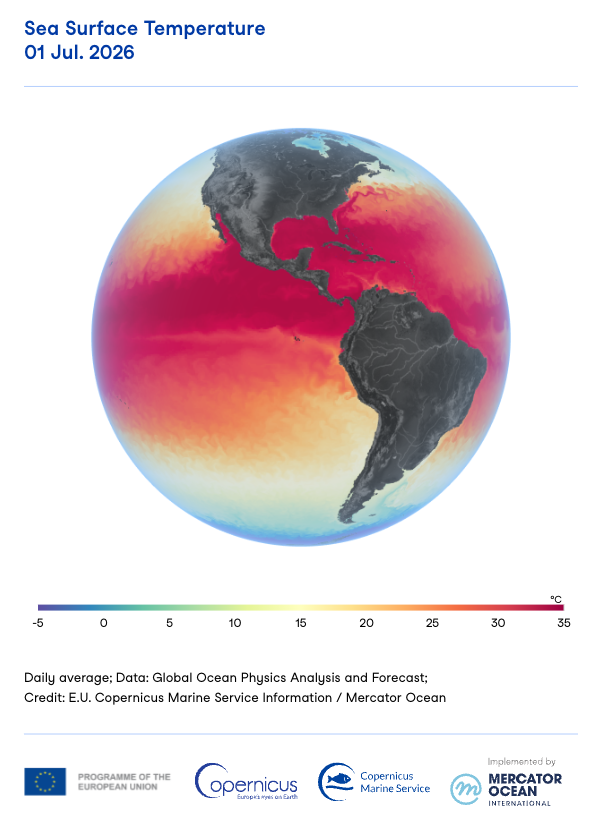
The world’s average ocean temperature shattered records in June, according to two European Union Earth monitoring systems, the Copernicus Climate Change Service and the Copernicus Marine Service.
On June 21 ocean temperatures hit approximately 21 degrees Celsius (about 70 degrees Fahrenheit), setting an “unprecedented” new record for that time of year, the two services announced in a joint statement. The previous records were set in 2023 and 2024. Warmer oceans threaten marine life and could lead to greater sea-level rise.
Sea surface temperatures
On supporting science journalism
If you're enjoying this article, consider supporting our award-winning journalism by subscribing. By purchasing a subscription you are helping to ensure the future of impactful stories about the discoveries and ideas shaping our world today.
The high is notable because the planet is entering into an El Niño event—a cyclic shift in ocean and wind patterns defined by unusually warm ocean temperatures. Last month, after weeks of projections, the U.S. National Oceanic and Atmospheric Administration (NOAA) determined that El Niño is officially here and that conditions are likely to “strengthen” between November 2026 and January 2027. As Scientific American reported at the time, this could put this year’s event among the largest ever recorded, and it could raise ocean temperatures even further.
This means experts expect more broken heat records—and soon. “With ocean temperatures at these levels and El Niño on the horizon, we are likely to see more temperature records fall in the coming months,” said Carlo Buontempo, director of the Copernicus Climate Change Service, in the same statement.
“Current conditions could indicate the beginning of a new phase, leading, once more, to uncharted territory,” he said.