
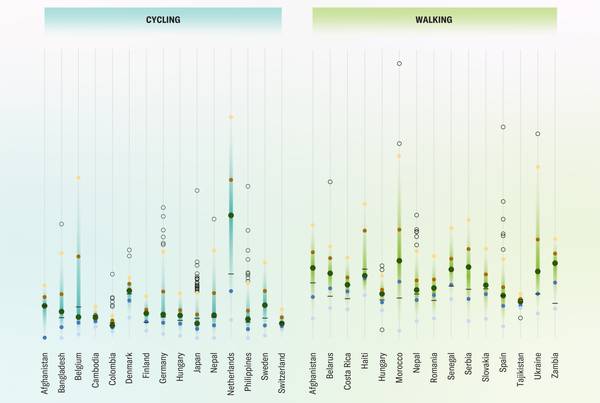
In some cities, cyclists and pedestrians seem as rare as unicorns. And in others, such as Wageningen in the Netherlands—the world’s top biking city, according to a recent study—they’re as numerous as bees in a hive.
The authors of the study, which was published in the Proceedings of the National Academy of Sciences USA, used data from Google to determine walking and cycling rates in 11,587 cities in 121 countries, a far larger sample size than in any previous research. Perhaps unsurprisingly, they found that cities with lots of cyclists and pedestrians tend to be dense and filled with bike lanes.
The authors also found that higher gas prices meaningfully increase national walking and cycling rates. “You need carrots and sticks,” says John Pucher, an emeritus urban transportation researcher at Rutgers University, who was not involved in the study. “You need incentives for cycling and walking [combined with] disincentives to car use.”
On supporting science journalism
If you're enjoying this article, consider supporting our award-winning journalism by subscribing. By purchasing a subscription you are helping to ensure the future of impactful stories about the discoveries and ideas shaping our world today.
Cities’ steep terrain can discourage cycling. But the study showed that climate—even frosty winters, scorching summers and ample precipitation—is not a major barrier to high walking and biking rates. In fact, some of the world’s most bike-friendly cities are windy and rainy, Pucher says.

Eve Lu; Source: “Global Health and Climate Benefits from Walking and Cycling Infrastructure,” by Adam Millard Ball et al., in Proceedings of the National Academy of Sciences USA, Vol. 122; June 9, 2025 (data)
Walking can be a necessity rather than a choice. Carole Turley Voulgaris, an urban planning researcher at Harvard University, who was not involved in the study, suspects that poverty drives high walking rates in countries such as Haiti, and she notes that car ownership provides an economic boost to low-income households.
Still, a car-free lifestyle has broader perks. The study’s authors estimate that if every city had a bike network like Copenhagen’s, private vehicle emissions would fall 6 percent, and annual health benefits would total $435 billion, partly because of reduced cardiovascular disease.
Besides Copenhagen, other “success stories,” according to the study’s authors, include Osaka, Japan, where slow-moving cars coexist with walkers and bikers on narrow streets, and Nairobi, Kenya, which commits at least 20 percent of its transportation budget to nonmotorized travel.
In the U.S., as of the past decade only about 1 percent of trips were taken by bicycle, in contrast to 28 percent in the Netherlands. “It’s not that Dutch people are genetically predisposed to cycling; it’s that most Dutch cities have really good infrastructure for cycling,” says study lead author Adam Millard-Ball, an urban planner at the University of California, Los Angeles. “If it were quicker and safe to walk or bike to their kids’ school or to the store or to work, then Americans would do that just as much as anyone else.”