
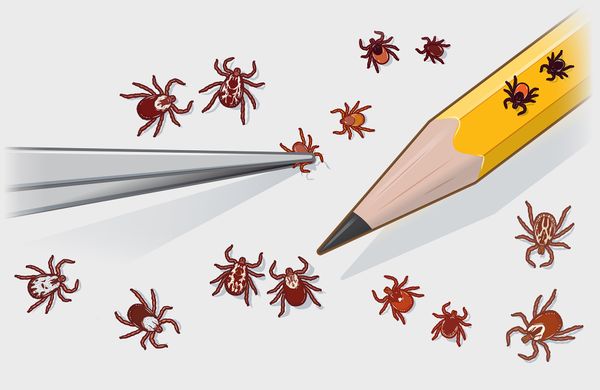
Tick season is in full swing, and unfortunately for us humans, these parasites are having a banner year. Across the U.S., weekly rates of emergency room visits for tick bites have been trending higher than in all years since 2019, according to the Centers for Disease Control and Prevention’s tick bite tracker. In the Midwest, the rates have consistently been at their highest since 2017, when the tracker was launched. That all adds up to a lot of bites. “Every year an estimated 31 million people in the United States are bitten by a tick,” says CDC epidemiologist Alison Hinckley. These bites can cause serious, sometimes deadly diseases, including Lyme disease, Rocky Mountain spotted fever, and, increasingly, alpha-gal syndrome (also known as red meat allergy) and Powassan disease.
I recently had a tick bite and wasn’t sure what to do. I live in an area with a high incidence of Lyme disease, so that was on my mind. Should I go to a doctor to have the tick extracted or remove the offending creature myself? Monitor the bite and watch for a bull’s-eye rash and other symptoms of Lyme disease or take a preventative dose of antibiotics? Some cursory Googling of tick bites suggested that I should remove the tick, flush it down the toilet and watch for any symptoms in the following days and weeks. But a closer look at the literature hinted that I might be better off taking a different approach, given my circumstances. So I went down the rabbit hole. Here’s what I learned about what to do—and not to do—when you discover a tick on your body.
Remove the tick as soon as you discover it. Don’t wait to go to a health care provider, the CDC advises. The longer a tick is attached, the more time it has to transmit bacteria and other pathogens that cause disease. Infected ticks generally need to be attached for more than 24 hours to transmit Lyme disease, but they may transmit Powassan virus in as little as 15 minutes. The sooner you get the tick off your body, the better.
On supporting science journalism
If you're enjoying this article, consider supporting our award-winning journalism by subscribing. By purchasing a subscription you are helping to ensure the future of impactful stories about the discoveries and ideas shaping our world today.
When I was a kid, the received wisdom was to get rid of ticks by burning them off with a match or cigarette (I remember my mom trying to do this with a tick she found on my head while washing my hair in the kitchen sink) or smothering them with petroleum jelly, among other tactics. Don’t do this. Interventions such as these could cause the tick to release infected fluids into the host, according to the Johns Hopkins Medicine Lyme Disease Research Center. All you need is a pair of fine-tipped tweezers. (Incidentally—and this is friendly advice, not official guidance—if you’re a little squeamish, take a moment to calm yourself first. The tick is gross. You might see its legs move when you lift it away from the skin. You can scream/shudder/sob later. Right now your job is to stay cool and remove the tick safely. You’ve got this.)
The tick is only attached to the host by its mouthparts, so grasp the tick with the tweezers at or near its head, as close to the skin as possible, and using steady, even pressure, pull it straight up and out, away from the skin. Do not squeeze its body, which could force infected fluids into the skin. Don’t crush the tick, which could complicate species identification. Put it in a clear, sealable plastic bag for identification and possible lab analysis. Clean the bite area and your hands with soap and warm water or alcohol. If you see that the tick’s head or mouthparts broke off and are stuck in the skin, don’t worry—the tick can’t transmit disease without its body. Your body will eventually expel the stuck parts as the wound heals.
Assess your risk for disease. Different species of ticks live in different parts of the country, and each species carries its own set of pathogens. “Knowing the type of tick, the likely tick infection rate in the region, and how long the tick was attached and feeding are all critical details for making tick bite management decisions,” according to the University of Rhode Island’s TickEncounter resource center.
In New England, where I live, four tick species are well established: the brown dog tick, American dog tick, black-legged tick (also known as the deer tick) and the lone star tick; Gulf Coast ticks occur in smaller numbers in the southern part of the region. My tick was a few millimeters long and teardrop-shaped, with a brick-red abdomen surrounding the black shield on its back—hallmarks of an adult female deer tick.
Not all ticks are as easy to identify as mine. Not only do tick species differ in size, colors and markings, but individuals of the same species can look different depending on what their life stage and sex are and how engorged they are from a blood meal (ugh). Some tick species are so similar that identification is best left to a pro. If you need help identifying your tick, your doctor may be able to assist you. And TickEncounter has a free tick identification program that allows users to submit a photograph of their tick and get an expert ID, usually within 24 hours. You can also contact your state or local health department for information about tick infection rates and disease case rates in your area.
The most common tick-borne disease in the U.S. is Lyme disease. The CDC estimates that 476,000 people a year are treated for Lyme. In North America, it is transmitted exclusively by the black-legged tick and the Western black-legged tick. In parts of the eastern U.S., the domain of the black-legged tick, more than half of these parasites carry the Borrelia bacteria that cause Lyme disease. Western black-legged ticks, which are found mostly on the Pacific coast, also carry Lyme bacteria, as well as several other pathogens, but typically less than 5 percent of them are infected, according to TickEncounter.
If you were bitten by a black-legged tick in an area where Lyme is common and your tick was attached for 36 hours or more, your doctor may recommend a single prophylactic dose of the antibiotic doxycycline to kill bacteria before they multiply. This preventative dose is most effective when given within 72 hours of tick removal, while the bacteria are incubating. Doxycycline is the same drug that is used to treat Lyme disease, but treatment requires a much longer course of the antibiotic than prevention—10 to 28 days or more.
Because my tick bite met all the criteria for high risk for transmitting Lyme, and because I was within the 72-hour window, my doctor and I decided to go ahead with the preventative dose of doxycycline.
Consider testing your tick. My doctor also advised me to send my tick to a lab for analysis—“for peace of mind,” she said. If it tested negative for Borrelia, then I could put Lyme out of my head. If it was positive, then I could feel smug about taking the preventative—but I would need to keep an eye out for Lyme symptoms in the coming weeks in the unlikely event that the doxycycline didn’t get the job done. I’d also get information about other pathogens that my tick might have passed along to me, such as the microscopic Babesia parasites that cause the blood disease babesiosis, which can co-occur with Lyme disease.
My home state has a tick testing program that evaluates ticks submitted by residents for free. Its laboratory accepts all ticks for identification, but it only tests the kind that most often causes problems here: black-legged ticks that can transmit Lyme disease, anaplasmosis, babesiosis, hard tick relapsing fever and Powassan virus disease. All I had to do was pack up my tick in its sealed plastic bag and some bubble wrap to prevent crushing, along with a form containing details about my tick bite, and drop it in the mail. (When I handed my envelope to the worker at the post office, she saw the address and groaned, “Oh no, another one.”)
Six days later I received an e-mail with the results. They confirmed that my tick, B23327, was a female black-legged tick and noted that she was “slightly engorged,” meaning she been attached to me long enough to feed on my blood and pass along pathogens. B23327 tested positive for the bacterium that causes Lyme disease but negative for other disease-causing microbes. This was a relief because ticks can transmit multiple diseases at once. I’d need to remain vigilant about Lyme symptoms in the coming weeks, but beyond that, I could rest easy.
If you don’t live in a state with free tick testing, there are labs that will test your tick for a fee. The Tick Research Lab of Pennsylvania, for example, has free testing for Pennsylvania residents and charges a fee for nonresidents. That said, not everyone recommends tick testing. The CDC discourages it, in part because the results can be misleading—a positive result doesn’t necessarily mean that the tick passed the pathogen along to you, and a negative result does not preclude the possibility that you’ve been unknowingly infected by a different tick. Either way, if you feel sick, don’t wait for tick testing results before going to the doctor.
Watch for symptoms. Lyme is the only tick-borne disease for which preventative intervention is recommended. So unless someone is at high risk for Lyme, the standard advice following a tick bite is to wait and watch for fever, rash or flulike illness over the next 30 days and see a doctor right away if any symptoms appear. Many tick-borne diseases have similar symptoms, particularly in the early stages of infection. Blood tests can differentiate but may take a while. Knowing which species of tick bit you and where you might have picked it up can help your doctor make a timely diagnosis.
Not all tick-borne illnesses can be cured. The rare but increasingly prevalent Powassan virus, spread mainly by the black-legged tick, can reach the brain and cause encephalitis. Treatment is aimed at managing symptoms. Alpha-gal syndrome, which is most commonly caused by the bite of a lone star tick, renders people allergic to mammal products, requiring that they avoid red meat and sometimes dairy and nonfood products containing the alpha-gal molecule.
Of course, the best way to prevent tick-borne illness is to avoid tick bites in the first place. After my experience with B23327, I’ll be redoubling my efforts to keep these bloodsuckers at bay.
TICK IDENTIFICATION
Ticks are tiny parasitic arachnids that feed on the blood of other animals. Each tick species carries its own set of pathogens that can cause serious human diseases. Not every tick is infected, and not every tick bite results in disease. But knowing what kind of tick bit you can help you and your doctor figure out what next steps to take to manage your risk.


Diogo Guerra; Sources: TickEncounter, University of Rhode Island (primary reference); Thomas Mather (expert reviewer)
WHERE TICKS LIVE
These maps show the approximate distributions of the tick species that transmit disease to humans in the U.S. Just because a tick species occurs in a given area does not necessarily mean it transmits disease in that area, however—the percentage of ticks infected with a given pathogen can vary considerably depending on location. Contact your state or local health departments for information about infection rates and disease case rates in your area.


Jen Christiansen; Sources: Centers for Disease Control and Prevention; Pacific Southwest Regional Center of Excellence in Vector-Borne Diseases (references)