
While the COVID-19 pandemic continues to rage around the world, another disease could be on its way out. Only 14 cases of infection with Guinea worm—a parasite that causes painful skin lesions—were reported in humans in 2021.
This is the lowest tally ever for an infection that, as recently as the 1980s, was found in more than 20 countries and infected 3.5 million people a year (see ‘On the way out’)—however, a remaining reservoir for the parasite in animals means eradication could be a while off, if indeed it is possible, say some scientists.
“It’s pretty amazing,” says Adam Weiss, director of the Guinea Worm Eradication Program of the Carter Center, which is headquartered in Atlanta, Georgia. The centre announced the numbers in late January. “Fourteen people on a planet of almost eight billion. It’s mind-bending to think about.”
On supporting science journalism
If you're enjoying this article, consider supporting our award-winning journalism by subscribing. By purchasing a subscription you are helping to ensure the future of impactful stories about the discoveries and ideas shaping our world today.
The reduction—nearly a 50% drop compared with the 27 cases reported in 2020—is the result of a near 40-year effort by international organizations and national governments to rid the world of Guinea worm, says Weiss. If it succeeds, the condition will join smallpox and rinderpest (a virus that mainly infected cattle and buffalo) as the only diseases to have been purposefully eradicated in human history.
This progress is “remarkable”, says Julie Swann, a disease modeller at North Carolina State University in Raleigh—especially given that there is no recognized treatment or vaccine for the parasite. Instead, eradication campaigns have focused on preventing transmission, she says.

Credit: Nature doi: https://doi.org/10.1038/d41586-022-00385-z; Source: The Carter Center
Track and eliminate
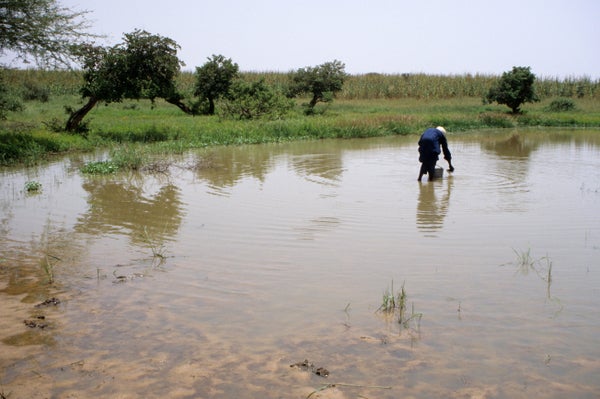
People and some animals, including cats, dogs and baboons, become infected with Guinea worm by drinking water that is contaminated with its larvae. After spending a year growing inside the host, the parasite—which can be up to one metre long—pushes through the skin of its host and waits to come into contact with water to release its larvae. The worm’s escape is painful and can last for up to six weeks, sometimes preventing people from working or even walking.
But the recognizable nature of Guinea worm disease also makes the parasite easy to detect. In Chad, where 7 of the 14 cases were reported last year, field agents create a network to track contaminated water sources, says Philippe Tchindebet Ouakou, the coordinator of the nation’s Guinea Worm Eradication Program, who is based in N’Djamena. They then prevent people from drinking the contaminated water and use pesticides to disinfect it.
Similar approaches have been used in countries such as South Sudan, Mali and Ethiopia, where the remaining 7 detected cases in 2021 occurred. These methods are what have kept case numbers low, says Ouakou, and could be used to tackle other endemic diseases.
But Swann isn’t entirely convinced that eradication is possible: she says that it’s hard to control diseases that have animal reservoirs, pointing out that there were 790 reported cases of Guinea worm infection in dogs in Chad alone last year.
But animal cases were also down by 45% in 2021 and Weiss remains optimistic that eradication is within reach. He says that eradication programmes are tackling animal reservoirs by tethering dogs to curb the spread of the parasite. Weiss adds that baboons are probably contracting Guinea worm from water contaminated by dogs, so controlling the parasite in dogs could help to rein in its spread in wildlife.
“I absolutely believe Guinea worm is eradicable,” he says. “It will take more work, but if we couldn’t do it, I’d be the first one to say it.”
The International Task Force for Disease Eradication currently has eight diseases identified as potentially eradicable. In addition to Guinea worm, these are poliomyelitis, mumps, rubella, lymphatic filariasis, cysticercosis, measles, and yaws.
This article is reproduced with permission and was first published on February 11 2022.