
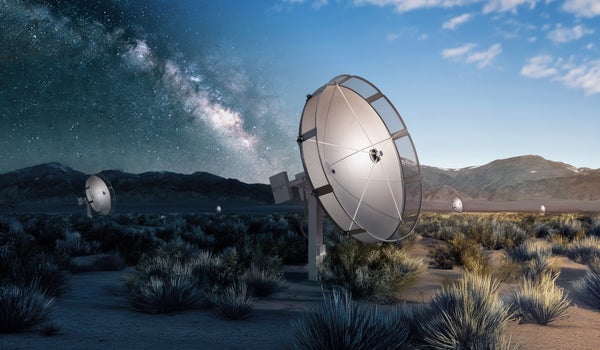
In a dark Nevada valley, a new eye is opening on the cosmos. Before the decade is out, the Deep Synoptic Array (DSA)—1,650 20-foot diameter dish-shaped antennas spread over just more than 120 square miles of desert—should begin soaking up radio waves from across the sky. The DSA will combine unprecedented sensitivity and power to try answering some of astronomers’ biggest questions about how galaxies form and grow.
The DSA just reached its final design milestone and will soon begin construction, with completion targeted for 2029. The project is led by the California Institute of Technology and bankrolled by Schmidt Sciences, a splashy new philanthropic venture poised to shake the pillars of U.S astrophysics, where advances are often more sedate—and government funding is the norm.
“The DSA is going to have, by far, the best combination of both sensitivity—seeing far—and sky coverage—seeing wide,” says Maura McLaughlin, an astronomer at West Virginia University, who is part of the telescope’s Science Advisory Committee. “It's a very different way of doing radio astronomy.”
On supporting science journalism
If you're enjoying this article, consider supporting our award-winning journalism by subscribing. By purchasing a subscription you are helping to ensure the future of impactful stories about the discoveries and ideas shaping our world today.
That difference comes from how the DSA will combine signals from its many sensitivity-boosting dishes. Radio arrays typically must save the raw feeds from each antenna for subsequent processing, requiring enormous computational and data storage resources. Data from the DSA’s combined 1,650 dishes, for instance, would churn out as much data as all U.S. Internet traffic. The project will avoid that deluge by instead combining and processing the signals in real time, automatically tossing out much of the raw data to rapidly produce crisp images.
“It’s beautifully designed, and it’s pioneering this new way to build telescopes,” says astronomer Dan Werthimer, who is not directly involved with the DSA. “It’s the future of radio astronomy.”
This “radio camera” approach should allow the DSA to survey the sky 100 times faster than any other radio observatory and is built on a mix of state-of-the-art and mundane innovations. In addition to the most powerful graphics processing units (GPUs) on the planet—NVIDIA’s next-generation Vera Rubin GPUs—the DSA will rely on thousands of modified household cake pans, purchased on the cheap from the bakeware-manufacturing company Fat Daddio.
“Why go and pay for some custom design when there’s a company that’s figured out how to make these things at very low cost?” says Gregg Hallinan, an astronomer at Caltech and one of the DSA’s principal investigators, who adds how “amazing” a scientific collaborator Fat Daddio has been. “They’re excited to be involved.”
Several astrophysical mysteries sit in the radio band of wavelengths. For decades, observatories have recorded brief-but-bright flashes of radio waves—fast radio bursts, or FRBs—whose origin on the sky astronomers have managed to pinpoint in only a handful of cases. The DSA will observe and hopefully localize tens of thousands of FRBs. Hopefully, this will help determine whether they’re sparked by an eruption from a single neutron star, or when two of these tiny but massive bodies collide.
The DSA will also carefully track rapidly spinning neutron stars called pulsars across the whole sky. Pulsars beam light outward as they spin, hitting us at regular intervals like a cosmic lighthouse. In 2023 a collaboration of radio astronomers reported tiny deviations in the timing of these flashes from dozens of pulsars in the Milky Way. They think the effect might be due to giant gravitational waves—ripples in spacetime between the astral lighthouses and us. The DSA will help decide whether the signal is real, and what exotic cataclysm is causing it. This could be orbiting pairs of supermassive black holes, or even cosmic strings or echoes from our universe’s early period of rapid inflation.
Beyond these big questions, the DSA will also trace the step-by-step formation of stars in young galaxies, and observe energetic outbursts from gluttonous black holes. Most excitingly for astronomy as a whole, it will also synergize with other observatories to rapidly hunt down radio counterparts for any conspicuous things going “bump” in the cosmic night. It might even find “technosignatures” of advanced alien civilizations—presuming they, too, are blasting radio waves out from their own planetary systems, just as we are with our homegrown technology.
“DSA will really open up the sky in a ridiculous way,” says Katie Jameson, the observatory’s project manager.
“The most transformative observatories are not defined by a single science goal,” says Arpita Roy, director of Schmidt Sciences’ Astrophysics and Space Center. “They create entirely new ways of seeing the universe.”