
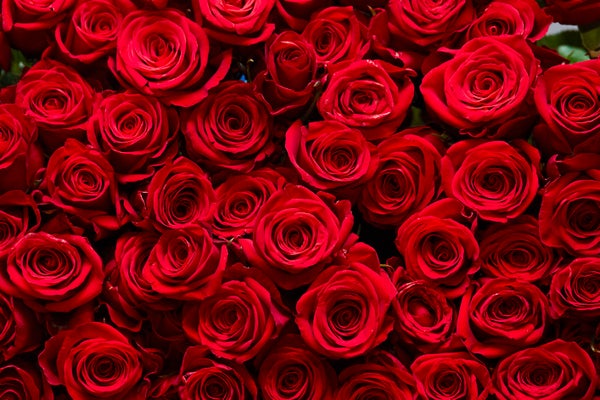
Roses are the “queen of flowers,” and they’ve earned the title: from Romeo and Juliet to Beauty and the Beast and ABC’s The Bachelor franchise, roses are the enduring symbol of passion, romance and love. It’s estimated that more than 250 million roses are produced for Valentine’s Day every year, and florists sell more on that day than on any other holiday. It’s also the official flower of the U.S. (thank former president Ronald Reagan). But the rose wasn’t always so regal, red and plump—in fact, its origins are much more humble and more ancient than you might think.
Roses first emerged some 35 million years ago during the Eocene epoch, which was when early horses and canids first appeared. And the flowers likely looked very different from the bunches we pick out today: one 2025 analysis of roses collected across China found that the ancestors of modern roses were probably yellow, not red. Their petals were also rather flat, and there were likely just five of them, explains Peter Kukielski, an expert on roses and author of the book Rosa: The Story of the Rose.
Thankfully for roses, aside from their beauty, they also have important medicinal properties—rose hips are full of vitamin C—and that helped earn the flower a high status among rulers throughout history who “brought the rose to prominence,” Kukielski says. Cleopatra, for example, is said to have doused her boat’s sails in rose perfume when she visited the Roman general Mark Antony.
On supporting science journalism
If you're enjoying this article, consider supporting our award-winning journalism by subscribing. By purchasing a subscription you are helping to ensure the future of impactful stories about the discoveries and ideas shaping our world today.
Modern roses, as we know them, date to 1867, when enthusiasts in Europe bred a “hybrid perpetual” rose with a “tea rose.” The product, a “hybrid tea” rose, had the classic rose shape—a pointed bud centered high on a single stem.
After that, the rose industry really bloomed. “This flower form became all the rage,” Kukielski says. Indeed, if you’re lucky enough to receive a bouquet of roses for Valentines Day this year, chances are that it’s a hybrid rose, although hybrid tea roses are just one of more than 40 classes of the flower.
But hybridization had its side effects. By breeding roses for their shape, Kukielski says, the hearty flower that’d survived in the wild for tens of millions of years became weakened, losing some of its disease resistance. “People were producing roses at such a fever for this flower form that, genetically, things got lost,” he says. The flowers have also lost most of their scent.
Roses are still changing today. Biologists are working to make roses more disease-resistant so that they can grow without harsh or toxic chemicals and to undo some of humans’ evolutionary meddling. Some growers have also started to focus more on roses that are appropriate to their local climates, Kukielski says.
The flowers could morph even further, too: In 2024 research published in Science suggested that the type of “thorns” found on roses and other plants stem from mutations in a single gene. The findings could “pave the way” for scientists to create roses without such thorns (which are technically considered “prickles” rather than true thorns) using gene editing, the authors wrote.
At least for now, no other flower has come close to unseating the rose from its throne. And that’s how it should be, as far as Kukielski is concerned.
“This one plant has the ability to transcend all of our generations,” he says. “And I just think that's special.”