
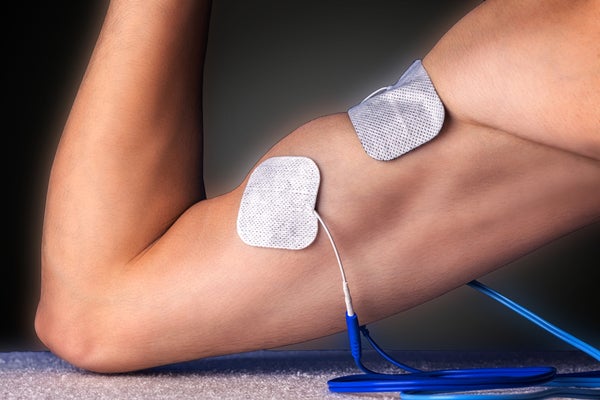

Electrical Muscle Stimulation (EMS), also known as neuromuscular electrical stimulation (NMES) or electromyostimulation, is a protocol that elicits a muscle contraction using electrical impulses that directly stimulate your motor neurons. An EMS unit (like a Powerdot, Compex, Tone-A-Matic, or MarcPro) is a device that delivers this in the comfort of your own home.
This stimulation creates muscle contractions that can be quick and frequent, fast with long pauses, or contractions that are held for several (uncomfortable) seconds or minutes at a time.
On supporting science journalism
If you're enjoying this article, consider supporting our award-winning journalism by subscribing. By purchasing a subscription you are helping to ensure the future of impactful stories about the discoveries and ideas shaping our world today.
Normally, it is your body that fires your muscles by sending electrical impulses from your brain through your central nervous system (CNS). But an EMS device allows you to engage in deep, intense, and complete muscular contractions without actually activating (or stressing) your CNS—not to mention your joints and tendons.
The coolest thing is that your body doesn’t know the difference between a voluntary contraction and an electrically stimulated one. Your (silly) body only recognizes that there is a stimulus and reacts to it accordingly.
If this sounds a little wacky to you, don't worry—there is science to back this up.
A study published in the Journal of Strength and Conditioning looked into whether or not EMS could help elite athletes gain a performance edge. They concluded that “the analysis shows that trained and elite athletes, despite their already high level of fitness, are able to significantly enhance their level of strength to same extent as is possible with untrained subjects.”
At the conclusion of that study, the researchers stated that “EMS offers a promising alternative to traditional strength training for enhancing the strength parameters and motor abilities in athletes.”
Another study from 2015 titled “Effects of high-frequency current therapy on abdominal obesity in young women: a randomized controlled trial” provides a different example of the effectiveness of EMS. Instead of fitness levels, this study looked into whether EMS could help you lose body fat.
In this study, a group of subjects received 30 minutes of high-frequency current therapy via a series of electrodes placed on their stomachs. The subjects did these sessions three times per week for six weeks. After those six weeks, the researchers measured the subject’s waist circumference, body mass index, subcutaneous fat mass (fat under the skin), and total body fat percentage.
Surprisingly, without modifying their exercise or diet, the EMS did indeed cause significant effects on decreasing waist circumference, abdominal obesity, subcutaneous fat mass, and body fat percentage, leading the researchers to conclude: “The use of the high-frequency current therapy may be beneficial for reducing the levels of abdominal obesity in young women.”
Other studies have shown EMS to be helpful for everything from pain management to helping increase muscle blood flow for warming up prior to performance-related activities.