
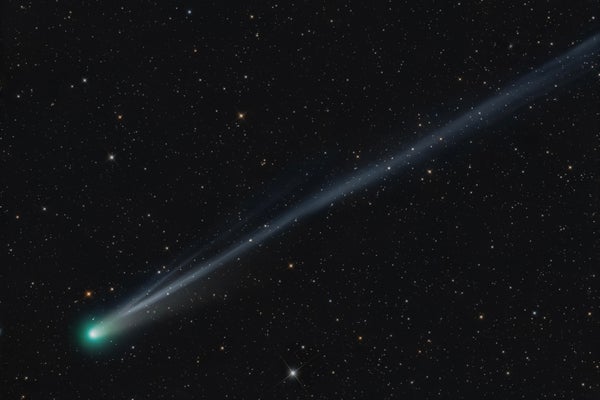
A comet discovered earlier this year, now just bright enough to be visible to the naked eye, is poised to be among the top celestial events of 2025. Known as C/2025 A6 (Lemmon), this celestial wanderer is currently in the western sky after sunset, not far from the Big Dipper, and is well placed for viewing as the sky gets dark.
Astronomers discovered the comet in January as part of the Mount Lemmon Survey in Arizona and calculated that it’s on a 1,350-year orbit around the sun—so if you miss it this time around, you’re out of luck.
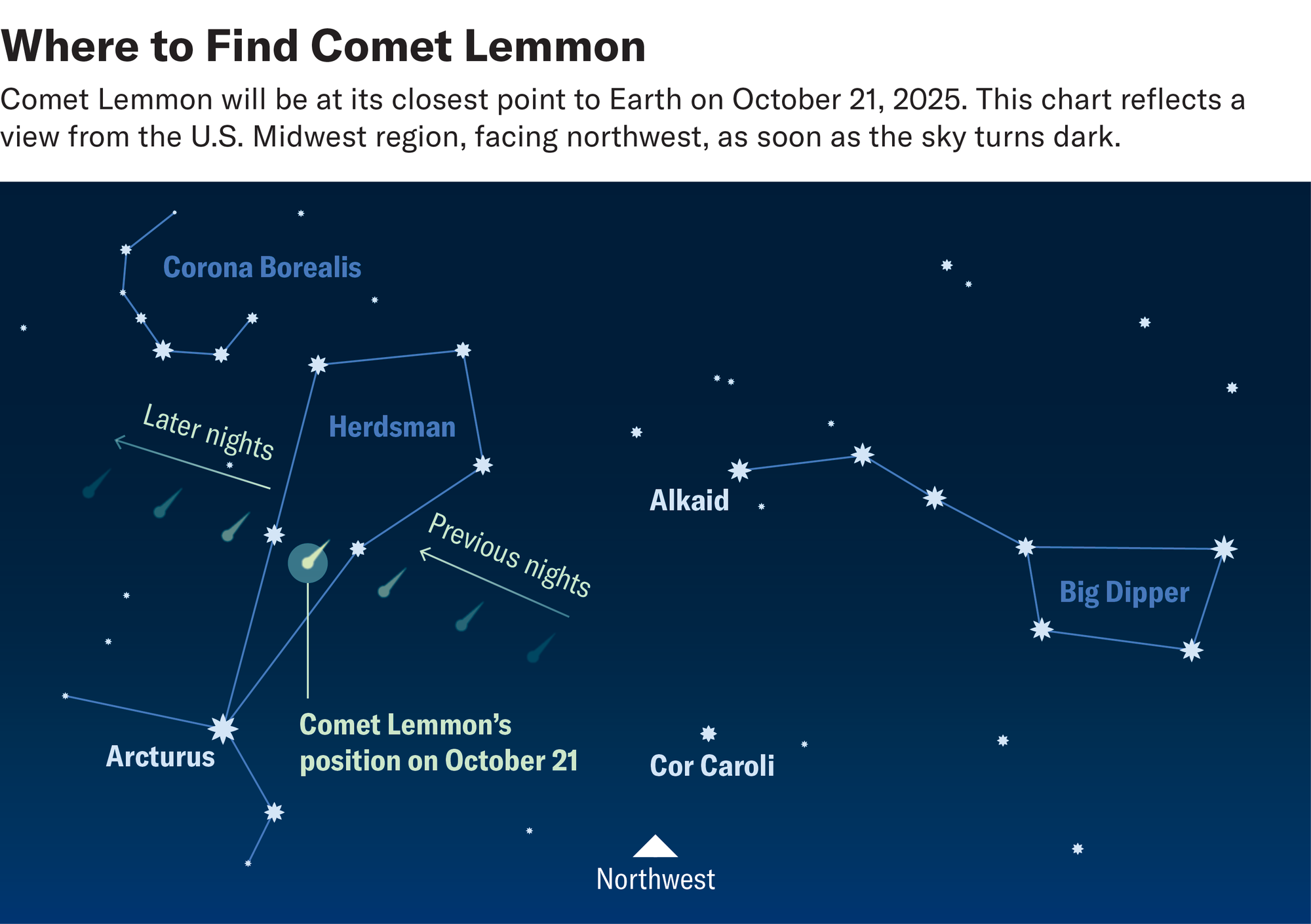
Comet Lemmon will be closest to Earth on October 21, when it passes within 55 million miles (89 million kilometers) of our planet. Conveniently, this is also the date of the new moon, meaning the sky will lack moonlight, making it easier to spy fainter objects. By coincidence, the Orionid meteor shower also peaks on the night of October 21, so lucky skywatchers may glimpse a few shooting stars as they gaze at the comet.
On supporting science journalism
If you're enjoying this article, consider supporting our award-winning journalism by subscribing. By purchasing a subscription you are helping to ensure the future of impactful stories about the discoveries and ideas shaping our world today.
The comet is expected to be at its brightest from around that date through early November. It will be closest to the sun (a point known as perihelion) on November 8.
“From the city, you probably won’t see it with the naked eye, but with binoculars you should be able to pick it up,” says Bob King, a contributing editor at Sky & Telescope. “From the country, when the moon’s not in the sky, you’ll be able to see it [with the] naked eye. “It’s going to be a little fuzzy spot, and the binocular view should be really lovely.”
Amanda Montañez; Source: Stellarium with additions by Bob King (reference)
Even those who aren’t intimately familiar with the constellations should be able to use the Big Dipper, as well as the bright star Arcturus—the brightest star in the western sky at this time of year—to find the comet. The wanderer is currently below the “handle” of the Dipper, and in late October it will be above Arcturus, to the left of the Dipper. Because the comet will be fairly low in the sky, the best time to see it will be soon after dusk, with the sweet spot coming around one hour after sunset. Binoculars may be necessary to view the comet’s wispy tail, which is a result of high-speed particles from the sun pushing gas and dust away from the comet’s nucleus.
Although observing from a rural spot is ideal, people who can’t escape the city shouldn’t be put off, says Debra Ceravolo, an astrophotographer who images the sky from southern British Columbia. “At least find a dark corner of the backyard, someplace shielded from the streetlights,” she says. “Binoculars will definitely help.”
Skywatchers should also be aware that what they see with their eyes will never quite measure up to the stunning photographs captured by seasoned astrophotographers, who typically use a mechanism called a clock drive to compensate for Earth’s rotation and processing techniques such as image stacking to make celestial objects appear brighter. Even so, people shooting with nothing more than their smartphone may still get good results, especially if they’re able to mount their phone on a tripod, King says. “Today’s smartphone cameras can do long exposures, say, from three to 10 seconds. That should be enough to pick it up.”
Comets are famously unpredictable, and although Comet Lemmon is due to get brighter through the second half of October, it almost certainly won’t rival comets such as Hale-Bopp and Hyakutake, which lit up the sky in the 1990s. Even so, it is very much worth a look, Ceravolo says. “I love comets,” she says. “So whenever there’s a good one, I’m there.”