
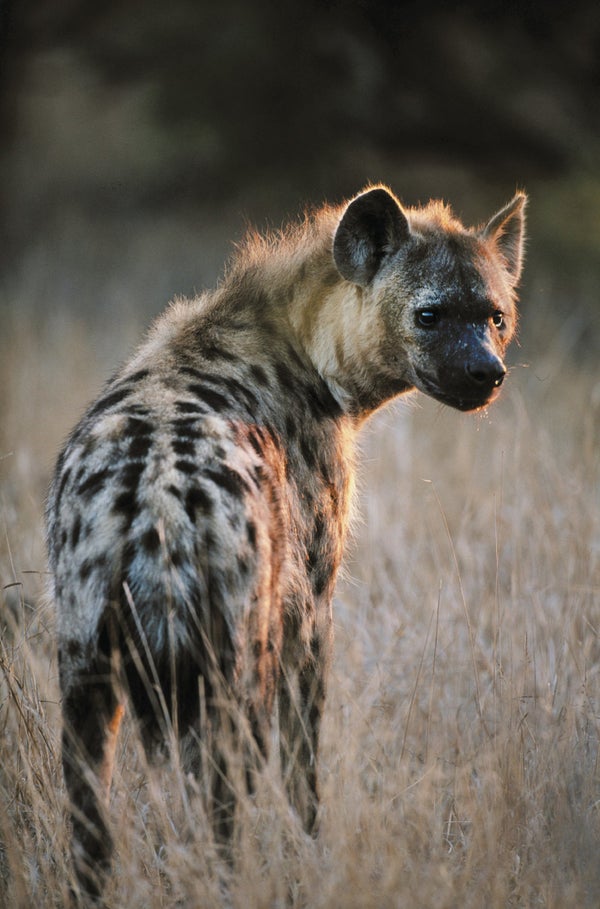
Giggling, sneaky, carrion-scavenging—and good for public health? Hyenas around the Ethiopian city of Mekelle often dine on livestock carcasses. In the process, a new study suggests, they may prevent infections of anthrax and bovine tuberculosis in nearby humans and animals.
More than 300,000 people live in Mekelle, along with more than 100,000 head of livestock, according to the study authors. When residents toss dead chickens, donkeys or cattle into the city’s dump, spotted hyenas come calling. “If you’re walking around in Mekelle at night and you don’t see a hyena, you’re doing something wrong,” says Stanford University graduate student Chinmay Sonawane. Wild game has become scarce in the area, and hyenas make up the difference with dead livestock. The resulting reduction in fetid waste “is something that people in Mekelle and people in Ethiopia broadly do appreciate,” Sonawane says.
To investigate the possible public health benefits more closely, Sonawane and his colleagues observed hyenas chowing down in the local landfill over 40 nights to learn how much they eat. The researchers then estimated how many cases of anthrax and bovine tuberculosis could spread from contact with animal carcass waste in Mekelle and modeled disease rates with and without hungry hyenas cleaning up.
On supporting science journalism
If you're enjoying this article, consider supporting our award-winning journalism by subscribing. By purchasing a subscription you are helping to ensure the future of impactful stories about the discoveries and ideas shaping our world today.
They found that a single hyena crunches up 983 kilograms of dead livestock a year. In 2019 Mekelle’s roughly 210 hyenas gulped down about 4.2 percent of the available animal carcasses. By doing so, the model suggests, the scavengers prevented three anthrax and two bovine tuberculosis infections in people and 11 anthrax and 129 bovine tuberculosis infections in livestock. Figuring in disease treatment and livestock costs, the scientists calculated that hyenas saved humans more than $50,000 that year. Sonawane and his colleagues published their results in the Journal of Applied Ecology.
Despite its importance to the ecosystem, scavenging has been studied less than behaviors such as predation, says University of Washington wildlife ecologist Laura Prugh, who was not involved in the study. Prugh says she hopes studies like this one, which explore how scavengers directly benefit humans, “will help motivate people to conserve species that often don’t get the same respect.