
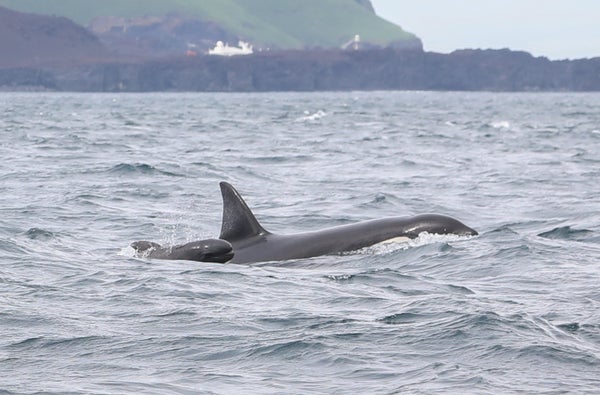
One day in June 2022 Chérine Baumgartner, a researcher at the Icelandic Orca Project, was watching from a dinghy as a pod of killer whales fed on herring—when she noticed something very odd about what seemed to be a young member of the pod. “At first, we were like, ‘Oh my god, this killer whale calf has a problem,’” she says. It was far tinier than normal and lacked an infant orca’s characteristic black-and-pale-orange coloration. Baumgartner, now a Ph.D. student at the Swiss Federal Institute of Technology Zurich, suddenly realized she was seeing an entirely different species: a baby pilot whale. She and her team observed the pod for nearly three hours before weather conditions forced them back to land. They found the pod the next day, but the pilot whale calf was nowhere to be seen.
Scientists noticed orcas interacting with baby pilot whales off Iceland every year from 2021 to 2023. Each instance was short-lived and featured different individual pilot whales (dark-gray members of the dolphin family with a bulbous forehead) and different pods of orcas. Now, in a new study in Ecology and Evolution, Baumgartner and her colleagues describe the 2022 and 2023 incidents and posit three potential explanations: predation, play or parenting.
A neonate long-finned pilot whale swims among killer whales on June 23, 2022.
On supporting science journalism
If you're enjoying this article, consider supporting our award-winning journalism by subscribing. By purchasing a subscription you are helping to ensure the future of impactful stories about the discoveries and ideas shaping our world today.
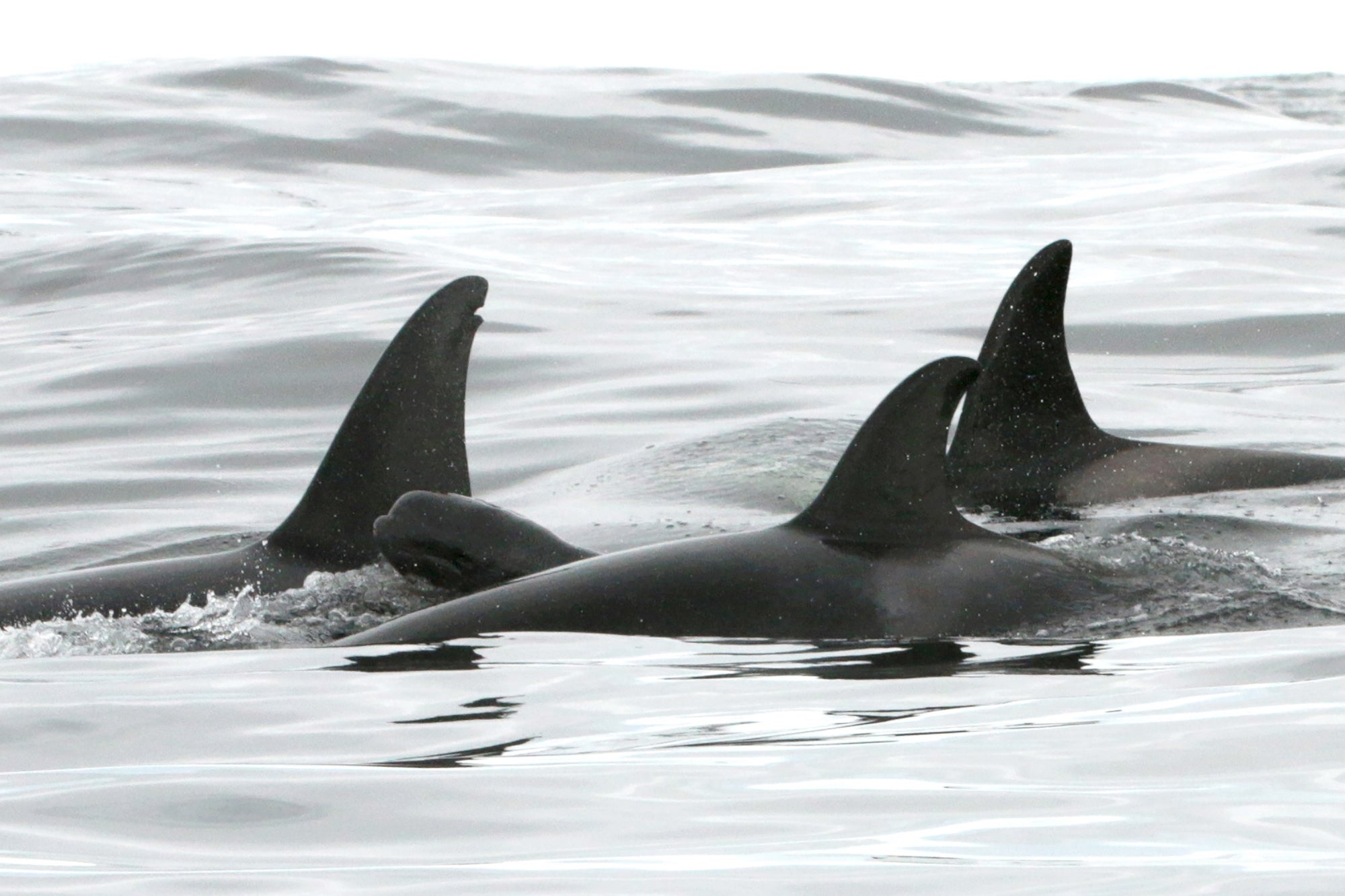
In all the sightings, a weeks-old pilot whale swam by a female killer whale in what scientists call an echelon position, with the young whale located beside and slightly behind the adult orca. In the 2022 and 2023 instances, the killer whales occasionally nudged the calf along. In 2023 a calf was seen swimming ahead of the group, possibly as if to run away—and at one point it was lifted, belly-up, out of the water on the back of an orca.
With the first possible explanation, the killer whales could have been keeping the young pilot whales around like a living lunch box; some orcas in Iceland are known to eat harbor seals and porpoises. But Baumgartner notes that these Icelandic killer whales are predominantly fish eaters and that they didn’t display overtly aggressive behavior toward the pilot whale calves. So predation is less likely, though not impossible, she and her colleagues say.
Alternatively, the killer whales could have been playing with the young whales or using them to practice hunting. Iceland’s orcas often herd herring, and they could have been incorporating the pilot whale calves in their hunting games.
Finally, the killer whales could have been extending their parental instincts to the young calves. Whales and dolphins in the wild often care for the young of other members of their pod, and although it’s rare, dolphins have adopted calves from different species. In the pilot whales’ case, Baumgartner says, she wouldn’t categorize the relationship as adoption because the interactions seemed to be short-lived. The young pilot whales would likely have died without milk, and none of the female orcas were lactating at the time.
These three possibilities also aren’t mutually exclusive, she says. “It could be [that the orcas] encountered the pilot whale opportunistically, and some individuals played with the whale, and others tried to nurture it,” Baumgartner adds.

A neonate long-finned pilot whale is lifted out of the water on the back of an unidentified killer whale on June 20, 2023.
The other conspicuously missing pieces of the puzzle are how, in each instance, the orcas came across a pilot whale calf in the first place and what happened to that calf afterward. “Was it lost or abandoned?” asks study co-author Filipa Samarra, principal investigator at the Icelandic Orca Project and director of the University of Iceland’s research center on the Westman Islands. “Or did the killer whales actively approach to take the calf away?” The researchers also wonder if the calves escaped or died or were killed or eaten by the orcas.
Sarah Teman, a graduate student in ecology at the University of Washington, who was not involved with the new study, says her jaw dropped when she saw pictures of the pilot whales with the orca pods. Teman previously studied southern resident killer whales interacting with porpoises in the Salish Sea off British Columbia and Washington State. In that research, she observed interactions that may have been motivated by nurturing, hunting practice or “play”—and often ended up killing the porpoises. “It was fascinating to see such similar behaviors” in the Icelandic orcas, she says, adding that the animals’ interactions with the pilot whales seemed to be largely driven by nurturing or play behavior, just as had been seen in the southern resident killer whales’ interactions with porpoises.
Samarra also speculates that the unusual interactions off Iceland could be a result of climate change because pilot whales increasingly follow schools of mackerel moving into warmer waters that overlap with the killer whales’ range. She hopes that, next summer, her group will finally observe how the young pilot whales get entangled with the orcas and what happens to them next.