
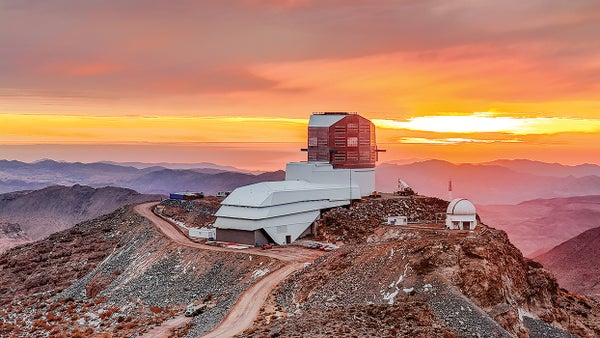
In her first year of graduate school at Stanford University, back in 2021, Sydney Erickson knew only that she was going to be a physicist. She rotated through different research groups, from particle physics to cosmology, until she started hearing buzz about a giant camera being built on campus for the Vera C. Rubin Observatory. “I was drawn toward that community,” she says, recalling those involved with the telescope, which turned on last summer in the Chilean Andes. “Rubin drove me into cosmology, I would say.”
Now Erickson is finishing her doctoral degree and developing new ways to pin down the universe’s accelerating rate of expansion. She focuses on huge astrophysical objects such as massive galaxies, whose gravity magnifies the light of more distant targets. By studying the arrival time of light from these so-called gravitational lenses, cosmologists can calculate how much the universe expanded during different time intervals. It’s an incredibly complex measurement requiring both lots of images captured repeatedly, which Rubin provides, and deep finesse, which Erickson and her computer models offer.
The $800-million Rubin observatory was designed and built largely with federal money. That federal purse has long been the primary source of funding for research and development in the U.S., growing from $21.3 billion in 1956 to $156.1 billion in 2024, adjusted for inflation, according to the National Science Foundation. The funds, which flow through numerous entities, from the NSF and the National Institutes of Health to NASA and the Department of Energy, have helped usher in a golden age of American science.
On supporting science journalism
If you're enjoying this article, consider supporting our award-winning journalism by subscribing. By purchasing a subscription you are helping to ensure the future of impactful stories about the discoveries and ideas shaping our world today.
This booming science enterprise has been under threat since last January, when President Donald Trump took office for the second time and began slashing programs and implementing major funding cuts to dozens of government departments and agencies. Morale among scientists is low, and government scientists have left their jobs in droves; about 10,000 science and technology Ph.D.s have exited the government since Trump’s reelection. Many graduate students have not been as fortunate as Erickson, who will start a postdoctoral fellowship at the University of California, Los Angeles, this summer. So far 2026 is, surprisingly, a very good time to be an astrophysicist in the U.S., with many telescopes already built and paid for. Some have recently turned on, such as the Rubin observatory, or will launch this year, such as the Nancy Grace Roman Space Telescope. But if Congress passes the Trump administration’s proposed 55 percent cut to the NSF budget, grants and early-career programs for people who want to use those telescopes will drop dramatically or face elimination.
“There is this huge momentum behind what has been the U.S. science enterprise.” —Mari Ostendorf University of Washington
Still, what about other fields? To find out, I contacted researchers and leadership from several of the institutions that receive the most funding from the NSF and the NIH. I asked deans and vice provosts how their universities are faring, and I interviewed laboratory directors, research professors and early-career scientists. Against this depressing backdrop, I found positive signs in other fields, including research on Alzheimer’s disease and other forms of dementia, artificial intelligence, and protein design for anything from vaccines to plastic recycling.
In the interest of fairness and accuracy, I asked everyone the same set of questions:
What’s the mood or general vibe of your scientific community these days?
Does your field feel representative of what’s going on in science more broadly or different somehow?
How has funding in your area changed recently?
What are you most hopeful about in your field?
What are you most worried about?
Even while sharing success stories or excitement, respondents were all careful to acknowledge the ongoing uncertainty about federal funding. “Although there are bright spots, I think it’s important to understand that even though a reasonable budget was implemented [this year], we are not seeing it on the ground,” says Michael Graham, interim associate vice chancellor for research and an engineering professor at the University of Wisconsin–Madison. Grants from both the NSF and the NIH have been slow to trickle through to the labs that rely on them, he says.
Other administrators agreed. Mari Ostendorf, vice provost for research at the University of Washington, attended a meeting of the Association of American Universities this past February. There, senior research officers at dozens of universities described how funding awards were down substantially compared with amounts in previous years. The University of Washington is also seeing considerable funding losses, but Ostendorf says good projects are continuing to produce good science. “A lot of these things happen because of the initial investments of the federal government,” she says, referring to past funding that got projects off the ground. “There is this huge momentum behind what has been the U.S. science enterprise.”
The past few decades of growth and investment in research mean science in the U.S. has an incredibly strong foundation. Computers are more capable, instruments are more advanced, and collaboration has never been easier or more welcomed across disciplines and institutions. “One has to separate public perception of science, the actual doing of science and the outcomes from the doing of science,” says Peter Armitage, a condensed matter physicist at Johns Hopkins University, which leads the country in federally funded research money. “For right now, for the last one, we are just drinking from the fire hose. In biology, in physical sciences, there’s just gobs of things going on. We almost can’t keep up with how exciting it is.”
Many people I contacted mentioned new advances in computing that are making research simpler or more collaborative. Graham studies rheology, the physics of how matter responds to forces. This line of research can reveal how certain materials—for instance, mRNA vaccines packaged inside lipid nanoparticles—move through the body to do their work. “The mRNA molecule itself is one thing; how you transport it through the body and get it to where it goes is a problem that touches on many things,” Graham says.
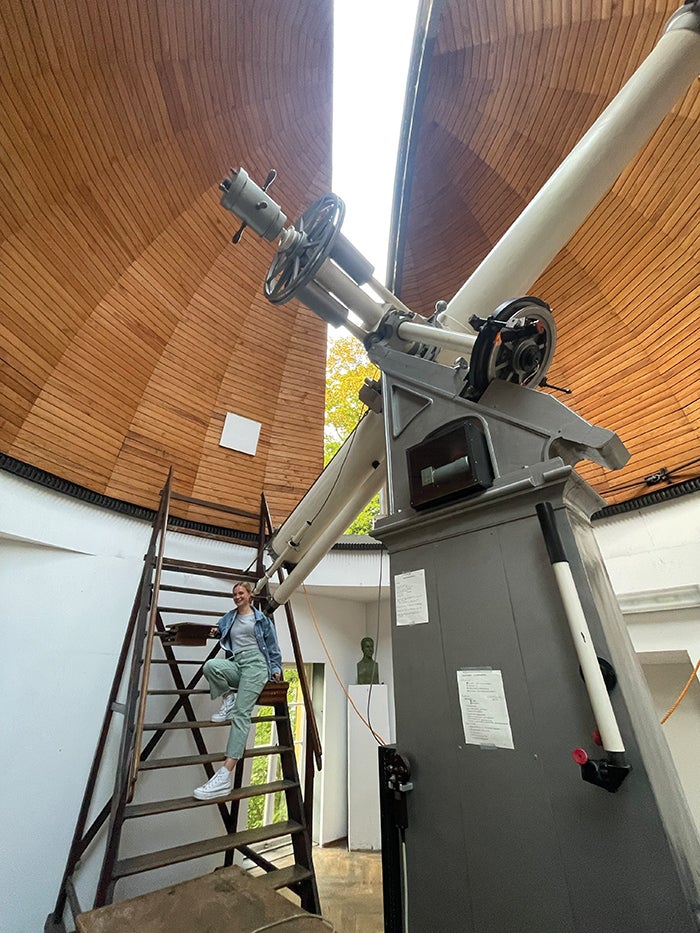
Sydney Erickson stands next to a historical telescope at Ludwig Maximilian University of Munich in 2024.
Sydney Erickson
But computers aren’t great at simulating fluid flows. Scientists just don’t have enough basic physics knowledge for AI systems to model this kind of flow accurately. So Graham and chemical engineer Matthew Helgeson of the University of California, Santa Barbara, developed a technique for taking x-ray scattering measurements of flowing fluids containing polymer molecules. Then they feed those data into a machine-learning algorithm to generate more accurate models. “This is a really great big-data example in my field of soft matter,” Graham says. “We can learn the governing equations for how the microstructure evolves in time as the fluid is flowing, and we can move away from simple models.” Practically, such a system could be used to design more efficient solar cells, among other uses.
Gerontologists are also using novel machine-learning approaches, in their case to study a rapidly aging U.S. population. At the University of Texas at Austin, Elizabeth Muñoz, an early-career scientist, is working with older people to develop a more complete picture of what happens in an aging brain. Rather than conducting her research in clinical settings, Muñoz surveys people at home and in their communities. She gives participants frequent, short cognitive tests, records their stress levels and notes whether they are living alone or with loved ones. She correlates responses to cognitive tests with demographic information, environmental and neighborhood information, and other data. (She has already published research showing that cohesive, supportive neighborhoods are linked to better cognitive function.) Next, researchers feed the data into computers; the crunched data paint a more complete picture of a person’s dementia risk.
Karen Fingerman, who directs the Texas Institute on Dementia, Aging and Longevity, says Muñoz’s work is revolutionary. “We used to come up with the research problems based on the literature we were reading. The new perspective is to go out there and ask people what’s happening,” she says. “Let’s not just bring you in and put you in a machine, let’s not have some neurologist give you a test, but let’s go to where you are, and let’s use your smartphone and design something new that will assess something in your life.”
Another U.T. Austin colleague, Stephanie Grasso, is focusing on whether bilingualism and language fluency can protect people from dementia. In a study on language use, Fingerman and her colleagues found that people with deeper thinking patterns tend to use third-person and plural first-person pronouns (“they,” “we,” “us”), whereas people with less complex thinking use just first person. The discovery came from feeding transcripts into a computer and having a machine-learning algorithm analyze the speech patterns of study participants. “Saying ‘I went to the store’ is much simpler than explaining what someone else did,” Fingerman says, adding that this result was unexpected. “We would not have found that five years ago, because we would not have looked for third-person pronouns, but we found it with machine learning.”
Although federal grants are down, state funding for research on Alzheimer’s and other forms of dementia ballooned starting in 2024, according to the Alzheimer’s Impact Movement, a nonprofit advocacy group. At the University of California, San Diego, researchers are working on a campus-wide effort to produce an Alzheimer’s vaccine, says Corinne Peek-Asa, an epidemiologist and the university’s vice chancellor for research and innovation. “Let’s try a lot of things and fail along the way, and boy, are we going to learn a lot in the process,” she says.
Research on infectious diseases is growing at universities, despite multiple crises in funding and staffing within the federal Department of Health and Human Services. By early 2025 officials led by Secretary of Health Robert F. Kennedy, Jr., had eliminated more than 800 grants focused on HIV research, vaccine hesitancy and transgender health. The administration has pushed thousands of federal scientists to quit or take early retirement, including at the NIH. As of mid-May 2026, the Centers for Disease Control and Prevention, the nation’s public health agency, had been without a confirmed leader for all but one month of Trump’s second term.
Yet public universities generate innovative projects amid this uncertainty. At the University of Washington, researchers came up with a novel way to diagnose strep throat, one of the most common childhood illnesses. If not treated quickly, strep infection can lead to serious complications. Rather than a swab of the back of a patient’s throat, the technique, called CandyCollect, involves a lollipop of sorts. A flavored candy head collects a child’s saliva in a grooved spiral. The candy is engineered to dissolve over a set time so that when the flavor is gone, the sample is ready. Lab technicians can then test the lollipop for Streptococcus bacteria.
One of the biggest bright spots in science is the study of proteins, which has yielded things ranging from a detailed understanding of how their amino acid chains fold into certain shapes to precisely engineered molecules for use in medicine or even environmental cleanup. Protein research sits at a fruitful nexus between health and AI, which are both noted as Trump administration priorities. In 2024 University of Washington scientist David Baker won the Nobel Prize in Chemistry for computer systems that can design proteins. For his breakthrough, he applied AI diffusion models to create atomic arrangements quickly. The university’s Institute for Protein Design recently released one of these models as open-source software, making it freely available to any scientist. When anyone in the world can use the same code, advances will benefit researchers everywhere, Baker says. Recently he and his team have been looking into applications such as building proteins able to break down plastics.
A couple thousand miles southeast, U.T. Austin computational protein engineer Danny Diaz leads the Deep Proteins Group within the AI Institute for the Foundations of Machine Learning (IFML), which is funded by the NSF. Diaz and his team have patented half a dozen novel proteins whose design was hastened by AI. “In protein engineering, nature is really good at giving us an MVP,” Diaz says. “An AI model is useful because [it] can speed up evolution, so we can create proteins [whose] function is on par with human needs.”
During his doctoral research at U.T. Austin in 2020, Diaz worked down the hall from a separate team that designed a shelf-stable version of one of the most consequential proteins in years: the coronavirus spike protein. “You can make a few modifications and turn [the protein] into biotech that is useful, like making it stable in the lab,” Diaz says. Those modifications enabled scientists to produce a vaccine in record time.

This illustration shows complex flow-microstructure interactions in an advanced coating process.
Brian Long/University of California, Santa Barbara
That work got the attention of Adam Klivans, who directs the IFML. “Adam was like, ‘Wow, proteins seem important,’ but he didn’t really speak the same language,” Diaz recalls. Now the two work together to design proteins, using generative software techniques originally developed for language models or image production.
Vaccines have since come under fire as well; in 2025 and 2026 the Trump administration moved to cut funding for vaccine research at the NIH and the CDC. Last June, Kennedy fired all 17 members of a key vaccine advisory panel at the CDC, and his handpicked replacements have since been blocked by federal courts. He then ordered sweeping changes to the number of shots recommended routinely for American children, a move also tied up in litigation. In April 2026 Kennedy blocked $600 million in funds for a State Department–controlled program that provides vaccines for children in developing countries.
Yet protein research is going strong, even when it is being used to develop vaccines for ailments old and new. Diaz’s group created an open neural network called MutCompute, a machine-learning platform that determines mutations to optimize many types of proteins, such as enzymes, which are proteins that speed up chemical reactions. For instance, MutCompute applied just three mutations to a natural enzyme called PETase to create an enzyme that can break down the plastics in single-use water bottles. In ongoing work, the team is designing a protein that can bind to a type of cancer receptor, possibly making it easier to target cancer cells. “It’s like looking for a needle in 1,000 haystacks, so that is where AI is very, very helpful,” Diaz says.
Although research progresses at America’s largest interdisciplinary universities, federal money has been slow to arrive. Officials across the country say the NIH and the NSF are not disbursing grants as quickly as usual. “At the moment, the biggest challenge for us is the unpredictability,” Peek-Asa says.
In the past year private and state funds have increasingly served as a bulwark against that uncertainty. Research funds from state governments and private donors mushroomed last year, even in states where such investment may come as a surprise. In Texas, state legislators have passed laws that dissolve faculty representation; restrict free speech on campuses by limiting protests; prohibit diversity, equity and inclusion initiatives; and require faculty to certify that they are not indoctrinating students. And yet last November voters approved a $3-billion, 10-year project to study Alzheimer’s disease, Parkinson’s disease, and other ailments of aging. In California, state lawmakers are debating a University of California–sponsored ballot issue to support a $23-billion endowment for research across the state. “California has a history of stepping up when research is threatened,” Peek-Asa says, noting previous efforts to fund stem cell research after federal bans in the early 2000s.
The past few decades of growth and investment in research mean science in the U.S. has an incredibly strong foundation.
Private funding for major projects is nothing new, but the size of the donations is growing. In 2008 the Rubin observatory received a $30-million gift from Bill Gates and Microsoft software architect Charles Simonyi for construction of its enormous mirrors. Last August philanthropist Penny Knight and her husband, Nike co-founder Phil Knight, gave $2 billion to Oregon Health and Science University’s Knight Cancer Institute, marking the largest-ever private donation to a U.S. university. The University of Notre Dame, a private university, is adding faculty positions this year to the Stavropoulos Center for Complex Quantum Matter, which is funded by former Dow Chemical chair Bill Stavropoulos and his wife, Linda Stavropoulos.
And nationwide in 2025, 186 institutions received a windfall of nearly $7.2 billion from philanthropist MacKenzie Scott. Since 2020 she has donated more than $1.1 billion to dozens of historically Black colleges and universities, tribal colleges, two-year schools, and institutions that promote college access.
Nobody is sure whether such public and private windfalls will last. And private donors, though valuable, can’t make up for billions of dollars in federal funding that support science every year. “I don’t know if it is all or just the lion’s share, but some universities are able to move forward with hiring because of private funds,” says Johns Hopkins physicist Armitage. “There are always private funds in the system, but if that is all there is, that’s not sustainable.”
Federal money is flowing into projects that align with the Trump administration’s priorities. Although the White House called for dramatic cuts to scientific research funding this year, congressional appropriations remained mostly stable, notes mechanical and aerospace engineer Massimo Ruzzene, senior vice chancellor for research and innovation at the University of Colorado Boulder. “All of us were shaken up. Now we have some relief in sight, given the funding levels, so I think there is cautious optimism,” he says.
In Texas, the IFML’s funding was renewed for $20 million from the NSF for 2026 to study the fundamental algorithms and architecture that drive generative AI. The Texas Advanced Computing Center at U.T. Austin hosts the fastest supercomputer system in U.S. academia. Later this year it will bring online a new supercomputer called Horizon, which will be the largest open-use science supercomputer in the country.
Graham at the University of Wisconsin says AI, quantum science and fusion technology are all bright spots. Scientists who focus on those projects, all noted as Trump administration science priorities, might have an easier time securing funding. But he’s not sure whether AI is as promising for science as some people suggest. “To my mind, that is good and bad,” he says. “Those tools are going to help us largely in fields where we know a lot of the physics, where we have a lot of the data.”
In California, where state lawmakers are looking to plug gaps in federal funding, the University of California system—which includes 10 campuses such as U.C.S.D., U.C. Irvine and U.C.L.A.—is still well positioned to work on subjects such as AI and quantum technology, which the Trump administration has said are high priorities, says Peek-Asa, the U.C.S.D. vice chancellor. “I think there is a lot of concern that all the agencies are kind of moving to the same priorities because they are safe,” she says.
In the meantime, U.C.S.D. is trying to work with industry. In fall 2024 the university launched a new Fusion Engineering Institute, hiring professors and creating courses to steer people into possible fusion careers. Fusion energy became newly attractive as a possible future energy source after a major doe breakthrough in 2022, when scientists were finally able to produce more energy from a nuclear fusion reaction than the laser energy used to drive it. Although commercializing fusion energy is a long way off, many people I talked to cited fusion as a net-positive research area because the Trump administration considers it a major priority.
Ruzzene says administrators and scientists should think about new ways to explain the importance of basic research, as well as the solutions it provides. “That’s on us,” he says. “We have to do a better job of doing that than we used to.”
Before speaking with me, Ostendorf consulted her colleagues at the University of Washington and prepared a list of projects to discuss, some of which are delivering new findings. From the diagnostic lollipop to citizen scientists monitoring the health of baby crabs in the Salish Sea, her university is still producing great science, even though Ostendorf believes it has suffered more than other schools from funding cuts. Still, she was glad for the chance to discuss positive news for a change.
Many of the experts I contacted for this article referenced the shaky environment of American science. Scientists feel like higher education and research-driven university work are under attack. For administrators, many of whom are still active researchers, the stress is manifold. “What I need to do in my administrative role is make sure people don’t give up. Just keep submitting proposals,” Ruzzene says. “Money has been appropriated, and at some point [the Office of Management and Budget is] going to have to spend it, and we are well positioned.”
Armitage at Johns Hopkins says there are more entry-level jobs in physics now than there were a few years ago. Educators are getting jobs, but so are people with bachelor’s-level education, who are getting hired to work in machine learning, quantum materials, and other fields. Mathematically literate, highly trained people are still finding work, he says. “But I don’t want to come off as flippant saying the world is great. The job market is not great overall,” he adds. “There are a lot of storm clouds. I think the system will weather the coming squalls if grants start coming back out later this year, if there is a return to normality in the funding. But if it doesn’t happen, then we are going to see a generational collapse in science.”
Sydney Erickson, the Stanford grad student and soon-to-be U.C.L.A. postdoc, says she knows nothing is a guarantee. “One thing I think about is how lucky I am to be able to study fundamental science and make a living off it. I get to think about the universe expanding and ask, ‘What’s happening, what’s our fate?’” she says. “I feel really lucky to be able to keep doing the science for as long as I can.”