
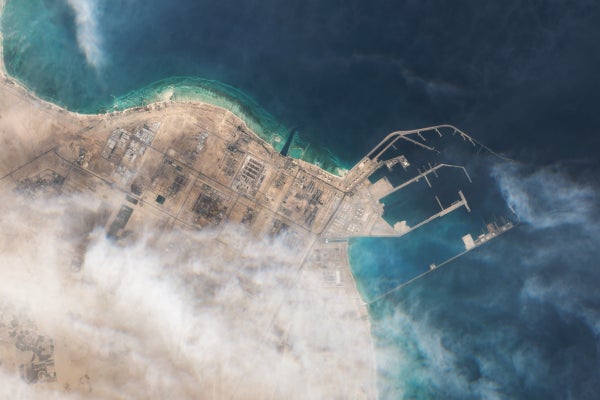
An Iranian attack on Qatar’s liquefied natural gas (LNG) facilities has knocked out 17 percent of the country’s LNG export capacity, an impact that will take years to recover from.
The impact, first reported by Reuters, is one of many now reverberating across the globe from the U.S. and Israel offense against Iran. The Strait of Hormuz, through which 20 percent of global LNG was transported in 2024, remains functionally closed to shipping traffic. That closure has already driven up oil and gas prices. Though some of the consequences could ease if the war were to end quickly, the accumulating damage on pieces of critical infrastructure such as Qatar’s LNG compressor trains cannot be repaired rapidly, said Chuck McConnell, executive director of the Center for Carbon Management in Energy at the University of Houston.
“I would probably say it’s going to be a shock that lasts two to three years,” McConnell says of the overall conflict and the fact that the LNG processing capability has been set back.
On supporting science journalism
If you're enjoying this article, consider supporting our award-winning journalism by subscribing. By purchasing a subscription you are helping to ensure the future of impactful stories about the discoveries and ideas shaping our world today.
Natural gas is a fossil-fuel energy source extracted from deep underground where organic matter, under immense pressure and heat, turns into methane and other gases over millions of years.
The gas can be transported through pipelines over land, but the gas is too voluminous for easy transport overseas. That’s why manufacturers liquefy the gas in plants called trains, like the two destroyed in the recent attack, which occurred March 18 at the Ras Laffan Industrial City production site in Qatar. Inside these trains, natural gas is purified and cooled to about –260 degrees Fahrenheit (–162 degrees Celsius), below the boiling point of methane. The process requires high pressure and a series of refrigerant chemicals that cool the gas to colder and colder temperatures at each step. The liquefied gas can then be transported—still cold and pressurized—in insulated storage tanks to terminals around the world. Because molecules in a gas are farther apart and in thermal motion, cooling and compressing a gas into a liquid drastically reduces its volume: LNG takes up 600 times less space than natural gas in its room-temperature state. After shipping, LNG terminals regasify the LNG for use in power plants and other applications.
The two destroyed trains processed about 12.8 million metric tons of LNG per year, Saad al-Kaabi, QatarEnergy’s CEO, told Reuters. Though the precise energy contained in that volume can vary depending on the compression, 12.8 million metric tons converts to nearly 185 million megawatt-hours of electricity, or more than New York State generates in a year.
The recent destruction is happening against a backdrop of a rapidly growing natural gas market, however, says Michael Orlando, an economist at the University of Colorado Denver Business School. LNG has become a desirable fuel for countries trying to move away from coal. That background growth could mean that prices on natural gas drop more quickly than prices on oil, which will likely remain elevated for years.
Europe and Asia depend on LNG from the Middle East for electricity, heating and cooking. Because gas is a global commodity, however, increases in price will be felt everywhere, McConnell says, including in the gas-exporting U.S.
The trains are huge facilities that require a lot of specialized, expensive equipment. “These are not repairs that can be made in a week or two,” he says. “These are repairs that are going to take probably years to replace, and, by virtue of that, there is going to be a sizable impact.”
Qatar also makes other liquefied gas products, such as naphtha, used both as a precursor to plastics and in gasoline production, and helium, which could affect the semiconductor industry if the war continues. Natural gas is also the major ingredient in nitrogen-based fertilizers, meaning any price increase will affect the cost of food globally.
There may be a downward pressure on gas prices in the upcoming years, however, Orlando says. The world’s capacity to liquefy and ship natural gas is currently expanding, with the U.S. and Qatar both investing in new LNG projects. Whether the capacity in Qatar comes online depends on the length of the war, but the U.S. is expected to produce an additional 19 billion cubic meters of LNG this year alone, according to International Energy Agency (IEA) statistics. If countries in Asia and Europe retreat to coal or rapidly expand their renewable power base in response to the geopolitical situation, that could further decrease the price of gas, Orlando says.
Oil, by contrast, will likely remain expensive because the oil industry has been in a steady state of demand, Orlando says, and investors will likely remain skeptical about investing in multiyear projects in response to a sudden, possibly temporary, price spike.