
As negotiations continue over ending the U.S. and Israel’s war with Iran, Tehran’s pressure campaign around the Strait of Hormuz has moved from oil tankers to the seafloor Internet. Iranian officials and state-linked media floated plans in May to impose fees on fiber-optic cables beneath the strait and to hand Iranian firms control over their maintenance and repair.
Yet those cables currently carry less than 1 percent of global international bandwidth, according to TeleGeography, a telecom research firm, and the network as a whole is engineered to route around routine failures. More vulnerable, though, is the small, aging global fleet of ships that fixes the cables when they break. The seafloor Internet is built to absorb damage, but its repair system has far less slack.
The industry now sees some $4 billion to $5 billion in annual investment, close to double what it was a decade ago, driven by a building boom in new cables. “But we have a lack of investment in the maintenance ship fleet,” says Mike Constable of the consulting firm Infra-Analytics and the SMART Cables initiative. He likens the situation to buying an expensive Mercedes without insurance. “It’s a huge investment going in, but there’s very little investment, almost zero, in protecting it,” he says. The existing fleet could also be deployed more efficiently: Constable adds that a couple repair ships in the Pacific perform just two repairs a year and otherwise sit on standby, even as other regions face heavier demand.
On supporting science journalism
If you're enjoying this article, consider supporting our award-winning journalism by subscribing. By purchasing a subscription you are helping to ensure the future of impactful stories about the discoveries and ideas shaping our world today.
The network depends on a global fleet of around 60 specialized vessels that lay and maintain the world’s cables, and fewer than 20 of these ships are dedicated solely to repair. Some 150 to 200 cable faults happen every year, with 70 to 80 percent of them arising from accidents involving fishing equipment and ships’ anchors, according to the International Cable Protection Committee.
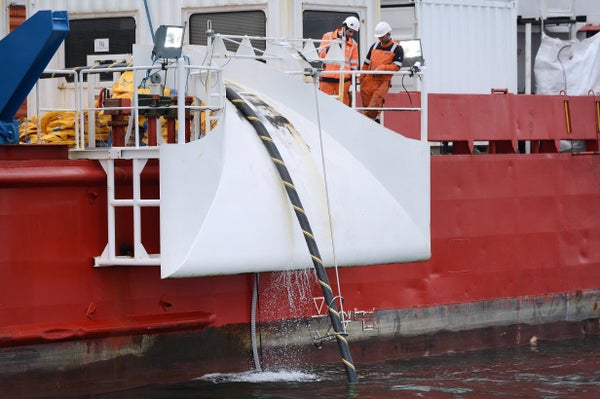
The process of replacing a cable segment is relatively straightforward: crews locate and retrieve the damaged cable using a remotely operated vehicle, splice in a replacement section, test the line and lay it back down. But it often requires a ship to hold position for days, potentially near a conflict zone, and only one such repair vessel is currently inside the Persian Gulf.
Many vessels in the maintenance fleet are themselves in need of maintenance, according to a recent study from TeleGeography that was co-authored by Constable. About half the vessels in the global cable fleet, and nearly two thirds of those in the maintenance fleet, will be nearing the end of their service life by 2040, the study finds. Many ships that were recently added to the fleet neither are new nor were originally designed for the purpose; they’re secondhand vessels converted from other sectors, including construction ships from the oil and gas industry. At least a quarter of the world’s existing cable kilometers will be due for retirement by 2030. Meanwhile more than a million kilometers of new cables are slated for the southwest Pacific Ocean and parts of the Atlantic, including dozens of new cable routes in and near the Middle East.
The busiest repair zones tend not to be the ones making geopolitical headlines. Constable says many repairs occur in Southeast Asia, especially in the South China Sea, with its shallow waters crowded with fishing boats and trawlers. Undersea mudslides occasionally damage cables, too, and future seabed mining could eventually add another hazard. “If it’s high-risk, go around it,” he says.
Permitting is another obstacle, says Sheryl Ong, head of Asia at Global Marine, a U.K.-based company with its own fleet of cable ships. Securing a government’s sign-off to enter its territorial waters can take a month or more. “Sometimes permitting takes a long time before we can actually get out to sea and get things done,” she says.
Concerns about cable security have been mounting for several years, particularly since Russia’s invasion of Ukraine in 2022, the Nord Stream gas pipeline sabotage later that year and a series of cable disruptions in the Baltic Sea. The Red Sea has offered a more direct warning to cable operators. In 2024 a commercial vessel struck by Houthi militants severed multiple cables as it sank. Repairs were delayed for months while companies and governments worked out whether it was safe and lawful to enter the area.
Cable companies often bury lines in shallow water where they can, but that provides only limited security. A ship dragging an anchor can still damage a cable, Constable says. In Hormuz, the cables are clustered closely together; Iran might deliberately disrupt connectivity in Kuwait, Qatar or Saudi Arabia that way, but it would risk damaging cables serving its own networks, too.
Instead, Constable says, the more vulnerable targets are on land. Cable landing stations along the coast are exposed to drone attacks in a way that undersea cables are not, and Iran could target those without necessarily risking its own connections.