
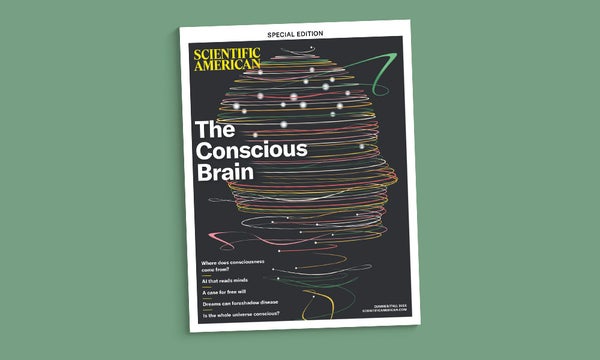
More than half a billion people around the world have downloaded artificial-intelligence chatbot companion apps such as Xiaoice and Replika. These virtual confidantes can provide empathy, support and, sometimes, deep relationships. Chatbots, of course, aren’t conscious—they just feel that way to users, who often become emotionally attached to them. As AI grows more fluent in mimicking human empathy, language and memory, we’re left to confront an uneasy problem: If a machine can fake awareness so well, what exactly is the real thing? It's a deceptively simple question—one that scientists, philosophers and even neuroscientists still struggle to answer: What is consciousness?
Unlike other scientific phenomena, consciousness cannot be observed directly; one can observe behavior or brain activity but not the subjective experience itself. Whether human awareness is a “stage” where inputs compete for our attention or a unified system processing information all at once is still up for debate. In fact, our reality may stem from subjective internal experiences, such as colors or tastes, that arise because of consciousness. Behavior may also feed this experience, as suggested by a thought experiment about pain-pleasure invert “philosophical zombies” described here.
As complicated as this mystery seems, human cognition operates at a relatively slow, fixed speed of roughly 10 bits per second for tasks such as remembering, making decisions and imagining. Sudden insights can bubble to the surface while unconscious operations churn away. And people’s brain waves predictably sync up as the individuals interact, which is perhaps an evolutionary adaptation that helps us bond. Automatic processes suggest our minds operate without our conscious involvement, but that’s not the whole story.
On supporting science journalism
If you're enjoying this article, consider supporting our award-winning journalism by subscribing. By purchasing a subscription you are helping to ensure the future of impactful stories about the discoveries and ideas shaping our world today.
Much goes on in the unconscious mind. It turns out dreams can be a bellwether of cognitive disorder. And famous nappers such as Thomas Edison have believed they could manipulate their sleep to spark creativity. Our era of constant surveillance may cause cognitive changes without our knowledge. In people who are in comas, the mind might be aware but trapped.
Reality can shift for people with illnesses that arise from complex interactions of genetics and environment, such as schizophrenia. Scientists can now identify early biomarkers to diagnose Alzheimer’s disease, but these tools raise ethical and social concerns. A rare neurological condition called Alice in Wonderland syndrome appears to warp a person’s perception of bodies and time, especially in children. And sometimes a rift develops between the world and a mind, a stark reminder that awareness is malleable. Surprising activity in dying brains can temporarily restore neural function.
AI will certainly continue to advance, becoming better at imitating the hallmark behavior of conscious beings and perhaps even someday achieving artificial general intelligence. But as cognitive scientist Anil K. Seth tells reporter George Musser, “Consciousness is not a matter of being smart. It’s equally a matter of being alive.” So far that’s a claim that only humans, among other creatures on Earth, can make.