Jaye Gardiner

Learning how the matrix around cells and tissues impacts cancers

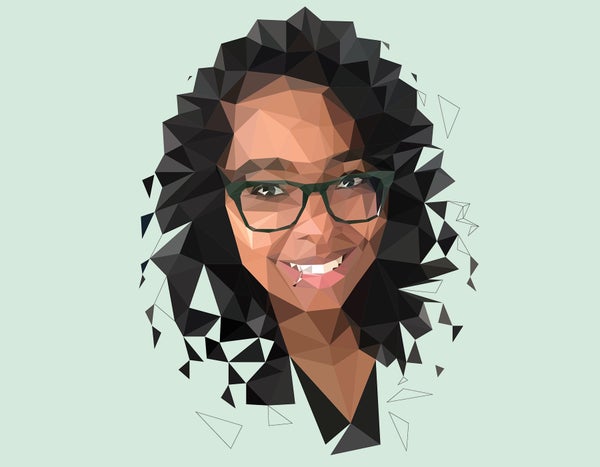
Stylized illustration portrait of Jaye Gardiner by Jessine Hein.

Jessine Hein

Join Our Community of Science Lovers!

Jaye Gardiner is an assistant professor of biology at Tufts University, where she focuses on the extracellular matrix (ECM) around cancerous tumors. Being first-generation as both an American and a college graduate, Gardiner didn’t have the easiest path there. But starting in high school, several mentors, including a chemistry teacher who made the periodic table fun, helped to guide her to a career in science.

Throughout her education she was drawn to ideas and questions at surprising intersections. That’s how she landed on looking at the protein-packed microenvironment around tumors. “If you think of a tumor cell like a seed, the tumor microenvironment would be the soil that the seed is in, and it can dictate whether the seed will grow into cancer or be restricted and not germinate at all,” Gardiner says. As it turns out, not only does this tumor microenvironment change and affect cancer cells, but other forces such as everyday viruses might shape it in turn.


On supporting science journalism

If you're enjoying this article, consider supporting our award-winning journalism by subscribing. By purchasing a subscription you are helping to ensure the future of impactful stories about the discoveries and ideas shaping our world today.


Portrait photograph of Jaye Gardiner by Tony Luong.

Tony Luong

What if, Gardiner wondered, consistent exposure to a routine virus such as the one that causes the common cold somehow changes the body’s extracellular matrix to make it more conducive to cancer growth? Ultimately the information could reveal the interplay between the ECM and diseases such as cancers. “I want to take the ideas and kind of run with the nonconventional connection between virology and cancer biology,” Gardiner says.

Gardiner recognizes how her mentors put her where she is today. She pays that forward as she works to set up her own lab. “Right now I’m excited for us to actually do experiments,” Gardiner says. “I really love mentoring and teaching others. And it’s by the grace of others who passed on information that I’m even in this position.”

This article is part of The Young American Scientists, an editorially independent project that was produced with financial support from Regeneron.

Jeanna Bryner is executive editor of Scientific American. Previously she was editor in chief of Live Science and, prior to that, an editor at Scholastic's Science World magazine. Bryner has an English degree from Salisbury University, a master’s degree in biogeochemistry and environmental sciences from the University of Maryland and a graduate science journalism degree from New York University. She has worked as a biologist in Florida, where she monitored wetlands and did field surveys for endangered species, including the gorgeous Florida Scrub Jay. She also received an ocean sciences journalism fellowship from the Woods Hole Oceanographic Institution. She is a firm believer that science is for everyone and that just about everything can be viewed through the lens of science.

More by Jeanna Bryner
Scientific American Magazine Vol 335 Issue 1This article was published with the title “Jaye Gardiner” in Scientific American Magazine Vol. 335 No. 1 (), p. 46
doi:10.1038/scientificamerican072026-oy6NURu5Rg1s3WiTKlL8v

It’s Time to Stand Up for Science

If you enjoyed this article, I’d like to ask for your support. Scientific American has served as an advocate for science and industry for 180 years, and right now may be the most critical moment in that two-century history.

I’ve been a Scientific American subscriber since I was 12 years old, and it helped shape the way I look at the world. SciAm always educates and delights me, and inspires a sense of awe for our vast, beautiful universe. I hope it does that for you, too.

If you subscribe to Scientific American, you help ensure that our coverage is centered on meaningful research and discovery; that we have the resources to report on the decisions that threaten labs across the U.S.; and that we support both budding and working scientists at a time when the value of science itself too often goes unrecognized.

In return, you get essential news, captivating podcasts, brilliant infographics, can't-miss newsletters, must-watch videos, challenging games, and the science world's best writing and reporting. You can even gift someone a subscription.

There has never been a more important time for us to stand up and show why science matters. I hope you’ll support us in that mission.

Thank you,

David M. Ewalt, Editor in Chief, Scientific American

Subscribe