
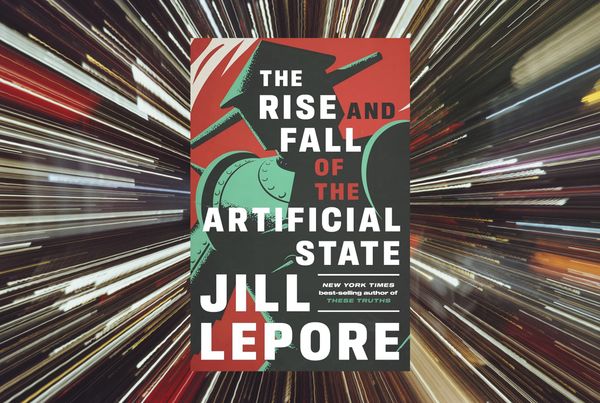
The story always goes the same way: guy meets girl, guy explains he’s here from the future to stop the robot apocalypse, and guy and girl fall in love and fight off the robot overlords. The end. But historian Jill Lepore is interested in the part that gets skipped: How did the robots get so much power in the first place, and who gave it to them?
In her new nonfiction book The Rise and Fall of the Artificial State, out August 25, Lepore traces the long history of a fantasy in which human judgment gives way to systems that promise speed and efficiency. In its modern form, she argues, that fantasy has helped shift power toward machines owned by corporations and the people who run them.
Sci-fi has been imagining versions of that future for more than a century. Now that narrative is colliding with politics as communities fight to stop the proliferation of the enormous data centers going up across the country to support AI. In that resistance, Lepore sees signs of the fall of what she calls the “Artificial State.”
On supporting science journalism
If you're enjoying this article, consider supporting our award-winning journalism by subscribing. By purchasing a subscription you are helping to ensure the future of impactful stories about the discoveries and ideas shaping our world today.
Scientific American spoke with Lepore about how we got here, what Silicon Valley gets wrong about science fiction and whether the Artificial State’s grip is already slipping.
[An edited transcript of the interview follows.]
Early in the book, you describe this as a kind of archaeology of the Artificial State. What exactly is that?
I define the Artificial State in the book as both a fantasy of a posthuman world and something that is currently being built: the liberal, democratic, constitutional nation-state is being replaced by an artificial state in which humans do not consent to be governed but are instead governed by machines owned by corporations, owned by people who we did not elect.
You write that the Artificial State is “less a state than a dream of being without one.” What does that actually look like?
I think it immediately looks dystopian, and it’s a kind of fantasy that you can find across science fiction dating back even to the 1860s. The technological apparatus of modern governments is everywhere, right? We have had social security numbers since the 1930s. We’ve been counting the census using tabulating machines since the 1880s and 1890s. We get veterans benefits by way of mainframe computer processing. That’s just how modern nations and how modern governments work.
And so I try to distinguish [between] technological improvements that help societies function—that are in the interest of speed and efficiency and make it easier to provide benefits or keep track of taxation—from the era that I think we’re in now. That really begins at the beginning of the 21st century, with the libertarianism coming out of Silicon Valley. “A Declaration of the Independence of Cyberspace” went viral in 1996, and it was a manifesto that said there will be no laws in cyberspace. This is a libertarian’s fantasy. That libertarianism shaped the Internet we got, and it’s been carried over into social media and now into AI. The replacement of government by consent with a kind of lawless, somewhat anarchist libertarianism is now giving way to a small number of corporations whose leaders see themselves as above the nation-state.
You write that the Artificial State in science fiction is “nearly always a nightmare.” Are we living in one of those nightmares now?
I find some of the science fiction just terrifyingly prescient. My favorite of these, because I’d never read it before, is a story by E. M. Forster from 1909 called The Machine Stops. It [came out the year after he published A Room with a View,] and I think of it as the room without a view because it’s about a future world in which everything is provided by “the Machine.” Our main character lives in a room that’s just like a cell because she doesn’t need to go anywhere.... One day, the Machine [breaks down]. The protagonist’s son is trying to get his mother to come out and be part of the natural world, but she doesn’t, and everybody dies.
I don’t know that people think, “Oh, we’re living in that dystopia”—although people who are losing their jobs to AI feel that way, and people who have no place to live and are watching their communities build these massive data centers, spending gargantuan sums of money to build housing for machines, feel that way.
You say the architects of the Artificial State read a lot of science fiction, but they read it badly. What are they getting wrong?
I think [sci-fi writer] Ted Chiang had it right. He wrote this great pair of articles a few years ago about the central conceit of the robot-apocalypse story. The idea is that we build these machines and tell them to do something—like [philosopher] Nick Bostrom’s thought experiment in which you task a robot to efficiently, cheaply and quickly maximize the manufacture of paper clips. The robot would eventually kill all the humans because we just get in the way. Also, we have minerals in our bodies that could be useful for the manufacturing of paper clips.
And Chiang is like, now let me think for a minute: What is it in our society that will pursue a goal single-mindedly, relentlessly, ruthlessly, without remorse, without pity for other human beings and to the exclusion of any other sense of accountability in the world? Well, that would be the modern corporation. They’ll destroy a wetland, they’ll cut down a forest, whatever it is. You’re conquering nature to extract its resources in order to manufacture goods. You are the robot in the apocalyptic fiction story.
So Chiang’s thing is, there’s actually no particular reason to think that actual robots would act this way, except that they’re being programmed by the people that run corporations that work this way.
Which writers should they be reading instead?
I did a podcast about Elon Musk and I spent a whole episode on all the science fiction that none of these guys ever read, like Octavia Butler, Ursula Le Guin, Ted Chiang. They want to read Robert Heinlein and Isaac Asimov—not that there’s no difference between Heinlein and Asimov—but they want to read these libertarian people from the 1950s that were writing about rockets and robots and flying cars.
Your book’s title is The Rise and Fall of the Artificial State. Are we still watching the rise, or are we starting to see the fall?
I feel like kind of both. When I wrote this book last summer, it felt very much like we were in the throes of the rise. But now, because of how much the data center debate in the U.S. has affected the primaries this spring and summer across the country, where, all over the country, Democrats and Republicans and Independents alike have been recalling people from office who approve these data centers or who were very pro–data center, you can kind of hear the screaming of the brakes. We have a real democratic deliberation about it.
What always happens in the stories is that the natural limits mean the machine can’t just keep getting bigger and stronger and faster, extracting more and more, because eventually the machine’s going to stop. I think we are at a moment where there is an opportunity for a resurgent environmental movement that is less coded left but more about the world that we want to live in and share. And that feels like a fall, not a rise, for sure.